Table of Contents
- Why Classroom Seating Matters
- What Makes a Good Classroom Chair?
- Feet Should Have Support
- Standard Classroom Chairs vs Adaptive Classroom Chairs
- Adjustable Classroom Chairs
- Rifton Compass Chair for Inclusive Classrooms
- TherAdapt School Chair
- First Class School Chair
- Kinder Classroom Chairs
- Classroom Chairs and Postural Support
- Sensory Seating vs Supportive Classroom Chairs
- Active Classroom Seating
- Choosing Classroom Chairs for Special Education
- Classroom Chair Size Matters
- Matching Classroom Chairs and Tables
- Classroom Seating for Writing and Fine Motor Activities
- Seating for Classroom Feeding and Mealtimes
- Classroom Seating and AAC Access
- Classroom Chairs for Therapy Spaces
- Classroom Seating for Autism and ADHD
- Classroom Chairs and Calm Spaces
- When Should a School Consider Adaptive Seating?
- Who Should Help Choose an Adaptive Classroom Chair?
- Adaptive Seating and the IEP
- Choosing Classroom Chairs for a New Classroom
- Durability and Cleaning
- Growth and Long Term Use
- Questions to Ask Before Buying Classroom Chairs
- Shop Classroom Chairs at eSpecial Needs
- FAQs
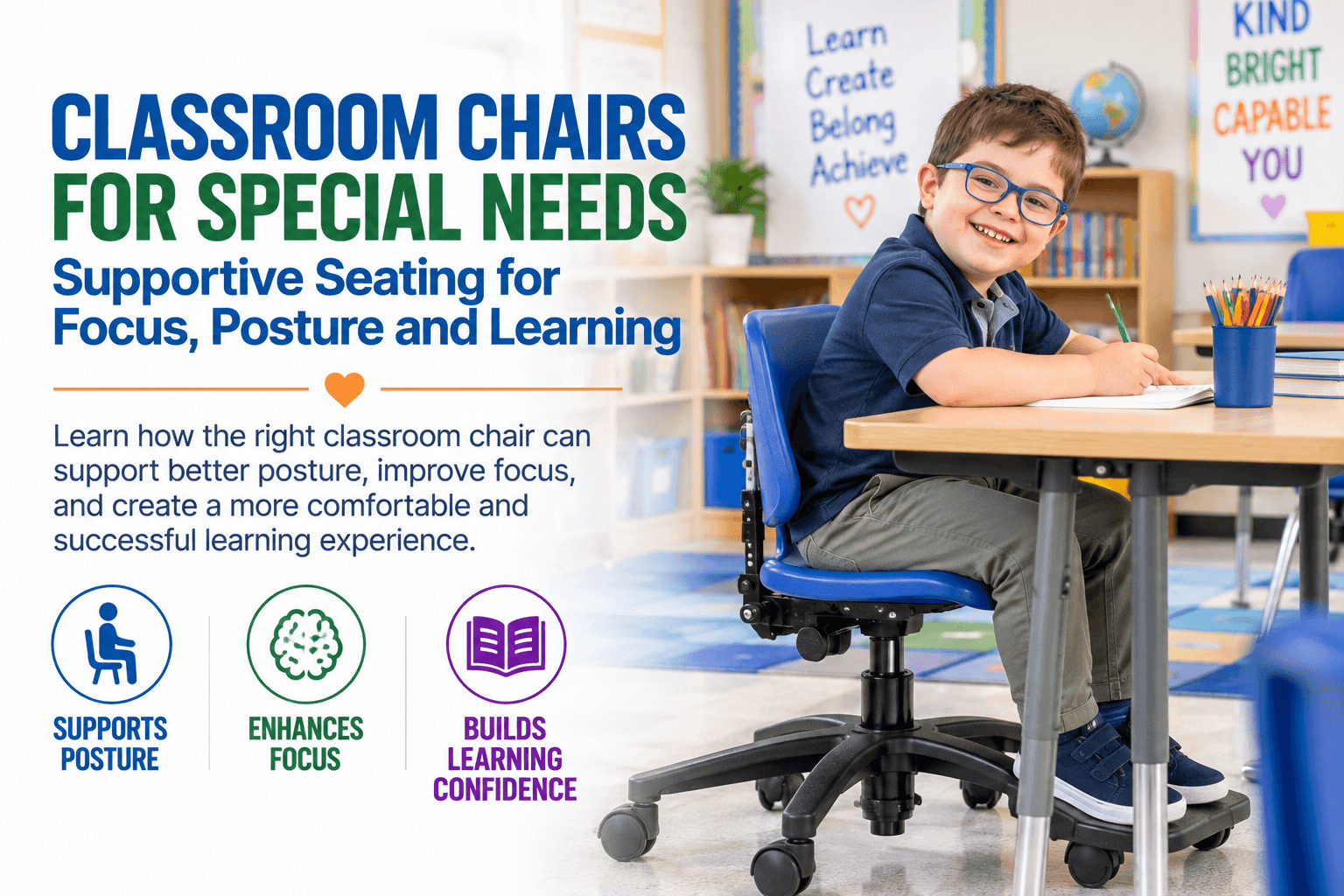
Classroom chairs for special needs can help students build a more stable, comfortable foundation for learning. Sitting affects much more than comfort. A student's seating position can influence posture, hand use, access to a desk, communication, feeding, attention, endurance, and participation throughout the school day. A standard classroom chair may work well for many students, but others need additional support, adjustability, foot positioning, or movement. The right Classroom Chairs can help schools create learning spaces that better accommodate different bodies, abilities, and classroom activities.
For students who frequently slump, slide, lean, prop themselves up, or struggle to remain comfortably seated, it may also be helpful to review When Does a Child Need Adaptive Seating at School? before choosing new seating.
Why Classroom Seating Matters
Students spend a significant portion of the school day sitting.
During that time they may need to:
- Write
- Read
- Cut with scissors
- Use a tablet or computer
- Access AAC
- Participate in group instruction
- Complete fine motor activities
- Eat meals or snacks
- Work with a therapist
- Communicate with teachers and classmates
If a student is using substantial effort simply to remain upright, fewer physical and attentional resources may be available for the actual classroom task. Supportive classroom seating can help create a more stable base for learning. The eSpecial Needs Classroom Chairs collection includes classroom ready seating with different sizes, support levels, adjustable features, and durable designs for educational environments.
For a broader classroom planning approach, Special Education Classroom Equipment Essentials covers seating along with sensory supports, communication equipment, mobility products, fine motor tools, and daily living aids.
What Makes a Good Classroom Chair?
There is no single classroom chair that is right for every student.
For some classrooms, a durable traditional student chair is appropriate. Other students may need an adaptive classroom chair with adjustable seat depth, foot support, positioning belts, lateral supports, or a tray.
Useful classroom chair features may include:
- Appropriate seat height
- Proper seat depth
- Foot support
- Stable construction
- Supportive backrest
- Adjustable components
- Easy to clean surfaces
- Armrests when needed
- Pelvic positioning
- Optional trays
- Growth adjustment
- Anti tip features
- Compatibility with classroom tables
The goal is to match the chair to the student and the activity rather than expecting the student to adapt to poorly fitting furniture.
Feet Should Have Support
Foot position is easy to overlook when selecting classroom furniture. When a student's feet cannot comfortably reach the floor or a footrest, the legs may dangle. Some students compensate by wrapping their feet around chair legs, sliding forward, sitting on their feet, or constantly repositioning themselves. Providing a stable place for the feet can help create a stronger base for sitting.
The eSpecial Needs guide Supportive Classroom Seating: Feet on the Floor explains why foot support can matter for classroom attention, posture, and participation.
When evaluating a classroom chair, consider whether the student's:
- Feet reach the floor
- Knees are comfortably positioned
- Hips remain supported
- Pelvis stays back in the seat
- Desk height matches the chair
- Feet need an adjustable footrest
Sometimes changing foot support can make a significant difference without requiring an entirely different seating system.
Standard Classroom Chairs vs Adaptive Classroom Chairs
A traditional classroom chair generally provides a fixed seat and back. An adaptive classroom chair may provide additional adjustments or positioning components to better match the student's body.
These can include:
- Adjustable seat depth
- Adjustable seat height
- Adjustable back height
- Adjustable foot support
- Positioning straps
- Pelvic supports
- Lateral supports
- Trays
- Seat angle adjustment
- Additional stability
The distinction is important because a student who needs physical positioning support may not benefit from simply switching to a different standard chair. The article Sensory Seating vs Positioning Chairs for Kids provides additional guidance for distinguishing between students who need movement and students who need greater physical support.
Adjustable Classroom Chairs
An adjustable classroom chair can accommodate changes in student size and positioning needs. The Adjustable Classroom Chair from Bailey Manufacturing includes an adjustable seat and footboard, padded seating, a sling style back, anti tip legs, and an optional tray. Its seat depth adjusts from 6 to 12 inches and the footboard can be repositioned to accommodate different users.
Adjustability may be especially valuable when:
- A child is growing
- Foot support is needed
- Seat depth needs refinement
- The chair is used for different activities
- A student requires a more individualized seated position
- Schools want equipment that can adapt over time
An occupational therapist or physical therapist can help determine the appropriate adjustments when posture needs are more complex.
Rifton Compass Chair for Inclusive Classrooms
The Rifton Compass Chair is designed as an adaptive classroom chair that can blend into an inclusive school environment. It is available in five sizes and includes a supportive seat, armrests, stable frame, and adjustable legs. Rifton describes it as seating for students who need mild levels of positioning support while maintaining a classroom appropriate appearance.
A chair such as the Compass may be considered when a student needs:
- More stability than a standard chair
- Adjustable seat height
- Arm support
- Improved classroom positioning
- Seating that fits standard learning environments
- A chair that can be sized as the student grows
Inclusive seating should support access to the classroom without unnecessarily separating the student from peers. That same principle is explored in Inclusive Learning Tools Every Classroom Needs, which looks at seating, assistive technology, sensory supports, communication tools, and accessible learning equipment.
TherAdapt School Chair
The TherAdapt School Chair is designed for children with mild to moderate physical involvement who need more support than a typical classroom chair provides. It is available in multiple sizes and includes an adjustable padded seat and pelvic positioning belt. The seat can be adjusted in height, depth, and angle, allowing the chair to be configured around the student's positioning needs.
This type of chair may be useful when classroom participation is affected by:
- Pelvic instability
- Difficulty maintaining upright posture
- Poor foot positioning
- Sliding forward
- Limited trunk control
- Reduced endurance
- Difficulty accessing a table comfortably
The chair should be adjusted around the student rather than simply selecting the closest age based size.
First Class School Chair
The Inspired by Drive First Class School Chair provides another adaptive option for children who need mild to moderate positioning support. The chair includes adjustable seat height and depth and allows the seat to be positioned with anterior or posterior tilt. It is available in small and large sizes and can be configured with additional accessories as needed.
Seat tilt can change how a student experiences sitting, so adjustments should be made with a clear purpose and appropriate professional input when necessary.
Kinder Classroom Chairs
The Kinder Classroom Chairs provide a more traditional furniture appearance while incorporating additional support. These hardwood chairs include padded seating and an adjustable back angle. Optional trays can create an individual work surface, while the larger version can be configured with padded headwings for additional lateral head support.
A classroom chair with an integrated tray may be helpful when:
- Desk access is difficult
- A consistent working surface is needed
- The student benefits from materials being positioned close to the body
- Fine motor activities require a stable surface
- Classroom layouts change frequently
Classroom Chairs and Postural Support
Posture does not simply mean reminding a student to sit up straight.
Some children cannot independently maintain an upright and functional sitting position for extended periods.
They may:
- Slide forward
- Lean heavily to one side
- Prop the head on a hand
- Wrap legs around the chair
- Constantly reposition themselves
- Fall from the chair
- Use both hands to stabilize their body
- Become tired during seated activities
These may be signs that the chair does not adequately match the student's body or support needs. The guide Positioning Equipment for Children: Top Picks provides additional information about seating, foot positioning, trunk support, wedges, standers, and other positioning equipment that may be considered when standard furniture is not enough.
Sensory Seating vs Supportive Classroom Chairs
Not every student who struggles with sitting needs a positioning chair. Some students have adequate postural control but benefit from movement while learning. In that case, sensory or active seating may be more appropriate. Active Seating may include products that allow rocking, wobbling, bouncing, or subtle movement. Supportive adaptive chairs serve a different purpose. They are generally intended to improve alignment and stability.
For a deeper comparison, read Sensory Seating vs Positioning Chairs for Kids.
Active Classroom Seating
Active seating can be useful for students who seek movement but do not require substantial postural support.
Options may include:
- Wobble chairs
- Rocking seats
- Balance cushions
- Therapy ball chairs
- Dynamic stools
- Movement cushions
Movement can provide a quiet outlet for students who find prolonged stillness difficult. The eSpecial Needs article Active Seating in the Special Needs Classroom explores ways movement based seating may be incorporated into classroom routines.
However, active seating is not automatically beneficial for every student. Too much movement may be distracting or physically difficult for someone who already struggles with balance or postural control.
Choosing Classroom Chairs for Special Education
A special education classroom may include students with very different seating requirements. One student may use a standard chair with a footrest. Another may need a wobble chair for movement. Another may require lateral trunk support, a pelvic belt, and an adjustable tray. That makes a mixed seating approach more practical than purchasing one chair style for everyone.
When planning a special education classroom, consider including:
- Traditional classroom chairs
- Adjustable chairs
- Adaptive positioning chairs
- Active seating
- Floor seating
- Calm area seating
- Footrests
- Tables at different heights
The Special Education Classroom Setup: A Step by Step Guide provides a broader framework for planning learning areas, sensory spaces, movement areas, adaptive furniture, and classroom equipment.
Classroom Chair Size Matters
A chair designed for the average student may not fit every child. Seat height, seat depth, width, back height, and foot placement should all be considered. A seat that is too deep may cause a child to slide forward because the knees cannot comfortably bend at the front edge of the chair. A chair that is too tall may leave the feet dangling. A chair that is too short may position the knees too high and make desk access difficult.
Consider:
- Student height
- Hip width
- Thigh length
- Lower leg length
- Foot position
- Table height
- Arm position
- Growth
Age alone is not enough to determine chair size.
Matching Classroom Chairs and Tables
Even a properly sized chair can create problems if it does not match the table. If a table is too high, the student may elevate the shoulders or struggle to reach materials. If the table is too low, the student may bend forward or lose an effective working position. The Classroom Tables collection includes school tables in different shapes, heights, and configurations that can be paired with appropriate seating. For some students, an adjustable desk or tray may provide better access than a standard classroom table.
Classroom Seating for Writing and Fine Motor Activities
Writing, cutting, drawing, manipulating classroom materials, and using technology all depend partly on having a stable body position. If the trunk is unstable, the hands may need to work harder.
Supportive seating may help provide a stable base for:
- Handwriting
- Scissor use
- Coloring
- Puzzles
- Manipulatives
- AAC access
- Tablet use
- Art activities
This is why seating and fine motor support are often considered together. The Fine Motor Skills Activities and Tools Every OT Recommends provides additional ideas for supporting hand strength, coordination, grasp, and classroom participation.
Seating for Classroom Feeding and Mealtimes
Some adaptive classroom chairs may also be used during meals or feeding activities.
For students who require additional positioning during eating, consider:
- Trunk stability
- Pelvic positioning
- Foot support
- Head position
- Table height
- Arm support
- Ability to access adaptive utensils
Seating should be considered as part of the entire feeding setup rather than separately from dishes, utensils, and other supports. Browse Adaptive Utensils, Dining Aids, and Positioning when additional mealtime support is needed.
Classroom Seating and AAC Access
Students who use communication devices also need a stable and accessible position.
A poorly positioned student may have difficulty:
- Reaching a switch
- Touching a communication screen
- Maintaining visual access
- Using eye gaze equipment
- Pointing accurately
- Keeping the device within reach
When selecting a classroom chair for an AAC user, the chair, table, device mount, and positioning supports should work together. Explore AAC and Communication for additional communication equipment.
Classroom Chairs for Therapy Spaces
School occupational therapists and physical therapists may also use classroom chairs during therapy activities.
A chair may be used for:
- Fine motor work
- Reaching
- Hand strengthening
- Feeding
- Communication
- Dressing practice
- Table activities
- Postural exercises
- Transfer practice
Therapists may also recommend changes to a student's primary classroom chair based on observations during therapy.
Classroom Seating for Autism and ADHD
Students with autism or ADHD may have very different seating needs. Some may seek movement and prefer active seating. Others may feel more comfortable in a stable chair with clear physical boundaries. A student may also use multiple seating options throughout the day depending on the activity.
For example:
- A standard supportive chair for writing
- A wobble chair during independent work
- Soft seating during reading
- A calm chair during regulation breaks
The goal is not to choose an "autism chair" based only on diagnosis. Seating should respond to the student's actual sensory, physical, attention, and participation needs.
Classroom Chairs and Calm Spaces
Not every chair needs to be positioned at a desk.
Classrooms may also benefit from comfortable seating in:
- Reading areas
- Calm corners
- Sensory spaces
- Counseling rooms
- Quiet work stations
- Break areas
These chairs serve a different purpose from supportive work seating. A student may need firm, stable seating for handwriting and softer sensory seating for regulation. For classrooms building both types of spaces, Designing Sensory Calm Corners for Autism, ADHD, and Emotional Regulation provides guidance on setting up supportive break areas without treating them as punishment spaces.
When Should a School Consider Adaptive Seating?
A school team may want to evaluate seating when a student consistently:
- Slides out of the chair
- Leans heavily
- Cannot keep feet supported
- Props the head or trunk
- Falls from the seat
- Tires quickly
- Struggles to use both hands
- Cannot comfortably access the desk
- Requires frequent physical repositioning
- Has difficulty maintaining head or trunk alignment
- Cannot participate effectively from standard seating
These signs do not automatically mean a specialized chair is required, but they can indicate that the student's current setup should be reviewed.
Who Should Help Choose an Adaptive Classroom Chair?
For simple classroom furniture purchases, teachers and administrators may be able to select appropriate seating using measurements and product information.
Students with significant positioning needs may benefit from input from:
- Occupational therapists
- Physical therapists
- Assistive technology specialists
- Special education teachers
- Parents and caregivers
- Seating specialists
- School nurses when appropriate
The student should also be included in the process whenever possible. Comfort and usability matter.
Adaptive Seating and the IEP
When specialized seating is needed for a student to access school activities, the equipment may become part of the student's broader educational support plan.
School teams can document:
- When the chair is used
- Which adjustments are required
- How transfers are completed
- What level of supervision is needed
- Whether accessories are required
- How the seating supports participation
For families beginning this process, When Does a Child Need Adaptive Seating at School? provides more detail on seating assessment and school planning.
Choosing Classroom Chairs for a New Classroom
When furnishing an entire classroom, avoid thinking only about how many chairs fit around the tables. Consider the different activities students will complete throughout the day.
A well planned room may have seating for:
- Direct instruction
- Small group work
- Independent work
- Reading
- Sensory breaks
- Computer use
- Fine motor activities
- Feeding
- Therapy
- Collaborative learning
For more help designing the entire environment, Inclusive Learning Tools Every Classroom Needs discusses classroom seating alongside assistive technology, sensory supports, movement equipment, and accessible learning materials.
Durability and Cleaning
Classroom furniture experiences frequent daily use.
When comparing chairs, consider:
- Frame construction
- Upholstery
- Washable surfaces
- Replaceable components
- Hardware
- Adjustment mechanisms
- Stability
- Weight capacity
- Manufacturer care instructions
Chairs with straps, upholstery, trays, or positioning accessories may require additional cleaning procedures compared with molded classroom chairs. Schools should inspect adaptive seating regularly to make sure hardware remains secure and adjustments have not shifted.
Growth and Long Term Use
Children grow, and their seating needs can change. Adjustable classroom chairs may provide longer useful life because seat depth, foot support, back position, or leg height can be modified. However, adjustability does not mean a chair will fit indefinitely.
Review seating periodically, especially if:
- The student's feet no longer fit correctly
- Knees extend far beyond the seat
- The pelvis no longer fits comfortably
- Supports are positioned incorrectly
- The student has experienced a growth spurt
- Posture has changed
- New mobility equipment is being used
- Classroom activities have changed
Questions to Ask Before Buying Classroom Chairs
Before choosing classroom chairs, ask:
- Who will use the chair?
- Does the student need standard or adaptive seating?
- Is movement helpful or distracting?
- Does the student need foot support?
- Is seat depth adjustable?
- Does the chair fit the classroom table?
- Is a tray needed?
- Are positioning straps required?
- Does the student need lateral support?
- Can the chair accommodate growth?
- Is it easy to clean?
- Will the chair move between rooms?
- Does it fit through classroom spaces?
- Will therapists need to adjust it?
- Is the weight capacity appropriate?
These questions can help narrow the options before comparing individual products.
Shop Classroom Chairs at eSpecial Needs
The Classroom Chairs collection at eSpecial Needs includes supportive school seating designed for comfort, posture, participation, and everyday classroom use. The collection is intended for schools, therapy settings, educational programs, and home learning environments and includes chairs with different sizing, support, and adjustment options.
Popular adaptive classroom seating options include:
- Adjustable Classroom Chair
- Rifton Compass Chair
- TherAdapt School Chair
- Inspired by Drive First Class School Chair
- Kinder Classroom Chairs
You can also explore Classroom Seating, Active Seating, Classroom Tables, Seating Systems, Positioning, and Education.
FAQs
How do I know if a student needs adaptive seating?
A student may need adaptive seating if they consistently slide forward, lean heavily, cannot keep their feet supported, tire quickly, fall from the chair, need frequent repositioning, or struggle to use both hands effectively while seated.
For more signs to watch for, see When Does a Child Need Adaptive Seating at School?.
What is the difference between adaptive seating and active seating?
Adaptive seating is generally used to provide more physical support, positioning, or stability. Active seating is designed to allow controlled movement, such as rocking or wobbling.
Some students need more support, while others benefit from more movement. The guide Sensory Seating vs Positioning Chairs for Kids explains the difference in more detail.
Why is foot support important in a classroom chair?
Foot support can help create a more stable base for sitting. When a student's feet dangle, they may slide, lean, fidget, or use extra effort to stay upright.
A footrest or properly sized chair may help improve comfort, posture, and access to classroom tasks.
What happens if a classroom chair is too tall?
If a chair is too tall, the student's feet may dangle. This can reduce stability and may lead to sliding forward, wrapping the legs around the chair, or frequent repositioning.
What happens if the seat is too deep?
A seat that is too deep may prevent the knees from bending comfortably at the front of the chair. The student may compensate by sliding forward, which can reduce back support and overall stability.
Can classroom chairs help with handwriting?
Supportive seating may make handwriting and fine motor tasks easier by giving the student a more stable base for arm and hand movement.
Seating, table height, foot support, and posture all affect tasks such as writing, cutting, coloring, and using manipulatives.
The Fine Motor Skills Activities and Tools Every OT Recommends guide provides additional ideas for supporting hand skills in the classroom.