Table of Contents
- What Are Adaptive Utensils?
- Who May Benefit From Adaptive Eating Utensils?
- Why Handle Size Matters
- Weighted Utensils
- Adaptive Utensils for Tremors
- Built Up Utensils
- Curved and Angled Utensils
- Offset Utensils
- Bendable Adaptive Utensils
- Right Handed and Left Handed Adaptive Utensils
- Coated Spoons
- Maroon Spoons and Feeding Support
- Adaptive Utensils for Children
- Adaptive Utensils for Adults
- Adaptive Utensils for Seniors
- Adaptive Utensils for Arthritis
- Lightweight vs Weighted Utensils
- Adaptive Knives
- Adaptive Plates and Bowls
- Cups and Drinking Aids
- Seating and Positioning During Meals
- Adaptive Utensils at School
- Adaptive Utensils in Occupational Therapy
- How to Choose Adaptive Utensils
- Adaptive Feeding Equipment Beyond Utensils
- Cleaning Adaptive Utensils
- Adaptive Utensils and Feeding Safety
- Shop Adaptive Utensils at eSpecial Needs
- FAQs
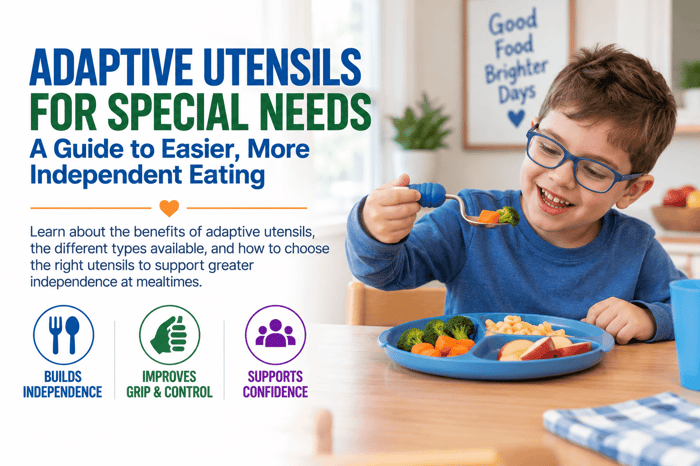
Adaptive utensils for special needs can make everyday meals easier for children and adults who have difficulty gripping, controlling, lifting, or positioning traditional forks, spoons, and knives. The right adaptive eating utensils may provide a more comfortable grip, require less wrist movement, improve utensil control, and support greater participation during meals.
Eating is an important daily living skill. For individuals with limited hand strength, tremors, arthritis, cerebral palsy, developmental disabilities, fine motor challenges, or reduced wrist movement, traditional silverware may create unnecessary barriers.
At eSpecial Needs, the Adaptive Utensils collection includes weighted utensils, curved utensils, built up handles, coated spoons, lightweight options, and other adaptive feeding tools for children and adults.
What Are Adaptive Utensils?
Adaptive utensils are forks, spoons, knives, and related eating tools designed to make eating easier for people who have difficulty using traditional silverware.
Depending on the product, adaptations may include:
- Larger handles
- Softer grips
- Added weight
- Curved or angled shafts
- Lightweight construction
- Coated spoon bowls
- Textured handles
- Bendable utensil shafts
- Specialized shapes
- Adjustable positioning
The best design depends on which part of eating is difficult for the individual.
For caregivers trying to identify equipment for several everyday routines, the Adaptive Equipment for ADLs: A Caregiver's Guide explains how adaptive tools can support eating, drinking, dressing, grooming, bathing, and other activities of daily living.

Who May Benefit From Adaptive Eating Utensils?
Adaptive eating utensils may be useful for children, teens, adults, and seniors experiencing:
- Limited hand strength
- Reduced grip
- Tremors
- Arthritis
- Limited wrist movement
- Fine motor challenges
- Reduced dexterity
- Poor coordination
- Muscle weakness
- Developmental disabilities
- Difficulty bringing food to the mouth
- Fatigue during meals
- Difficulty controlling traditional silverware
Rather than choosing an adaptive utensil based only on a diagnosis, start by identifying the specific movement or part of the meal that is difficult.

Why Handle Size Matters
Traditional silverware normally has a relatively thin handle. Gripping a narrow utensil requires finger flexion, hand strength, and fine motor control.
For someone with limited grip strength or dexterity, a wider handle may be easier and more comfortable to hold.
Built up handles may provide:
- More surface area to grasp
- Less need for tightly closed fingers
- Greater comfort
- Improved utensil control
- Less hand fatigue during meals
Foam Handle Utensils are one option for users who need a larger gripping surface.
The same principle can apply to many other everyday objects. The Adaptive Grips for Better Hand Control, Comfort, and Independence guide explores how grip adaptations can support utensils, writing tools, grooming items, and other daily activities.

Weighted Utensils
Weighted utensils include additional weight in the handle.
For some individuals, added weight may provide increased sensory feedback and make a fork or spoon feel more stable in the hand.
Adjustable Weighted Utensils can be useful when the appropriate amount of weight varies by user.
Weighted utensils may be considered for individuals who experience:
- Hand tremors
- Difficulty stabilizing utensils
- Reduced hand control
- Certain neurological conditions
- Difficulty judging hand movement
More weight is not automatically better. Someone with muscle weakness or limited endurance may actually find a heavier utensil more difficult to use.
Adaptive Utensils for Tremors
Tremors can make it difficult to keep food on a fork or spoon while moving it from the plate to the mouth.
Some users prefer a weighted utensil because the additional weight provides a more substantial feel in the hand.
Options such as Big Grip Weighted Adaptive Eating Utensils combine a larger gripping surface with added weight.
When comparing utensils for tremors, consider:
- Hand strength
- Tremor severity
- Grip ability
- Meal duration
- Overall utensil weight
- Handle diameter
- Wrist movement
- Fatigue
An occupational therapist may be able to trial different options before a long term utensil is selected.
Built Up Utensils
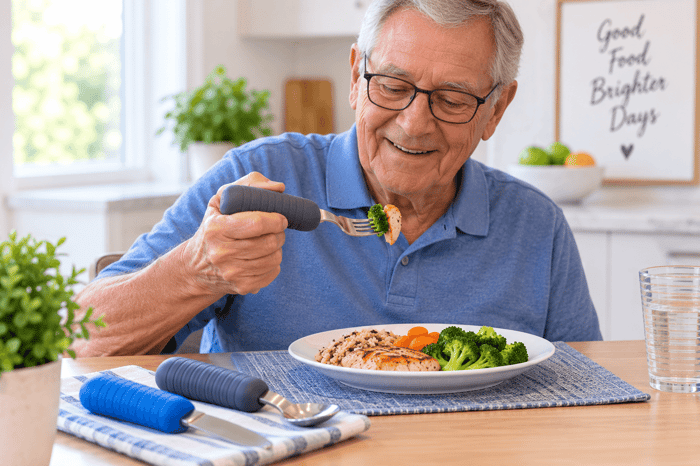
Built up utensils have larger handles than traditional forks and spoons.
These may be useful for people who find it difficult or uncomfortable to completely close their fingers around a narrow utensil.
Built up utensils may be considered for people with:
- Arthritis
- Reduced finger movement
- Weak grip
- Hand discomfort
- Limited dexterity
- Fine motor challenges
Grip strength and hand coordination also affect many activities beyond eating. The Fine Motor Skills Activities and Tools Every OT Recommends guide explores hand strength, coordination, utensil use, dressing, handwriting, cutting, and other everyday fine motor skills.
Curved and Angled Utensils
Some individuals can grasp a utensil successfully but have difficulty rotating their wrist or positioning their hand to bring food to the mouth.
Curved and angled utensils change the relationship between the handle and the spoon or fork.
This may reduce the amount of wrist rotation needed during eating.
EasieEaters Curved Utensils are one example of an adaptive utensil designed around an angled eating position.
Curved utensils may be useful when a user:
- Has limited wrist rotation
- Has difficulty turning a standard spoon
- Keeps the wrist in a more fixed position
- Needs a different approach angle
- Uses one hand more effectively than the other
Offset Utensils
Offset utensils offer another option for people who have limited wrist or hand movement.
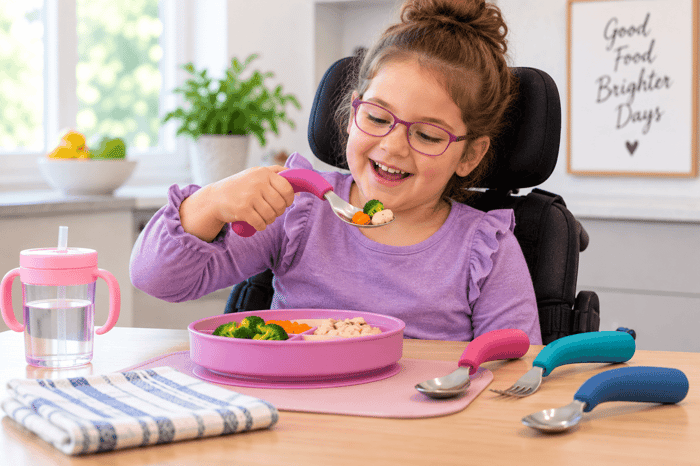
Offset Utensils reposition the eating surface relative to the handle. For some users, this can make it easier to reach the mouth without requiring as much wrist rotation.
An offset utensil may be especially worth considering when grip strength is adequate but wrist positioning makes traditional silverware difficult.
Bendable Adaptive Utensils
Some adaptive utensils include shafts that can be bent toward the left or right.
Instead of requiring the hand and wrist to accommodate a fixed utensil position, the utensil itself can be adjusted around the user's movement pattern.
Bendable utensils may help individuals with:
- Limited wrist rotation
- Reduced forearm movement
- One sided weakness
- Restricted hand movement
- Difficulty aligning a utensil with the mouth
When possible, trial different angles to determine which feels most natural.
Right Handed and Left Handed Adaptive Utensils
Adaptive eating equipment should match the hand the individual actually uses during meals.
Depending on the design, a utensil may:
- Work with either hand
- Bend in either direction
- Have separate right and left versions
- Include a predetermined curve
- Allow a therapist or caregiver to adjust the angle
Check individual product information when direction matters because not every curved utensil is interchangeable between hands.
Coated Spoons
Some adaptive spoons include a coating over the spoon bowl.
Plastisol Plastic Coated Spoons provide a different surface feel than bare stainless steel and may be considered when oral sensitivity, utensil feel, or a feeding program influences utensil selection.
For individuals with more significant feeding or oral motor needs, utensil choice may be only one part of a broader feeding plan.
Maroon Spoons and Feeding Support
Maroon Spoons are specialty feeding spoons with a relatively shallow bowl.
They may be incorporated into feeding activities when a therapist or caregiver wants more control over food presentation and portion size.
For children with more complex feeding challenges, the eSpecial Needs article Feeding Issues Can Occur in Children provides additional information about feeding difficulties and supportive strategies.
When swallowing, oral motor function, or significant feeding difficulties are involved, work with the appropriate feeding professional.
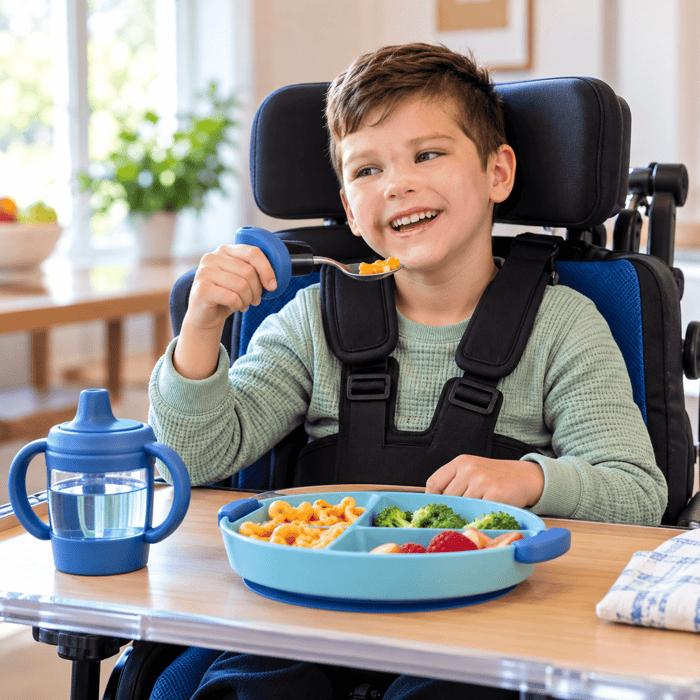
Adaptive Utensils for Children
Children learning to feed themselves may benefit from utensils that better match their hand size, strength, coordination, and range of motion.
Adaptive utensils can be incorporated into:
- Family meals
- School lunches
- Occupational therapy
- Feeding therapy
- Life skills instruction
- Snack time
- Home practice
Independence does not have to mean completing an entire meal without assistance.
A child who independently scoops a portion of food, brings a spoon to their mouth, or uses a fork for part of the meal is still participating more actively in an important daily living skill.
Adaptive equipment needs can also change significantly as children grow. From Toddlers to Teens: Adaptive Equipment for Growing Children provides a broader look at choosing equipment across different stages of childhood.

Adaptive Utensils for Adults
Adults may benefit from adaptive eating utensils when changes in grip, strength, coordination, dexterity, or range of motion make traditional silverware more difficult to use.
Potential reasons include:
- Arthritis
- Tremors
- Stroke recovery
- Neurological conditions
- Injury
- Reduced dexterity
- Muscle weakness
- Changes in endurance
For adults with needs across several daily routines, Understanding Adaptive Equipment for Adults in 2026 covers feeding, daily living, mobility, bathroom safety, seating, positioning, and other adaptive equipment categories.

Adaptive Utensils for Seniors
Older adults may experience changes in grip strength, joint comfort, tremors, coordination, vision, or endurance.
Helpful dining adaptations may include:
- Larger handles
- Weighted utensils
- Lightweight utensils
- Angled utensils
- Adaptive knives
- Scoop dishes
- Non slip surfaces
- Easy grip cups
For a broader range of supports, the Best Adaptive Senior Aids for Daily Living guide explores equipment for eating, bathing, dressing, mobility, home safety, and everyday independence.

Adaptive Utensils for Arthritis
Arthritis can make thin utensils uncomfortable to grasp and may reduce finger movement or grip strength.
A wider or softer handle may require less finger closure.
Depending on the individual, useful options may include:
- Foam handles
- Built up handles
- Lightweight utensils
- Angled utensils
- Easy grip utensils
- Adaptive knives
The best choice depends on which joints are affected and which movements cause discomfort.
Lightweight vs Weighted Utensils
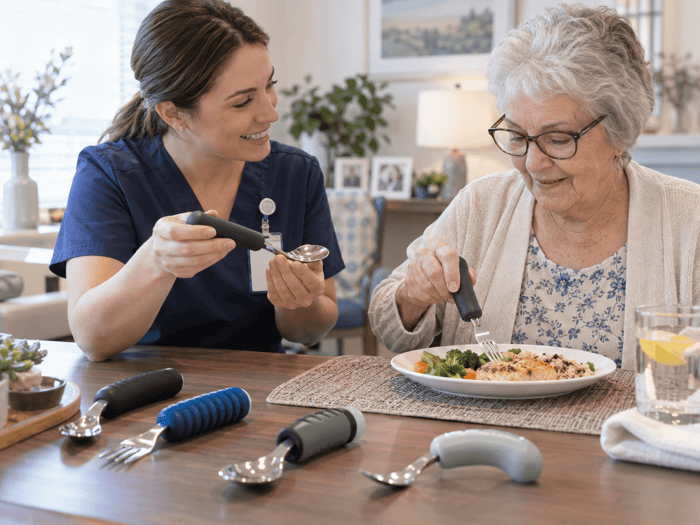
There is no single utensil weight that works best for everyone.
Weighted Utensils
Weighted utensils may provide a more substantial feel and additional sensory feedback for some users.
Lightweight Utensils
Lightweight utensils may be easier for individuals with:
- Muscle weakness
- Limited endurance
- Fatigue
- Reduced lifting strength
The goal is for the individual to comfortably control the utensil throughout the meal without creating unnecessary effort.
Adaptive Knives
Traditional knives require coordinated grip, downward pressure, wrist stability, and a cutting motion.
Adaptive knives may change the handle position or cutting movement to make food preparation and dining tasks more manageable.
Explore Dining Aids for adaptive utensils and other mealtime supports that can be combined into a more accessible eating environment.
Adaptive Plates and Bowls
Sometimes the utensil is only part of the difficulty.
A person may successfully grasp a spoon but still struggle to scoop food because it slides across a flat plate.
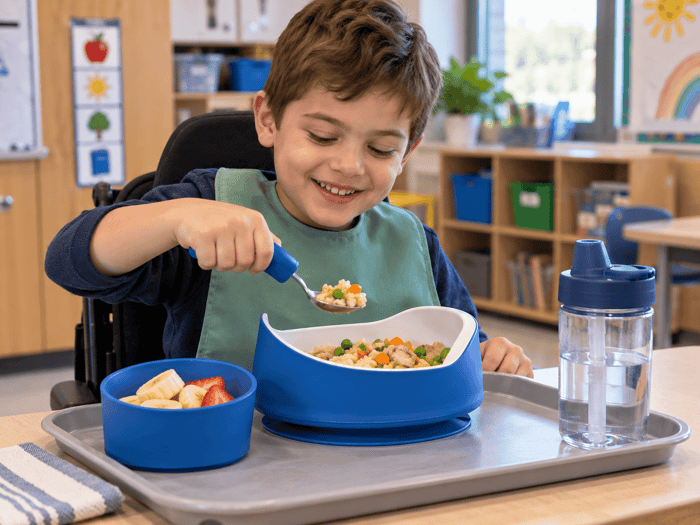
Adaptive Plates and Bowls may include features such as:
- Raised edges
- Scoop sides
- Divided sections
- Suction bases
- Non slip bases
- Plate guards
Pairing an appropriate utensil with the right dish may support more independent eating than changing either item by itself.
Cups and Drinking Aids
Drinking presents different motor challenges from eating.
Some users may need support with:
- Gripping a cup
- Controlling liquid flow
- Tipping a drink
- Maintaining head position
- Drinking without excessive wrist movement
Explore Cups and Drinking Aids when building a more complete adaptive dining setup.
Eating and drinking are only two parts of independence. The Daily Living Skills and Best Adaptive Tools to Build Independence guide explains how feeding fits alongside bathing, dressing, grooming, toileting, mobility, and other everyday skills.

Seating and Positioning During Meals
Even the best adaptive utensil may be difficult to use if the person does not have a stable seated position.
Good positioning can create a stronger foundation for controlled arm and hand movement.
Consider:
- Pelvic stability
- Trunk support
- Foot support
- Chair height
- Table height
- Head position
- Distance from the plate
Browse Seating and Positioning if additional postural support is needed.
For children who require more comprehensive adaptive seating, When Does a Child Need Adaptive Seating at School? explains common signs that additional positioning and seating support may be appropriate.
Adaptive Utensils at School
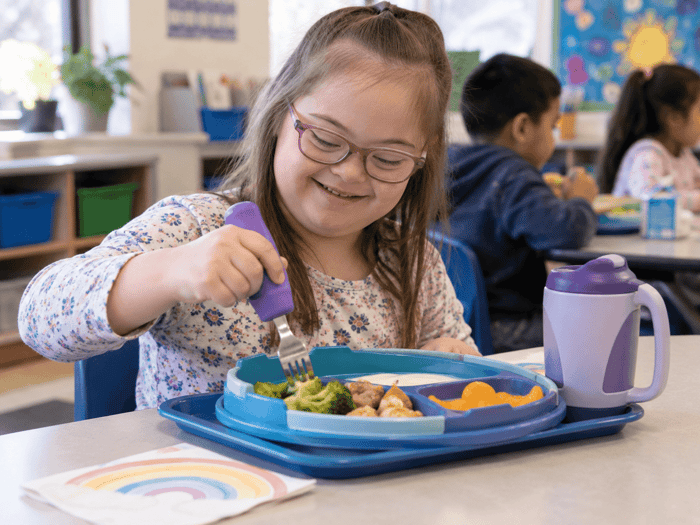
Adaptive utensils may be included in a student's school day during:
- Breakfast
- Lunch
- Snacks
- Occupational therapy
- Feeding therapy
- Life skills instruction
Using a similar utensil at school and at home may help reduce the need to repeatedly adjust to different equipment.
For schools building a more complete adaptive environment, Special Education Classroom Equipment Essentials covers classroom equipment for seating, sensory support, learning, mobility, daily living, and student participation.
School teams should also consider:
- Cleaning
- Storage
- Student access
- Supervision
- Individual feeding plans
- Therapy recommendations
Adaptive Utensils in Occupational Therapy
Occupational therapists may look at the complete eating task rather than only how the user holds a fork or spoon.
An assessment may consider:
- Grip strength
- Finger movement
- Wrist range of motion
- Coordination
- Tremors
- Posture
- Endurance
- Hand to mouth movement
- Plate stability
- One handed feeding
- Caregiver assistance
The Occupational Therapy Products for Adults: A Complete Guide explores additional adaptive equipment that may support feeding, grooming, dressing, positioning, and other functional activities.
The goal is not necessarily to use the most specialized utensil available. A simple change in grip size, weight, or angle may be enough to make a meaningful task easier.
How to Choose Adaptive Utensils
Begin with the specific difficulty the person experiences.
Ask:
- Is the utensil difficult to grip?
- Does the hand shake?
- Is the utensil difficult to stabilize?
- Does it feel too heavy?
- Does it feel too light?
- Is wrist rotation limited?
- Does food fall off before reaching the mouth?
- Does the person become tired during meals?
- Is one hand stronger than the other?
- Is cutting difficult?
- Does the plate move while scooping?
- Is seating affecting hand control?
- Are oral sensitivity or feeding therapy needs involved?
These questions can help determine whether a weighted, built up, curved, angled, coated, bendable, or lightweight utensil may be appropriate.
Adaptive Feeding Equipment Beyond Utensils
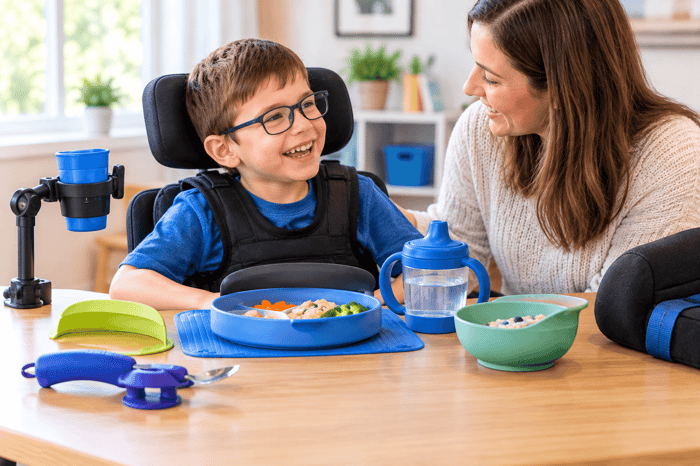
A complete adaptive mealtime setup may involve more than a fork and spoon.
Depending on the person's needs, additional equipment may include:
- Scoop dishes
- Plate guards
- Adaptive bowls
- Non slip mats
- Adaptive cups
- Drinking aids
- Universal holders
- Seating supports
- Positioning equipment
The Adaptive Equipment for ADLs: A Caregiver's Guide can help families look at feeding equipment within the bigger picture of daily living and independence.
Cleaning Adaptive Utensils
Care instructions vary according to the utensil's materials, coatings, weights, and handle construction.
Some adaptive utensils may be dishwasher safe while others contain specialty grips, foam, or components that should be washed by hand.
Always follow the care instructions provided for the exact product.
Utensils shared in schools, clinics, residential programs, and therapy environments should also be cleaned according to the facility's hygiene procedures.

Adaptive Utensils and Feeding Safety
Adaptive utensils can improve access to eating, but they do not replace professional evaluation when significant swallowing or feeding concerns are present.
Professional guidance may be appropriate when meals involve:
- Frequent coughing
- Choking
- Difficulty swallowing
- Significant oral motor challenges
- Major changes in eating ability
- Complex feeding needs
Depending on the concern, the care team may include an occupational therapist, speech language pathologist, feeding therapist, physician, dietitian, or another qualified professional.
Shop Adaptive Utensils at eSpecial Needs
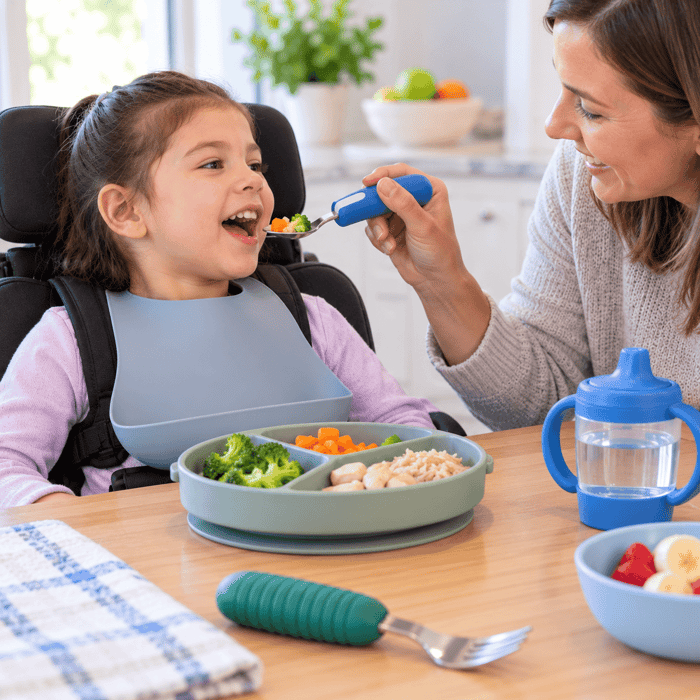
The Adaptive Utensils collection at eSpecial Needs includes feeding tools designed for different grip, hand control, coordination, strength, and positioning needs.
Explore options such as:
- Adjustable Weighted Utensils
- Big Grip Weighted Adaptive Eating Utensils
- EasieEaters Curved Utensils
- Offset Utensils
- Foam Handle Utensils
- Plastisol Plastic Coated Spoons
- Maroon Spoons
You can also browse Dining Aids, Plates and Bowls, Cups and Drinking Aids, Grips and Holders, Daily Living Aids, and Fine Motor Tools.
FAQs
Who can benefit from adaptive eating utensils?
Adaptive eating utensils may help children, adults, and seniors who have limited grip strength, tremors, arthritis, reduced dexterity, fine motor challenges, limited wrist movement, muscle weakness, or difficulty bringing food to the mouth.
For a broader look at adaptive tools used throughout everyday routines, see Adaptive Equipment for ADLs: A Caregiver's Guide.
How do I know which adaptive utensil is right for someone?
Start by identifying what makes eating difficult. Someone who struggles to grip a narrow spoon may benefit from a built up handle, while a person with limited wrist movement may do better with an angled or curved utensil. Tremors, strength, hand dominance, endurance, seating, and coordination should also be considered.
What is the difference between weighted and lightweight adaptive utensils?
Weighted utensils provide additional resistance and sensory feedback, while lightweight utensils reduce the effort required to lift and move the fork or spoon.
Weighted utensils may work well for some users with tremors, while lightweight designs may be more comfortable for individuals with weakness, fatigue, or limited endurance.
What are curved adaptive utensils?
Curved utensils position the fork or spoon at an angle instead of directly in line with the handle. This may reduce how much wrist and forearm rotation is required to bring food toward the mouth.
EasieEaters Curved Utensils are one example.
Can adaptive utensils help children learn to feed themselves?
They may help make self feeding practice more manageable by reducing difficulties with grip, wrist movement, utensil control, or positioning.
A child does not need to eat an entire meal independently for adaptive utensils to be useful. Scooping food or completing part of a meal independently can still support participation and daily living skills.
Are adaptive utensils only for children with disabilities?
No. Adaptive utensils are used by people of many ages. Adults and seniors may use them because of arthritis, tremors, stroke recovery, injury, neurological conditions, reduced strength, or changes in dexterity.
The Understanding Adaptive Equipment for Adults in 2026 guide covers feeding equipment along with other daily living, mobility, bathroom, and positioning supports.