Table of Contents
- What Are Fine Motor Skills and Why Are They Critical for Development?
- Fine Motor Skills vs. Gross Motor Skills
- Developmental Milestones for Fine Motor Skills by Age
- Signs a Child May Benefit From Fine Motor Skills Tools
- How Occupational Therapists Use Fine Motor Tools in Practice
- The Role of OT in Fine Motor Development
- Home vs. Clinic Use: Adapting OT Tools for Everyday Life
- Building a Fine Motor Kit for Occupational Therapy
- Top Fine Motor Skills Tools Recommended by OTs
- Pinch and Grip Strengthening Tools
- Lacing, Threading, and Bead Manipulation Sets
- Handwriting Tools for Occupational Therapy
- Adaptive Scissors and Precision Cutting Tools
- Therapy Putty, Resistive Dough, and Sensory Manipulation Tools
- Peg Boards, Stacking Toys, and Construction Sets
- Tweezers, Tongs, and Object Transfer Tools
- Fine Motor Skills Toys by Age
- Fine Motor Skills Toys for 12 to 18 Months
- Fine Motor Skills Toys for 2 Year Olds
- Fine Motor Skills Toys for 3 Year Olds
- Toys to Improve Fine Motor Skills for 4 Year Olds
- Fine Motor Skills Toys for 5 Year Olds
- Fine Motor Skills Toys for 7 Year Olds and School Age Children
- Fine Motor Skills Tools for Adults
- Hand Dexterity Toys and Tools for Adults
- Adaptive Equipment for Fine Motor Skills
- Fine Motor Equipment for Schools and Therapy Clinics
- Outfitting a Classroom or Therapy Room With Fine Motor Tools
- Purchase Orders and Bulk Buying for Schools and Clinics
- How to Choose and Buy Fine Motor Skills Tools
- What to Look for in a Fine Motor Kit for Occupational Therapy
- Shop Fine Motor Skills Tools and Adaptive Equipment at eSpecial Needs
- FAQs
Fine Motor Skills Tools Every OT Recommends
Fine motor skills activities help children develop the small hand and finger movements needed for everyday tasks such as holding a spoon, fastening clothing, turning pages, drawing, cutting, writing, opening containers, and using classroom materials. These skills are essential for independence, learning, play, and confident participation at home, school, therapy, and in the community.
Parents often notice fine motor challenges when a child avoids coloring, struggles to use utensils, has trouble with buttons or zippers, tires quickly during writing tasks, or becomes frustrated with activities other children seem to manage easily. The right fine motor skills tools can make practice more engaging while helping children build hand strength, coordination, dexterity, and confidence.
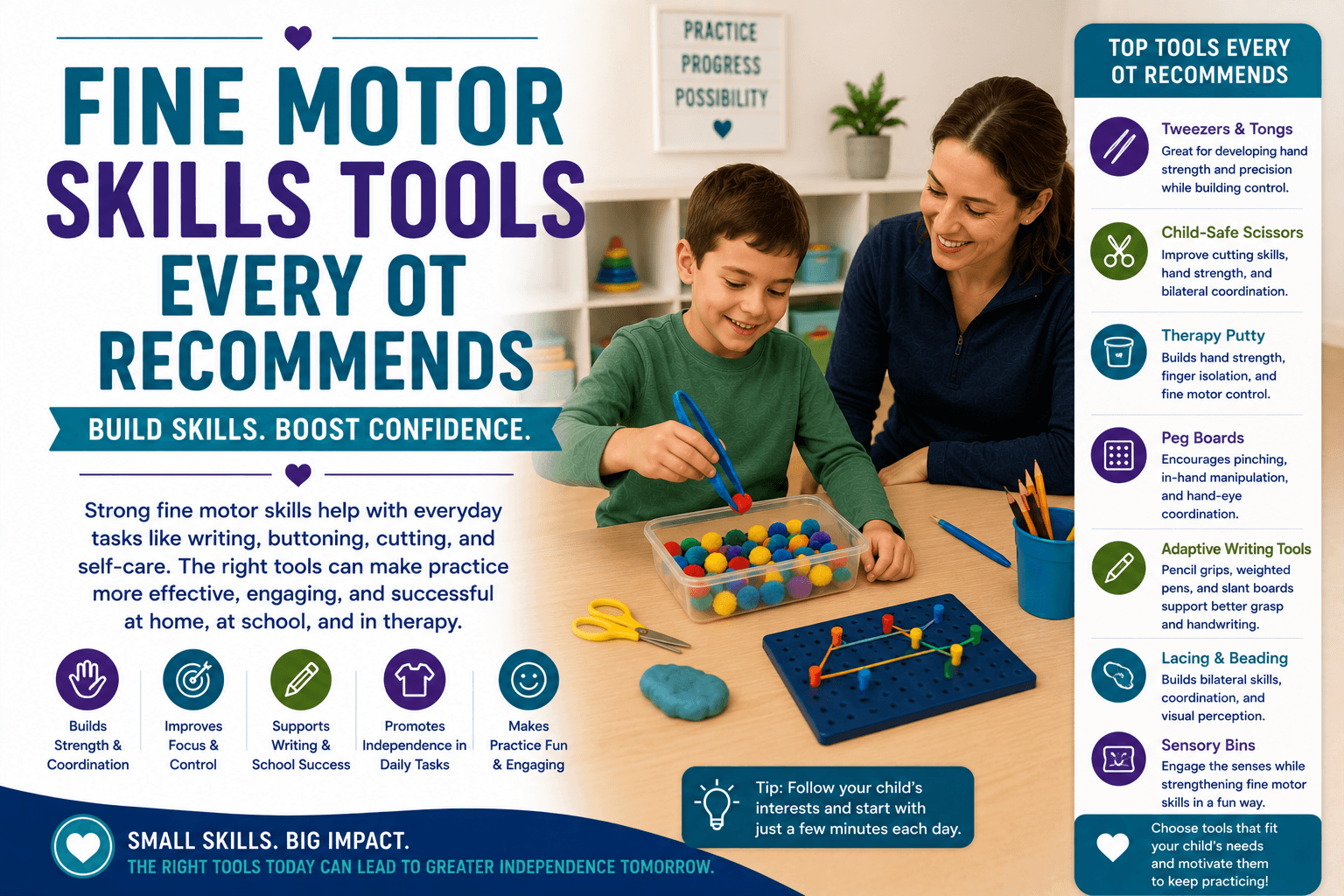
Occupational therapists often use a combination of hands on activities, adaptive equipment, writing supports, cutting tools, putty, lacing sets, peg boards, and games to target specific goals. The best fine motor skills activities are not always the most complicated. They are the ones that match the child’s current ability, create a successful challenge, and fit naturally into daily routines.
Families, schools, therapists, and clinics can explore supportive products through eSpecial Needs, including Handwriting Tools, Scissors and Cutting Aids, Grips and Holders, Education Products, Toys, and Sensory Motor Tools.
What Are Fine Motor Skills and Why Are They Critical for Development?
Fine motor skills are the small, coordinated movements of the hands, fingers, wrists, and eyes. These skills allow children to grasp, release, pinch, turn, press, manipulate, and control objects.
Fine motor development supports many everyday tasks, including:
Feeding with utensils
Drinking from cups
Turning book pages
Building with blocks
Playing with toys
Using crayons and markers
Drawing shapes and letters
Cutting with scissors
Buttoning and zipping
Opening lunch containers
Typing or using technology
Completing classroom assignments
Managing personal care routines
Fine motor skills activities help children practice these movements through meaningful play and daily tasks. Rather than focusing only on worksheets or writing drills, occupational therapists often use activities that make hands work in different ways.
For example, squeezing therapy putty can build hand strength. Picking up small objects with tongs can support pincer grasp. Threading beads can encourage bilateral coordination. Using adapted scissors can help a child experience success while learning cutting skills.
Fine Motor Skills vs. Gross Motor Skills
Fine motor skills and gross motor skills both support child development, but they involve different parts of the body and different types of movement.
Fine motor skills involve smaller movements of the hands, fingers, wrists, and eyes. They are used for tasks such as writing, drawing, cutting, fastening, feeding, and manipulating toys.
Gross motor skills involve larger movements of the arms, legs, torso, and whole body. They are used for walking, running, climbing, jumping, balancing, crawling, throwing, and riding.
Both areas are connected. A child often needs a stable body position before they can use their hands effectively. For example, a child who is working hard to stay upright in a chair may have less energy available for writing, cutting, or handling small materials.
This is why occupational therapists may address posture, seating, movement, and hand skills together. Fine motor skills activities work best when the child is comfortable, supported, and ready to use their hands.
Developmental Milestones for Fine Motor Skills by Age
Every child develops at their own pace. These general milestones can help caregivers understand common skill patterns, but they are not a substitute for a developmental evaluation.
Infancy
During infancy, children may begin to:
Bring hands to mouth
Reach for objects
Hold toys briefly
Transfer toys between hands
Bang objects together
Use a developing pincer grasp
Pick up small food pieces with fingers
12 to 18 Months
Fine motor skills toys for 12 to 18 months often focus on grasping, releasing, stacking, placing, and exploring.
Children may begin to:
Stack two blocks
Place objects into containers
Turn thick book pages
Scribble with large crayons
Use a spoon with help
Remove simple shapes from a sorter
Pick up small objects using fingertips
Helpful activities may include stacking cups, large peg toys, chunky puzzles, simple shape sorters, textured balls, nesting toys, and large crayon play.
Rainbow Building Blocks - Bead Blocks
$38.33
$45.95
Visual Building Blocks are an adventure in color, light and sound! Indulge your child’s appetite for exploration by merging blocks together to form new colors and sounds, or stack the blocks in a different order each time to form new… read more

2 Years Old
Fine motor skills toys for 2 year olds can support early independence and more purposeful hand use.
Children may begin to:
Stack several blocks
Turn knobs
String large beads
Build simple towers
Scribble with more control
Use a spoon with less help
Begin simple puzzle play
Open basic containers
Useful fine motor skills activities may include chunky puzzles, large lacing toys, stacking blocks, play dough, simple sorting games, large knob puzzles, and toddler safe art supplies.
3 Years Old
Fine motor skills toys for 3 year olds often introduce more challenging activities that require planning, coordination, and use of both hands.
Children may begin to:
Draw simple lines and circles
Use child safe scissors with help
Thread larger beads
Build more complex block structures
Use tongs or tweezers in play
Complete simple lacing tasks
Manipulate small toys with more control
Helpful tools may include large bead sets, lacing cards, play dough tools, beginner scissors, peg boards, tongs games, and art projects with simple tracing or sticker activities.
4 Years Old
Toys to improve fine motor skills for 4 year olds can help children practice more precision, hand strength, and early school readiness skills.
Children may begin to:
Draw basic shapes
Copy simple letters
Use scissors with more control
Fasten larger buttons
Build detailed structures
Complete more complex puzzles
Manipulate smaller objects
Use utensils with greater independence
Helpful activities may include cutting practice, construction toys, threading activities, dressing boards, puzzle games, simple crafts, dot marker activities, and beginning handwriting tools.
Melissa & Doug Jumbo Triangular Crayons
$8.95
$8.99
Your little artist will love this set of ten Jumbo Triangular Crayons from Melissa & Doug! Featuring ten bright, vivid colors to choose from, the special triangular shape of each crayon not only makes for easy gripping but keeps them… read more

5 Years Old
Fine motor skills toys for 5 year olds often support kindergarten readiness, handwriting practice, cutting, fastening, and more detailed construction tasks.
Children may begin to:
Draw people and recognizable pictures
Copy letters and numbers
Cut along simple lines and shapes
Use pencils with greater control
Fasten buttons and zippers
Build more advanced block structures
Use classroom tools more independently
Helpful products may include pencil grips, slant boards, adapted scissors, lacing cards, peg boards, tracing activities, building sets, putty, and fine motor task games.
Melissa & Doug Magnetic Chalkboard & Dry-Erase Board
$28.95
$30.99
Turn any wall or playroom into an interactive learning station with the Melissa & Doug Magnetic Chalkboard and Dry-Erase Board — a versatile 3-in-1 activity board that gives kids the freedom to draw, write, and create in three different ways,… read more

7 Years Old and School Age Children
Fine motor skills toys for 7 year olds and older children should continue to build precision, handwriting endurance, organization, dexterity, and independence.
School age children may benefit from activities that support:
Handwriting speed and legibility
Scissor precision
Keyboarding skills
Complex construction
Small object manipulation
Dressing independence
Art and craft tasks
Sports related hand skills
Daily living activities
Tool use in school and home routines
Fine motor skills activities for school age children can include more advanced construction toys, intricate puzzles, handwriting practice tools, model building, craft kits, adaptive equipment, sewing cards, art supplies, grip strengthening tools, and functional daily living tasks.
Signs a Child May Benefit From Fine Motor Skills Tools
Some children need more time and practice to develop hand skills. Others may benefit from targeted occupational therapy support or tools that make activities more accessible.
Possible signs include:
Difficulty holding crayons, pencils, or markers
Hand fatigue during writing or coloring
Avoiding drawing, coloring, or crafts
Trouble using scissors
Difficulty with buttons, zippers, snaps, or shoe fasteners
Struggling to use utensils
Frequently dropping objects
Trouble opening containers or packaging
Difficulty building with blocks or connecting toys
Using both hands unevenly
Difficulty manipulating small objects
Weak grasp or poor grip control
Becoming frustrated with classroom tasks
Slow progress with handwriting or cutting skills
Trouble keeping up with fine motor tasks at school
These signs do not automatically mean a child has a developmental delay. They can be useful observations to share with a pediatrician, teacher, or occupational therapist.
How Occupational Therapists Use Fine Motor Tools in Practice
Occupational therapists use fine motor skills tools to create activities that build strength, coordination, planning, precision, and independence. The exact activity is selected based on the child’s needs and goals.
An occupational therapist may use tools to practice:
Pincer grasp
Finger strength
Wrist stability
Hand eye coordination
Bilateral coordination
Crossing midline
In hand manipulation
Pencil control
Scissor skills
Dressing skills
Self feeding
Handwriting endurance
Tool use
Daily living tasks
For example, a therapist may use therapy putty to strengthen fingers, tongs to practice grasp patterns, beads to build coordination, adapted scissors to support cutting, and pencil grips to help with writing comfort and control.
The goal is not simply to complete an activity. The goal is to build skills that transfer into school, self care, play, and daily life.
The Role of OT in Fine Motor Development
Occupational therapists assess how a child uses their hands during meaningful tasks. They may observe handwriting, feeding, dressing, play, cutting, school participation, and other routines to identify where support is needed.
An occupational therapist may help with:
Hand strength and endurance
Grasp development
Fine motor coordination
Handwriting and prewriting
Scissor use
Sensory processing needs
Visual motor skills
Daily living tasks
Classroom access
Adaptive equipment recommendations
Home exercise activities
School based supports
OT recommendations should be individualized. A product that is helpful for one child may not be appropriate for another child with different sensory, motor, or developmental needs.
Home vs. Clinic Use: Adapting OT Tools for Everyday Life
Therapy clinics often have a wide variety of fine motor equipment, but parents can reinforce many of the same skills at home with simpler tools and everyday activities.
At home, fine motor skills activities can be built into routines such as:
Helping stir ingredients while cooking
Opening snack containers
Using tongs to serve food
Sorting laundry
Fastening clothing
Watering plants
Folding washcloths
Playing with blocks
Using stickers
Drawing and coloring
Building with construction toys
Picking up small items during clean up
Turning pages in books
Playing with putty
At a clinic, an occupational therapist may create a more structured task with specific positioning, resistance levels, repetition goals, and observations. At home, the priority is consistency and success.
Choose tools that are easy to store, durable, safe, and likely to be used in real routines.
Building a Fine Motor Kit for Occupational Therapy
A fine motor kit for occupational therapy should include a variety of tools that target different hand skills and can be adjusted for different ages or ability levels.
A practical starter kit may include:
Therapy putty or resistive dough
Tongs and tweezers
Large and small beads
Lacing cards
Peg boards
Pencil grips
Adapted scissors
Crayons and markers
Slant board
Fine motor games
Small sorting containers
Stacking toys
Clip activities
Textured fidgets
Simple dressing practice tools
The best fine motor kit occupational therapy setup includes activities for grasping, pinching, squeezing, pulling, threading, cutting, writing, and manipulating objects.
Top Fine Motor Skills Tools Recommended by OTs
Fine motor skills tools often work best when they encourage active hand use in a fun, repeatable way. The following categories are commonly used by occupational therapists, teachers, parents, and care teams.
Pinch and Grip Strengthening Tools
Pinch and grip strength are important for tasks such as holding pencils, using utensils, fastening clothing, opening packages, and picking up small objects.
Helpful grip strengthening activities may include:
Therapy putty
Resistive dough
Clothespin games
Squeeze balls
Hand exercisers
Tongs activities
Tweezer games
Pinch clips
Small object sorting
Hole punch activities for older children
Start with resistance that allows the child to succeed. Too much resistance can cause fatigue or frustration, while too little may not create enough challenge.
Lacing, Threading, and Bead Manipulation Sets
Lacing and threading activities support bilateral coordination because one hand stabilizes the material while the other hand threads, pulls, or places objects.
These fine motor skills activities may help build:
Finger dexterity
Hand eye coordination
Visual attention
Bilateral hand use
Sequencing
Focus
Pincer grasp
Crossing midline
For younger children, begin with large beads and thick laces. Older children may progress to smaller beads, more detailed patterns, sewing cards, or craft projects.
Handwriting Tools for Occupational Therapy
Handwriting tools occupational therapy programs may use include pencil grips, weighted pencils, triangular pencils, slant boards, writing guides, adaptive markers, and supportive paper positioning tools.
These products may support:
Pencil grasp
Hand stability
Wrist position
Letter formation
Writing comfort
Endurance
Visual alignment
Reduced hand fatigue
Confidence during classroom tasks
Explore Handwriting Tools for products that support writing, drawing, tracing, and early literacy tasks.
Adaptive Scissors and Precision Cutting Tools
Adaptive scissors can help children and adults with reduced hand strength, limited coordination, tremors, sensory needs, or difficulty controlling standard scissors.
Helpful options may include:
Loop scissors
Spring assisted scissors
Self opening scissors
Mounted scissors
Easy grip scissors
Left handed scissors
Tabletop cutting supports
Precision cutting tools
Adaptive scissors may help users practice opening and closing movements with less strain while building confidence in art, schoolwork, crafts, and daily activities.
Explore Scissors and Cutting Aids for supportive cutting tools for children and adults.
Therapy Putty, Resistive Dough, and Sensory Manipulation Tools
Therapy putty and resistive dough are versatile tools for building hand strength, finger control, endurance, and tactile tolerance. Children can squeeze, roll, pinch, flatten, stretch, hide objects, and form shapes.
These activities may support:
Grip strength
Finger strength
Pinch grasp
Hand endurance
Tactile exploration
Focus
Calming hand activity
Fine motor warm ups
Bilateral coordination
Therapy putty can be adjusted by resistance level. Start with a softer option for beginners or users with reduced hand strength, then increase challenge gradually.
Peg Boards, Stacking Toys, and Construction Sets
Peg boards, stacking toys, and construction sets can help children practice placing objects accurately, stabilizing with one hand, and planning how pieces fit together.
These activities may support:
Pincer grasp
Visual motor skills
Spatial reasoning
Hand eye coordination
Bilateral coordination
Finger strength
Problem solving
Attention
Construction play
For younger children, choose large pieces that are easy to grasp. For older children, select construction toys with more detailed parts, patterns, or building challenges.
Tweezers, Tongs, and Object Transfer Tools
Tweezers and tongs can turn simple sorting games into targeted fine motor skills activities. Children may use them to move pom poms, blocks, beads, toy foods, paper pieces, or other safe objects into containers.
These activities can support:
Pincer grasp
Hand strength
Precision
Wrist control
In hand manipulation
Color sorting
Counting
Turn taking
Eye hand coordination
For beginners, use larger tongs and bigger objects. As skill improves, introduce smaller tongs, smaller objects, and more detailed sorting tasks.
Fine Motor Skills Toys by Age
Fine motor skills toys should match the child’s developmental level, interests, hand size, and supervision needs. The right activity should be challenging enough to encourage growth without becoming frustrating.
Fine Motor Skills Toys for 12 to 18 Months
Fine motor skills toys for 12 to 18 months should focus on safe grasping, releasing, stacking, and early pincer grasp skills.
Helpful choices may include:
Stacking cups
Large blocks
Chunky puzzles
Shape sorters
Nesting toys
Large peg boards
Simple pop up toys
Thick crayons
Large tactile balls
Container play
Always select age appropriate toys with no small detachable pieces and supervise children closely.
Fine Motor Skills Toys for 2 Year Olds
Fine motor skills toys for 2 year olds can support stacking, turning, sorting, squeezing, and early tool use.
Helpful activities may include:
Large bead threading
Chunky puzzles
Simple lacing cards
Play dough
Stack and sort toys
Large knob puzzles
Easy open containers
Large tongs
Sticker activities
Crayon and paper play
At this age, repetition matters. A child may need many opportunities to practice the same movement before it becomes easier.
Fine Motor Skills Toys for 3 Year Olds
Fine motor skills toys for 3 year olds can build on early grasping skills by adding more controlled threading, drawing, cutting, and manipulation tasks.
Helpful options may include:
Lacing cards
Peg boards
Beginner scissors
Chunky construction sets
Play dough tools
Tongs and sorting games
Simple craft activities
Bead sets
Dot markers
Dressing boards
Choose activities that allow the child to use both hands together and practice independence.
Toys to Improve Fine Motor Skills for 4 Year Olds
Toys to improve fine motor skills for 4 year olds may include activities that challenge children to cut, fasten, build, trace, sort, and create.
Helpful choices may include:
Child safe scissors
Tracing activities
Lacing and sewing cards
Building toys
More detailed puzzles
Clip and clothespin games
Sticker scenes
Dressing practice boards
Putty activities
Art projects
These activities can prepare children for more structured school tasks while still feeling playful and creative.
Fine Motor Skills Toys for 5 Year Olds
Fine motor skills toys for 5 year olds often support prewriting, handwriting, scissor control, construction, and kindergarten readiness.
Helpful products may include:
Pencil grips
Handwriting practice tools
Adapted scissors
Slant boards
Construction sets
Peg boards
Fine motor games
Art and craft activities
Lacing projects
Putty and resistance tools
At this age, focus on both skill development and confidence. Children who feel successful are more likely to practice.
Fine Motor Skills Toys for 7 Year Olds and School Age Children
Fine motor skills toys for 7 year olds and school age children should support stronger handwriting, accuracy, endurance, independence, and detailed problem solving.
Helpful options may include:
Advanced construction toys
Model building sets
Detailed craft kits
Handwriting supports
Fine motor games
Art tools
Adapted scissors
Grip strengthening tools
Sewing activities
Keyboarding supports
Daily living practice tools
Older children may respond better when activities connect to their interests, such as building, drawing, gaming, crafts, sports, animals, science, or practical projects.
Fine Motor Skills Tools for Adults
Fine motor skills tools for adults can support hand dexterity, coordination, strength, rehabilitation, daily living tasks, and independence. These tools may be useful for adults with disabilities, arthritis, neurological conditions, brain injury, stroke recovery needs, aging related hand weakness, reduced sensation, or limited coordination.
Fine motor tools for adults may include:
Therapy putty
Hand exercisers
Dexterity boards
Large grip tools
Adaptive writing tools
Easy grip utensils
Dressing aids
Button hooks
Reachers
Adaptive scissors
Grip supports
Tactile manipulation tools
Fine motor games
Daily living aids
The best tools should support meaningful adult routines rather than feeling childish or unnecessary.
Hand Dexterity Toys and Tools for Adults
Hand dexterity toys for adults can help encourage repeated hand movement in a more engaging format. They may include puzzles, manipulation boards, putty activities, peg tasks, fidget tools, sorting tools, hand exercisers, and adaptive games.
These tools may support:
Finger coordination
Grip strength
Hand endurance
Finger isolation
Bilateral coordination
Daily living practice
Leisure activity
Rehabilitation routines
Confidence with hand use
Adults should be included in product decisions whenever possible. Personal interests, privacy, style preferences, and functional goals all matter.
Adaptive Equipment for Fine Motor Skills
Adaptive equipment for fine motor skills can help children and adults complete tasks with less strain, more control, or greater independence.
Common adaptive equipment may include:
Pencil grips
Built up handles
Easy grip utensils
Adaptive scissors
Button hooks
Zipper pulls
Reachers
Jar openers
Stabilizing tools
Writing aids
Page turners
Dressing aids
Grip supports
Explore Grips and Holders for products designed to make grasping, holding, writing, and daily living activities more accessible.
Fine Motor Equipment for Schools and Therapy Clinics
Schools and therapy clinics often need fine motor equipment that is durable, easy to clean, appropriate for multiple users, and flexible enough to support different age groups and goals.
A classroom or clinic fine motor setup may include:
Fine motor task bins
Peg boards
Lacing sets
Therapy putty
Tweezers and tongs
Adapted scissors
Pencil grips
Slant boards
Large and small beads
Construction toys
Handwriting supports
Sensory bins
Art supplies
Daily living practice tools
Organize equipment by skill category, age level, or therapy goal so staff can quickly find the right materials.
Outfitting a Classroom or Therapy Room With Fine Motor Tools
When outfitting a classroom or therapy room, start by identifying the most common student needs.
Consider:
Ages of the users
Fine motor skill levels
Handwriting needs
Scissor skill goals
Sensory needs
Daily living skills
Storage space
Cleaning requirements
Number of students using the materials
Staff supervision
IEP goals
Therapy plans
Budget
A balanced setup should include activities for grasp, pinch, hand strength, bilateral coordination, handwriting, cutting, and functional daily living skills.
Purchase Orders and Bulk Buying for Schools and Clinics
Schools, therapy clinics, government agencies, and organizations may need product quotes and purchase order support when ordering fine motor equipment.
Before requesting a quote, prepare:
Product links or product categories
Quantity needed
Age ranges of users
Classroom or clinic goals
Budget details
Delivery requirements
Purchase order contact information
Any required approval documents
eSpecial Needs offers Quote Requests for families, schools, clinics, and organizations seeking help with equipment planning, pricing, and larger orders.
How to Choose and Buy Fine Motor Skills Tools
When choosing fine motor skills tools, begin with the specific skill or routine you want to support.
Ask:
Does the child need help with grasp, strength, handwriting, cutting, or daily living?
Is the activity age appropriate?
Does the child need more challenge or more support?
Does the child enjoy tactile play, art, building, sorting, or practical tasks?
Is the product safe for the child’s abilities?
Does the tool need adult supervision?
Is the product easy to clean and store?
Can it be used at home, school, or in therapy?
Will the product support a real daily task?
Has an occupational therapist recommended a specific type of tool?
Start with a few versatile tools that can be used often. A small fine motor kit is usually more useful than a large collection of products that remain unused.
What to Look for in a Fine Motor Kit for Occupational Therapy
A fine motor kit occupational therapy setup should include different types of activities so the user can practice a range of hand skills.
Look for:
Different resistance levels
Large and small item options
Activities for pincer grasp
Grip strengthening tools
Writing and cutting supports
Tactile activities
Bilateral coordination tasks
Durable materials
Easy cleaning
Portable storage
Age appropriate pieces
Adaptable challenge levels
Functional daily living tools
The most useful kits can be adjusted as skills grow.
Shop Fine Motor Skills Tools and Adaptive Equipment at eSpecial Needs
Fine motor skills activities can help children and adults build the hand strength, control, coordination, and confidence needed for everyday life. From early grasping and stacking to handwriting, cutting, dressing, and adult hand dexterity, the right tools can make practice feel more achievable.
eSpecial Needs offers fine motor tools, handwriting supports, adaptive scissors, grips, holders, therapy supplies, educational products, and adaptive equipment for home, school, clinic, and care settings.
Explore:
Start with the skill that matters most right now. A single practical tool, used consistently during play or daily routines, can become a meaningful step toward stronger hands, greater independence, and more confident participation.
FAQs
What are fine motor skills?
Fine motor skills are the small, controlled movements of the hands, fingers, wrists, and eyes. Children use these skills for tasks such as holding a spoon, turning pages, stacking blocks, drawing, cutting, fastening clothing, using utensils, opening containers, and writing.
Why are fine motor skills important for child development?
Fine motor skills support independence, school readiness, self care, play, and participation in daily routines. Strong hand skills can help children feed themselves, dress, use classroom supplies, complete art projects, manage personal items, and communicate through writing or typing.
What is the difference between fine motor skills and gross motor skills?
Fine motor skills involve smaller movements of the hands and fingers, such as grasping, pinching, writing, cutting, and buttoning. Gross motor skills involve larger whole body movements, such as walking, running, climbing, jumping, balancing, and throwing.
Both are important because children often need stable posture and body control before they can use their hands effectively for detailed tasks.
What are examples of fine motor skills activities?
Fine motor skills activities may include:
- Squeezing therapy putty
- Picking up objects with tongs or tweezers
- Threading beads
- Completing lacing cards
- Building with blocks
- Coloring and drawing
- Using adapted scissors
- Opening and closing containers
- Fastening buttons and zippers
- Playing with peg boards
- Sorting small objects
- Using stickers
- Completing puzzles
- Rolling and shaping dough
What are the best fine motor skills tools?
The best fine motor skills tools depend on the child’s age, current ability, interests, and therapy goals. Common occupational therapy tools include therapy putty, lacing cards, peg boards, tongs, tweezers, pencil grips, adaptive scissors, slant boards, construction toys, fine motor games, grip strengthening tools, and sensory manipulation products.
When should I be concerned about my child’s fine motor skills?
A child may benefit from added support when they consistently struggle with tasks such as holding crayons, using utensils, cutting, fastening clothing, opening containers, building with toys, writing, drawing, or manipulating small objects.
Other signs may include hand fatigue, avoiding art activities, frequently dropping items, becoming frustrated with classroom tasks, or having difficulty keeping up with peers during fine motor activities.
What do occupational therapists use for fine motor development?
Occupational therapists may use therapy putty, peg boards, lacing cards, tongs, tweezers, pencil grips, adapted scissors, fine motor games, dressing boards, sensory bins, construction toys, grip strengthening tools, and handwriting tools.
The activity is selected based on goals such as pincer grasp, hand strength, coordination, pencil control, scissor skills, bilateral coordination, or daily living independence.