Table of Contents
- Key Takeaways: When Does a Child Need Adaptive Seating at School?
- What Is Adaptive Seating for Children?
- Signs a Child May Need Adaptive Seating at School
- How Adaptive Seating Supports Classroom Participation
- What to Consider During an Adaptive Seating Needs Assessment
- Types of Adaptive Seating Used in Schools
- How to Request Adaptive Seating Through an IEP or 504 Plan
- Matching Adaptive Seating to Your Student's Needs
- FAQs
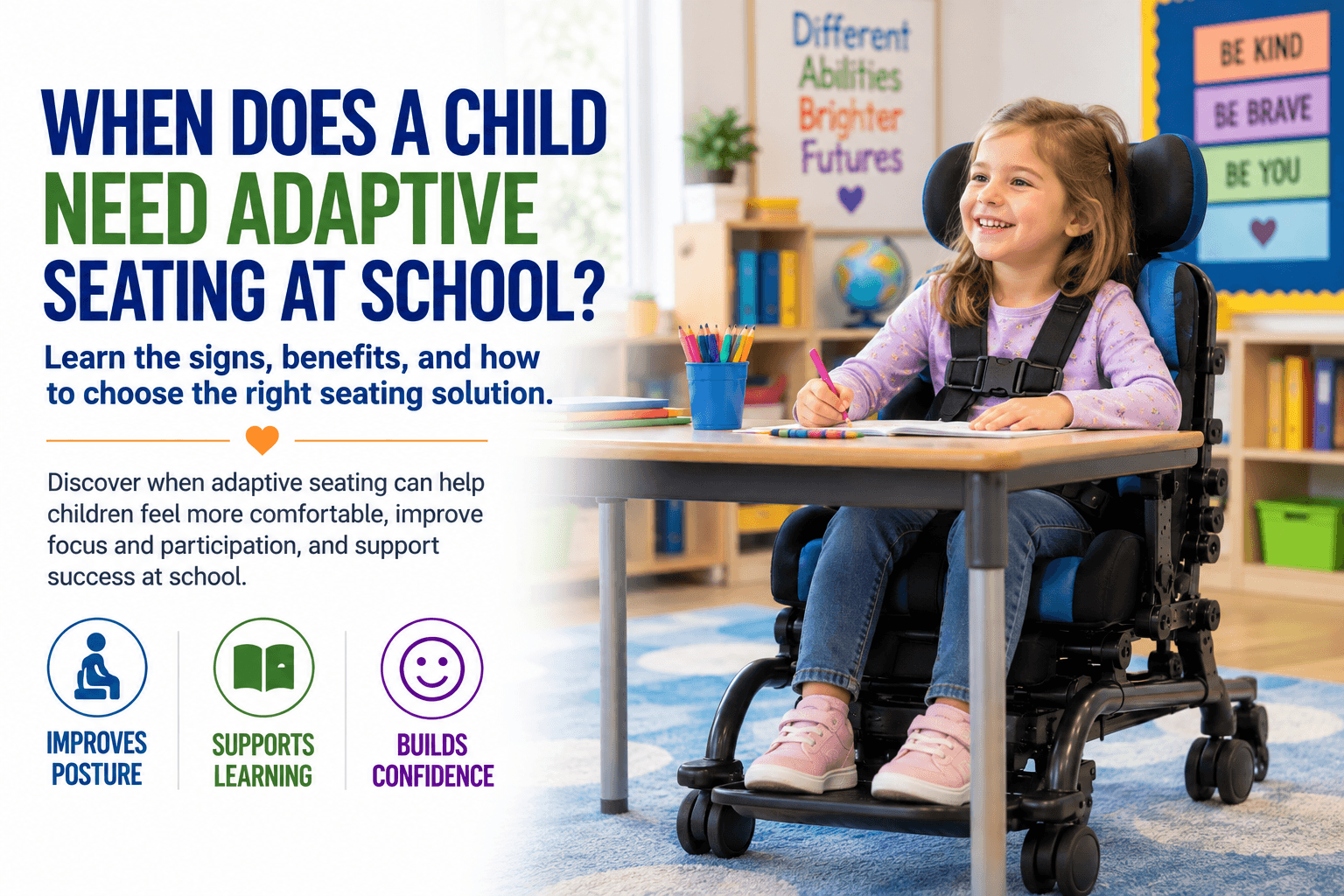
Keeping a child properly positioned during the school day is a real challenge, especially for students with physical or developmental disabilities. When standard classroom chairs fall short, adaptive seating for children with special needs can bridge the gap between a child's body and the learning happening around them.
Special seating goes beyond simple comfort. It addresses posture, trunk stability, and alignment so a child can focus on classwork rather than on staying upright. This article walks you through the signs that a student may need adaptive seating, the assessment process, and which seating options work in K-12 classrooms.
Key Takeaways: When Does a Child Need Adaptive Seating at School?
- Children who slump, slide, or constantly shift in standard chairs may benefit from adaptive seating support.
- Proper pelvic and trunk positioning frees up a child's hands and attention for classroom tasks.
- Observable behaviors like head propping, leg wrapping, and frequent falling signal a seating mismatch.
- eSpecial Needs offers a range of seating systems designed for school, therapy, and home use.
- An IEP or 504 team, including therapists, can formally recommend adaptive seating for eligible students.
What Is Adaptive Seating for Children?
Adaptive seating refers to chairs, positioning systems, and accessories specifically designed to support children who cannot maintain stable, functional posture in a standard seat. These products often include adjustable hip guides, lateral supports, harnesses, and tilt-in-space features.
The goal is not to restrict movement. Instead, this seating creates a stable base that encourages active sitting, allowing children to engage their trunk muscles and participate in activities around them. Pediatric occupational and physical therapists frequently recommend these solutions as part of a broader positioning strategy.
For children with cerebral palsy, low muscle tone, or spina bifida, the right seat can make a measurable difference. Research published in the Indian Journal of Physiotherapy and Occupational Therapy (2025) found that even a 10-degree change in seat inclination significantly improved postural control and hand function in children with spastic cerebral palsy.
Signs a Child May Need Adaptive Seating at School
Sometimes the clearest indicator is what you can see in the classroom. A child who constantly slides forward, leans heavily on the desk, or wraps their legs around the chair legs is working harder to stay seated than to learn.
The Wisconsin Assistive Technology Initiative (WATI) lists several observable behaviors: falling out of a chair, frequent position changes, slumping over the desk, propping the head on one hand, and repeatedly getting in and out of the seat.
Children with more significant physical involvement may already use a wheelchair or stander but still need a classroom-specific solution for table-height activities. If your student is spending more energy on staying upright than on the lesson, it is time to talk with the school's therapy team.
How Adaptive Seating Supports Classroom Participation
When a child's pelvis and trunk are properly aligned, their hands and arms are freed up for writing, eating, and manipulating learning materials. That connection between postural stability and hand function is well documented in pediatric rehabilitation literature.
Stable seating also reduces fatigue. A child who does not have to fight gravity for six hours is more likely to stay alert, follow instructions, and interact with peers. In special education settings, this can translate into more consistent progress on IEP goals.
eSpecial Needs carries adaptive chairs and positioning accessories that support this kind of active, engaged sitting across classroom, cafeteria, and therapy environments.
What to Consider During an Adaptive Seating Needs Assessment
A thorough assessment starts with a posture evaluation. The therapist looks at pelvic alignment, trunk control, head position, and extremity function in the current seat. Two standardized tools used for this process are the Segmental Assessment of Trunk Control (SATCo) and the Posture and Postural Ability Scale (PPAS).
Traditional guidelines recommend feet flat on the floor or on a footrest, hips flexed to about 90 degrees, and hips positioned well back in the seat. When a child cannot hold this alignment independently, hip guides, lateral trunk supports, or an angled seat may be recommended.
The assessment should also account for where the seat will be used. A child who moves between a classroom desk, cafeteria, and therapy room may need a portable solution. The Special Tomato Soft-Touch Sitter from eSpecial Needs can travel between settings while still offering structured support.
Types of Adaptive Seating Used in Schools
School-based therapists draw from a range of seating options depending on the child's level of physical involvement. Here are some categories you may encounter.
Activity Chairs
These are height-adjustable chairs with built-in lateral trunk supports, hip guides, and footrests. Activity chairs are among the most commonly prescribed special needs seating options in classrooms because they let children sit at standard desks and tables.
Corner Chairs and Floor Sitters
For younger children or students who need more trunk and head support, corner chairs offer a reclined seated position with lateral containment. Floor sitters allow children to participate in circle time and floor-based activities at the same level as their peers.
CalmContour Relaxer - Sensory Relaxing Positioning Chair
$749.95
Discover the ultimate solution for achieving serene relaxation with our CalmContour Relaxer positioning chair. This innovative product transforms your quest for the perfect relaxation posture into reality. Engineered to alleviate stress on contact, it masterfully balances your body's weight distribution.… read more

Seating Cushions and Stabilizers
Simpler modifications such as nonslip seat pads, inflatable disc cushions, and resistance bands stretched between chair legs can be enough for children with mild postural challenges. These are easy for teachers to implement and cost less than a full adaptive seating system.
Tilt-in-Space Seating Systems
For children with more complex needs, tilt-in-space systems adjust the entire seat angle while keeping the hip-to-back angle constant. This helps manage postural support and pressure distribution without forcing the child into a fixed position.
How to Request Adaptive Seating Through an IEP or 504 Plan
If you believe a student needs special seating, the school's occupational or physical therapist is usually the first person to contact. They can conduct the assessment described above and document the child's positioning needs.
For students with an Individualized Education Program (IEP), adaptive seating can be written into the plan as an assistive technology accommodation. The IEP team, including parents, teachers, and therapists, makes the final decision. A 504 Plan can also include adaptive chairs & seating for students who qualify.
Documentation matters. A clear letter of medical necessity from the treating therapist strengthens the request and helps ensure the school district funds the equipment. Families can also explore external funding sources for adaptive equipment.
Matching Adaptive Seating to Your Student's Needs
Recognizing the signs that a child needs an adaptive chair or seating is the first step. From there, a team-based assessment, clear documentation, and the right equipment can unlock meaningful gains in posture, participation, and independence.
Every child's needs are different, and what works in one classroom may not work in another. Working closely with therapists and families ensures the seating solution fits the student. Browse the full collection of adaptive seating options at eSpecial Needs to explore solutions for school, home, and therapy.
FAQs
What are the most common signs a child needs adaptive seating?
Frequent sliding, slumping over the desk, wrapping legs around chair legs, and difficulty keeping hands free for schoolwork are common indicators. These behaviors suggest the child's current seat is not offering enough postural support.
Who decides if a student gets adaptive seating at school?
The IEP or 504 team makes this decision, typically after an occupational or physical therapist completes a seating assessment. Parents, teachers, and school administrators are all part of that conversation.
Can adaptive seating help a child focus in the classroom?
Yes. When a child's trunk and pelvis are stable, less energy goes toward staying upright, and more goes toward attention and learning. eSpecial Needs carries activity chairs and positioning systems that help students stay engaged throughout the school day.
How do I know which type of adaptive seating is right for my student?
Start with a professional seating assessment from an occupational or physical therapist. They will evaluate your student's trunk control, pelvic alignment, and functional goals. eSpecial Needs offers a range of seating systems and activity chairs that therapists frequently recommend for classroom use.
Does insurance or the school district pay for adaptive seating?
It depends. If adaptive seating is documented in a child's IEP, the school district is typically responsible for funding. eSpecial Needs also shares guidance on writing a letter of medical necessity and navigating other funding options for families.