Table of Contents
- What Is a Child & Adult Changing Table?
- Who May Benefit From an Accessible Changing Table?
- An Adult Changing Table for Continued Personal Care
- Why Table Height Matters for Caregivers
- Fixed Height Changing Tables
- Hi Lo Changing Tables
- Changing Tables for Schools
- Changing Tables for Therapy and Clinical Settings
- Changing Tables for Home Use
- Choosing Between a Fixed and Adjustable Changing Table
- What Size Changing Table Do You Need?
- Weight Capacity Is Only One Part of Choosing a Table
- Consider Transfers Before Choosing a Changing Table
- Side Rails and User Safety
- Creating a More Accessible Changing Area
- Cleaning and Daily Maintenance
- Questions to Ask Before Buying a Special Needs Changing Table
- Shop Changing Tables for Special Needs
- FAQs
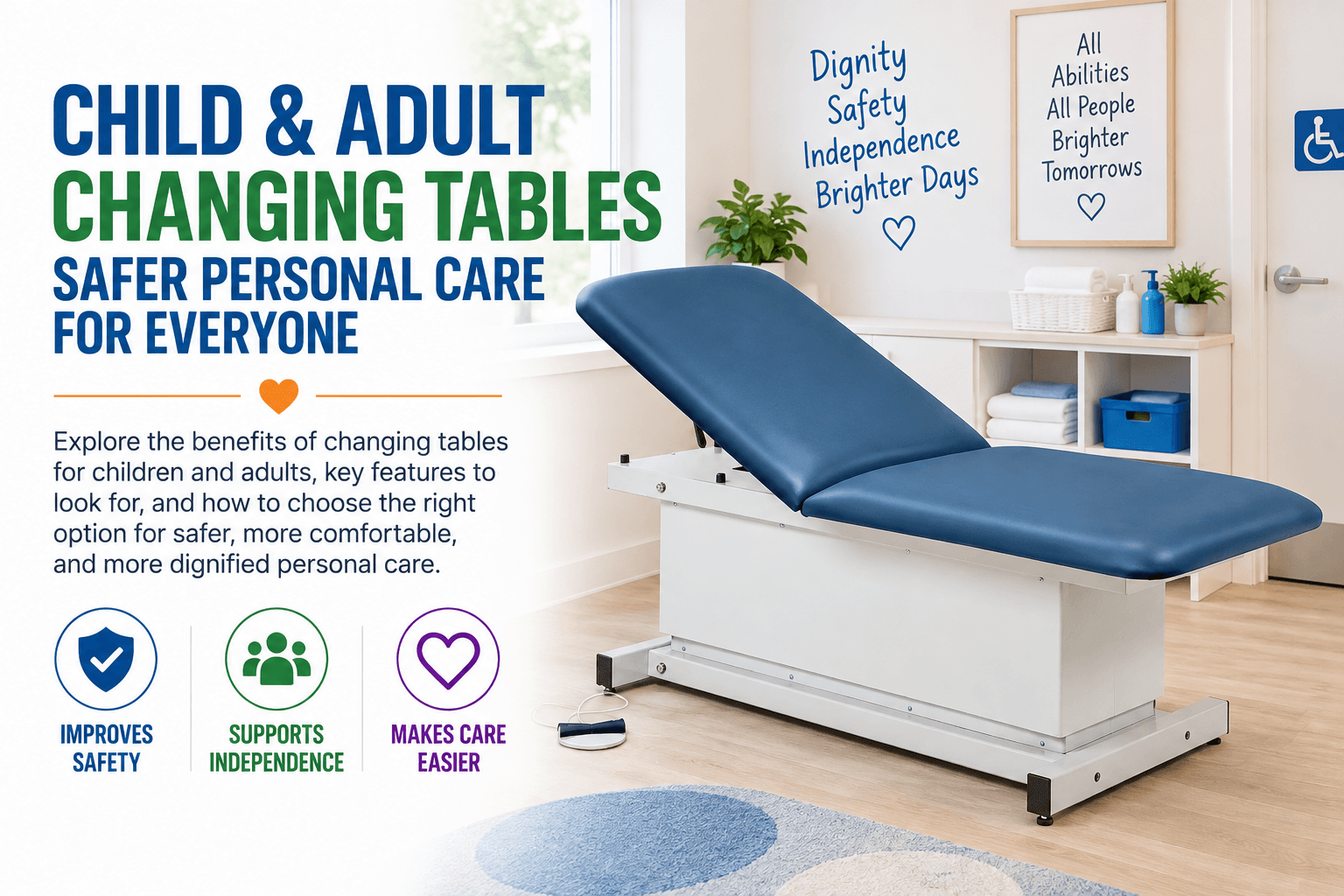
Looking for an child or adult changing table for special needs? These can provide a supportive surface for personal care routines involving children, teens, and adults who may need assistance with changing, dressing, hygiene, positioning, or transfers. For families, schools, therapists, residential programs, and care facilities, the right changing table can make routine care more comfortable for the individual while creating a more practical working height for caregivers.
A standard baby changing table may work during infancy, but it is rarely designed for the size, weight, positioning, and accessibility needs of an older child, teenager, or adult. A special needs changing table is designed around continued personal care, with options that may include larger surfaces, padded tops, higher weight capacities, adjustable heights, side rails, and powered positioning.
What Is a Child & Adult Changing Table?
A special needs child & adult changing table is a supportive care surface designed for individuals who need assistance with personal care beyond the infant and toddler years.
Depending on the model, these tables may be used for:
- Diaper and incontinence care
- Dressing and undressing
- Hygiene routines
- Skin care
- Position changes
- Caregiver assisted transfers
- Therapy preparation
- Daily personal care
Unlike a typical nursery changing station, special needs changing tables are often larger and built for repeated use with children, teens, or adults.
Who May Benefit From an Accessible Changing Table?
An accessible changing table may be useful whenever changing or personal care on a bed, floor, bathroom surface, or standard table becomes difficult.
Individuals with mobility limitations, developmental disabilities, physical disabilities, or ongoing personal care needs may require additional support during changing routines.
A changing table may be considered when a person:
- Requires caregiver assistance with dressing or hygiene
- Cannot independently stand during personal care
- Has difficulty transferring safely
- Has outgrown a traditional child changing station
- Needs a larger and more supportive changing surface
- Requires personal care several times throughout the day
- Needs improved positioning during hygiene routines
- Attends a school or program where accessible personal care is provided
The goal is not simply convenience. The changing environment should work for both the person receiving care and the caregiver providing assistance.
An Adult Changing Table for Continued Personal Care
The need for changing support does not necessarily end during childhood.
An adult changing table provides a larger surface for teens and adults who require assistance with incontinence care, dressing, hygiene, or other daily routines. Families sometimes search for a changing table for disabled adults when a bed or bathroom surface no longer provides an appropriate working area.
Important considerations for adult use include:
- Overall table length
- Table width
- User weight
- Transfer method
- Caregiver access
- Height adjustment
- Available room space
- Side support
- Compatibility with transfer equipment
- Cleaning requirements
Always compare the user's measurements and care needs with the specifications of the individual table.
Why Table Height Matters for Caregivers
Changing someone on a surface that is too low may require repeated bending, reaching, and awkward positioning.
An appropriately selected changing table can bring personal care tasks to a more practical working height. This may help caregivers maintain better body positioning during routine care.
Some models use a fixed elevated surface, while others allow the caregiver to raise or lower the table.
This distinction can be especially important when choosing equipment for:
- Schools
- Therapy clinics
- Residential programs
- Group homes
- Healthcare facilities
- High use changing areas
- Individuals who require frequent transfers
Fixed Height Changing Tables
A fixed height changing table can be a practical option when powered height adjustment is not required.
For example, the Spark Sensory Solutions Changing Table provides a 36 inch working height, two inches of foam padding, a 350 pound load capacity, and two available changing surface sizes. Its construction includes solid wood legs and supportive H braces.
A fixed height padded care table may work well when:
- The caregiver can safely complete transfers at the table height
- A simple dedicated changing surface is needed
- Powered adjustment is unnecessary
- The table will remain in one consistent location
- The user's size falls within the table's dimensions and capacity
Before selecting a fixed height option, consider how the individual will get onto and off the table.
Hi Lo Changing Tables
A Hi Lo changing table can be raised and lowered to accommodate different parts of the care routine.
Lowering the table may make some transfers easier, while raising it can provide a more comfortable working height for the caregiver.
The Armedica AM SX Hi Lo Changing Table Series, for example, uses motorized height adjustment. Its standard configuration adjusts from 18 inches to 37 inches, includes pivoting side rails, locking casters, and a 400 pound lifting capacity. It is available with 60 inch and 72 inch table lengths.
Adjustable height changing tables can be particularly useful in environments where:
- Several caregivers use the equipment
- Users have different transfer needs
- A mechanical lift may be involved
- Personal care occurs frequently
- Caregiver ergonomics are a priority
- Children and adults use the same care space
Changing Tables for Schools
Schools serving students with physical disabilities or significant personal care needs may require an accessible changing area.
A school changing table can provide a dedicated surface for toileting support, dressing, hygiene, and personal care during the school day.
When selecting a changing table for a school, consider:
- Student size ranges
- Weight capacity
- Privacy
- Staff access
- Transfer procedures
- Cleaning
- Available room dimensions
- Side protection
- Adjustable height
- Equipment used by the therapy or nursing team
Schools should also develop appropriate care procedures so staff understand transfers, supervision, cleaning, privacy, and emergency practices.
Changing Tables for Therapy and Clinical Settings
Therapy practices, clinics, and treatment environments may need tables that support both personal care and positioning.
Power tables can provide greater flexibility when users need adjustable working heights or different body positions. The Clinton Shrouded Power Table with Adjustable Backrest, for example, provides powered height adjustment and a pneumatic backrest that can raise up to 80 degrees from flat.
For professional environments, buyers may want to evaluate:
- Frequency of daily use
- Powered adjustment
- Backrest positioning
- Surface width
- Weight capacity
- Cleaning requirements
- Staff ergonomics
- Access from multiple sides
- Durability
- Room layout
The best configuration depends on what care activities will take place on the table.
Changing Tables for Home Use
Families providing ongoing personal care at home may find that routines become increasingly difficult as a child grows.
Changing on the floor can require significant bending and lifting. A bed may be too low or too soft. Bathroom counters typically do not provide enough space for an older child or adult.
A dedicated special needs changing table can create a predictable personal care area with a stable surface and enough room for supplies.
Before bringing a changing table into the home, measure:
- Available floor space
- Doorways
- Table location
- User height
- User weight
- Transfer clearance
- Caregiver working space
- Mechanical lift clearance if applicable
Also consider where wipes, clothing, briefs, gloves, hygiene supplies, and other care items will be stored so caregivers do not need to leave the individual unattended.
Choosing Between a Fixed and Adjustable Changing Table
Neither design is automatically better for every user.
A fixed height changing table may be appropriate when the transfer method is simple and the caregiver can work comfortably at the fixed height.
A powered or motorized changing table may offer greater flexibility when the person needs more transfer support or when multiple caregivers use the equipment.
Consider an adjustable table when:
- Lower positioning would simplify transfers
- A patient lift is used
- The caregiver needs different working heights
- Several staff members provide care
- The table serves users of different sizes
- Personal care occurs frequently
Consider a fixed table when:
- Transfers can already be completed safely
- A consistent working height is appropriate
- Simplicity is preferred
- Powered adjustment is not needed
What Size Changing Table Do You Need?
Size should be based on the individual rather than age alone.
Important measurements include overall body length and the amount of usable surface needed for comfortable positioning. The person should fit safely on the changing surface without being crowded.
For growing children, it may be useful to think beyond current measurements and consider expected future needs.
Also check:
- Manufacturer dimensions
- Weight capacity
- Changing surface dimensions
- Clearance around the table
- Caregiver working space
- Transfer method
A table that works today but will soon be outgrown may not be the most practical long term option.
Weight Capacity Is Only One Part of Choosing a Table
A high weight capacity does not automatically mean a changing table is appropriate for every user under that limit.
The changing surface must also provide adequate length and width. The transfer method, positioning needs, balance, caregiver assistance, and other factors should be considered.
For example, current options in the eSpecial Needs collection range from a padded fixed table rated for 350 pounds to the Armedica motorized model with a 400 pound lifting capacity.
Always use the specifications for the exact model being considered.
Consider Transfers Before Choosing a Changing Table
How the individual gets onto the changing surface is one of the most important questions to answer.
Transfer methods may include:
- Independent transfer
- Caregiver assisted transfer
- Stand and pivot transfer
- Sliding transfer
- Mechanical lift
- Other individualized transfer methods
A person who uses a mechanical lift may need additional clearance beneath or around the changing table.
A person who can perform a supported standing transfer may have very different equipment needs.
An occupational therapist, physical therapist, healthcare professional, or equipment specialist can help evaluate more complex transfer requirements.
Side Rails and User Safety
Some adjustable changing tables include side rails or other supportive features.
Side rails may help define the surface and provide added security during care, but they should never be treated as a replacement for appropriate supervision.
Caregivers should remain attentive throughout changing and personal care routines, particularly when the individual has involuntary movement, poor balance, limited safety awareness, or difficulty remaining positioned.
Follow the manufacturer's instructions for any side rails, straps, or positioning features.
Creating a More Accessible Changing Area
The table itself is only one part of an accessible personal care space.
A well planned area should provide enough room for the person, caregiver, mobility equipment, and any transfer equipment being used.
Consider including:
- Accessible storage for care supplies
- A waste container
- Disposable gloves
- Cleaning supplies
- Privacy measures
- Appropriate lighting
- Clear floor space
- Safe transfer paths
- Nearby hand washing access
- Emergency procedures in professional settings
Frequently used supplies should be within reach so the caregiver can remain with the individual.
Cleaning and Daily Maintenance
Changing surfaces used for personal care should be easy to maintain.
Follow the manufacturer's instructions for cleaning upholstery, padding, frames, rails, and powered components. Avoid cleaners that may damage the surface or equipment.
Regularly inspect the table for:
- Loose hardware
- Damaged upholstery
- Unstable components
- Worn padding
- Rail problems
- Caster issues
- Power adjustment problems
Equipment used in schools, clinics, and residential settings may benefit from a documented inspection and cleaning routine.
Questions to Ask Before Buying a Special Needs Changing Table
Before selecting a changing table, consider these questions:
- Who will use the table?
- What are the user's current height and weight?
- Is growth expected?
- How will transfers be completed?
- Is powered height adjustment needed?
- Will a mechanical lift be used?
- How much room is available?
- Is a longer adult changing surface needed?
- Are side rails important?
- How frequently will the table be used?
- Will several caregivers use it?
- What working height is comfortable?
- What cleaning requirements does the environment have?
- Is professional guidance needed for transfers or positioning?
Answering these questions can help narrow the options before comparing specific models.
Shop Changing Tables for Special Needs
The eSpecial Needs Changing Tables collection includes supportive care tables for children and adults, ranging from straightforward padded changing surfaces to motorized Hi Lo systems and powered clinical tables. Current options include products from Spark Sensory Solutions, Armedica, and Clinton Industries.
Shop Changing Tables at eSpecial Needs
Families and professionals may also want to explore related bathing, toileting, transfer, and adaptive furniture solutions when planning a complete personal care space.
FAQs
What should I look for in an adult changing table?
Consider the user's height, weight, transfer needs, table length, table width, weight capacity, caregiver working height, side support, room dimensions, and whether powered height adjustment is needed.
Is an adjustable height changing table better than a fixed height table?
It depends on the user and care routine. Adjustable tables may be helpful when multiple caregivers use the table, when transfer needs vary, or when a lower transfer height and higher caregiver working height are both important. A fixed height table may be sufficient when transfers are straightforward and the working height is appropriate.
Can changing tables be used in schools?
Yes. Changing tables may be used in special education classrooms, health rooms, therapy areas, accessible restrooms, or other spaces where students require assistance with personal care.
What should schools consider when choosing a changing table?
Schools should consider student size ranges, staff working height, transfers, privacy, cleaning requirements, available room space, side support, accessibility, weight capacity, and whether several students will use the same equipment.
Are changing tables useful in therapy clinics?
Yes. Therapy and clinical environments may use changing tables for personal care, positioning, dressing, transfers, and preparation for therapy activities. Adjustable models may be especially helpful when different clients and staff members use the same table.
How much space is needed around a changing table?
Allow enough room for the table itself, caregivers, mobility devices, transfers, storage, and any patient lift or other equipment that may be used. Measuring the room before ordering is especially important for larger adult changing tables.