Table of Contents
- Key Takeaways: Understanding Adaptive Equipment for Adults
- What Is Adaptive Equipment for Adults?
- Why Should You Choose Equipment by Daily Activity?
- Mobility Aids: Supporting Safe Movement at Home and in the Community
- Daily Living Aids: Dressing, Feeding, and Grooming Support
- Bathing and Toileting Equipment: Staying Safe in the Bathroom
- Adaptive Seating: Positioning for Comfort and Participation
- Assistive Technology: Tools That Extend Independence
- How to Assess Which Equipment an Adult Needs
- Purchase Considerations When Buying Adaptive Equipment For Adults
- Matching Adaptive Equipment to Real Daily Needs
- FAQs
Choosing the right adaptive equipment for adults with disabilities starts with one question: what daily activity needs support? Adults with physical, neurological, or developmental conditions often need tools that match specific routines, not general product categories. A mobility aid that works for community outings may not help during mealtime, and a bathing support designed for one condition may fall short for another.
eSpecial Needs gives you a need-based approach to selecting adaptive equipment, connecting each device category to the real daily activities it supports. This article walks through the major categories of adaptive equipment, explains how each one maps to common daily tasks, and outlines the purchase considerations that matter most when funding, fitting, and choosing the right tools for your clients or loved ones.
Key Takeaways: Understanding Adaptive Equipment for Adults
- Adaptive equipment should be matched to specific daily activities, not just a diagnosis or product category.
- Mobility aids, daily living tools, and assistive technology each serve different routines and functional needs.
- Occupational and physical therapists play a central role in assessing which equipment fits an adult's goals.
- eSpecial Needs offers adaptive equipment across mobility, bathing, toileting, seating, and feeding categories for adults.
- Funding through Medicaid, insurance, or state assistive technology programs may help cover qualifying devices.
What Is Adaptive Equipment for Adults?
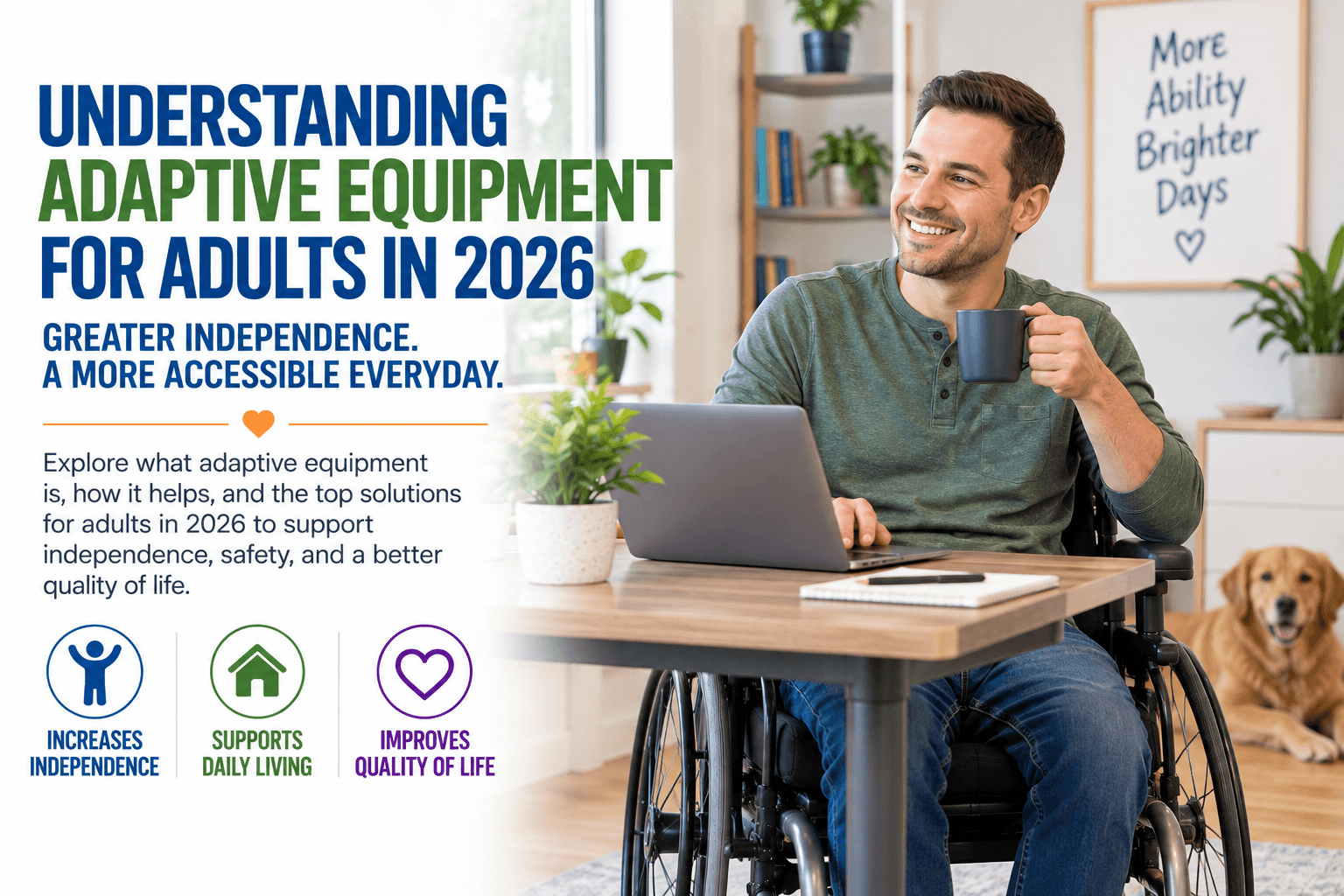
Adaptive equipment for adults refers to tools, devices, or modified products that help adults with disabilities perform daily tasks more safely and independently. These tools are designed to bridge the gap between what a person wants to do and what their body can currently manage.
You might hear the terms "assistive devices," "adaptive aids," or "durable medical equipment" used interchangeably. They overlap, but there are differences. Adaptive equipment modifies how a task is done. Assistive devices is a broader term that includes any tool that compensates for a limitation. Durable medical equipment, or DME, typically requires a prescription and may qualify for insurance coverage.
Understanding these distinctions matters when you are recommending equipment for students transitioning into adult services or guiding families through purchasing decisions.
Why Should You Choose Equipment by Daily Activity?
Many adults and caregivers start their search by browsing product categories or diagnosis-specific lists. That approach can lead to purchases that look helpful on paper but do not address the actual task that needs support.
A need-based approach flips the process. Instead of asking "what products exist for cerebral palsy?" you ask "what specific task is difficult, and what tool reduces that barrier?" This keeps the focus on function, not labels.
For special education professionals and school-based therapists, this mindset is especially useful during transition planning. When an adult student moves from school services to community or home-based routines, the daily activities change, and the equipment should change with them.
Mobility Aids: Supporting Safe Movement at Home and in the Community
Mobility aids help adults move through their environments with less effort and more safety. The right device depends on the person's strength, balance, endurance, and where they need to travel.
Canes and crutches offer lighter support for adults who walk independently but need added stability. Walkers and rollators give a wider base for those with greater balance concerns. Gait trainers add trunk and pelvic support for adults who need help with posture during stepping.
For adults who cannot walk safely or over longer distances, wheelchairs and power scooters can support independent community access. According to a 2026 MACPAC policy brief, Medicaid home and community-based services in most states cover at least some categories of mobility equipment for qualifying adults.
Daily Living Aids: Dressing, Feeding, and Grooming Support
Daily living aids target the personal care tasks adults perform every day. These include getting dressed, eating, drinking, brushing teeth, and managing personal hygiene.
Dressing aids like button hooks, sock aids, and elastic shoelaces reduce the need for bending, gripping, or fine motor precision. Adaptive utensils for adults with built-up handles, angled spoons, scoop plates, and weighted cups make mealtimes more manageable for adults with tremors, weak grip, or limited coordination.
Grooming tools such as long-handled combs, adapted toothbrushes, and universal cuffs allow adults to participate in hygiene routines that might otherwise require full caregiver assistance. eSpecial Needs carries a range of grip aids and holders for adults designed to support hand function across many of these routines.
Bathing and Toileting Equipment: Staying Safe in the Bathroom
Bathrooms present some of the highest-risk situations for adults with disabilities. Wet surfaces, low seating, tight spaces, and frequent transfers combine to create fall hazards.
Shower chairs and bath benches give adults a stable seated surface during bathing. Transfer benches help adults move across the tub wall while seated, reducing the need to step over an edge. Bath supports from eSpecial Needs are available for both children and adults.
Toileting aids include raised toilet seats, toilet safety frames, bedside commodes, and commode chairs that combine hygiene and positioning support. These tools help reduce the distance adults need to lower their bodies and add grab points that improve safety during transfers.
Adaptive Seating: Positioning for Comfort and Participation
Proper seating does more than keep someone comfortable. It supports posture, trunk stability, hand function, communication access, and participation in meals, therapy, work, and social activities.
Adults with cerebral palsy, spinal cord injuries, or neurological conditions may need adaptive seating with pelvic support, lateral trunk supports, headrests, footrests, and tilt or recline features. These elements keep the body aligned and reduce fatigue during seated activities.
For adults who benefit from gentle movement while seated, active seating options like wobble chairs or rocking seats may support focus and sensory regulation. eSpecial Needs offers active seating designed for adult use in home, classroom, and therapy settings.
Assistive Technology: Tools That Extend Independence
Assistive technology spans a wide range, from simple switches to complex communication systems. For adults with disabilities, these tools can support communication, environmental control, medication management, emergency response, and access to education or employment.
Communication devices, including speech-generating tools and augmentative and alternative communication (AAC) systems, help adults who are non-verbal or have limited speech stay connected with caregivers, coworkers, and community members.
Smart home devices, voice-activated controls, and personal emergency response systems also fall under this umbrella. The Administration for Community Living funds State Assistive Technology Programs in every U.S. state and territory, offering device demonstrations, short-term loans, and financing support to help adults try before they buy.
How to Assess Which Equipment an Adult Needs
Choosing adaptive equipment for adults starts with observing the adult's actual daily routines. Ask which tasks are difficult, unsafe, tiring, or frustrating. Then look at whether the barrier is strength, reach, grip, balance, coordination, cognition, or sensory processing.
An occupational therapist can run a formal assessment that evaluates range of motion, grip strength, seated balance, transfer safety, and home or workplace layout. A physical therapist may focus on gait, balance, mobility device selection, and fall risk.
For school-based therapists supporting transition-age students, the assessment should also look ahead. Consider the adult environments the student will enter, the daily routines they will perform independently, and the level of caregiver support available after school services end.
Purchase Considerations When Buying Adaptive Equipment For Adults
Before ordering, confirm the product's weight capacity, dimensions, cleaning requirements, and compatibility with the user's body and environment. A device that fits a clinic may not work in a small apartment bathroom or a narrow school hallway.
Funding sources vary. Medicaid and Medicaid waiver programs may cover certain adaptive equipment when documented as medically necessary. Private insurance plans sometimes cover durable medical equipment with a physician's prescription. State assistive technology programs, vocational rehabilitation agencies, and nonprofit grants can also offset costs.
eSpecial Needs accepts purchase orders from schools and government agencies and offers financing through Affirm for families purchasing directly. A quote request can help you compare products and prepare documentation for funding approval.
Matching Adaptive Equipment to Real Daily Needs
The most effective adaptive equipment for adults is the tool that solves a real, daily problem. Start with the activity, identify the barrier, and then match the device to the person's functional goals and environment.
Whether you are a therapist guiding a transition plan, a caregiver setting up a home, or a school professional recommending equipment for an adult student, a need-based approach keeps the focus where it belongs: on independence, safety, and dignity. Explore adaptive equipment for adults options at eSpecial Needs to find tools that fit your specific situation.
FAQs
What is the difference between adaptive equipment and assistive technology?
Adaptive equipment modifies how a daily task is performed, such as a built-up spoon that makes gripping easier. Assistive technology is a broader category that includes both simple tools and electronic devices like communication systems or smart home controls. All adaptive equipment is assistive, but not all assistive technology is adaptive.
How do I know which adaptive equipment an adult needs?
Start by identifying the daily tasks that are difficult or unsafe. Then work with an occupational or physical therapist to assess the person's strength, mobility, grip, balance, and environment. eSpecial Needs also offers expert consultations to help match products to individual needs.
Does Medicaid cover adaptive equipment for adults?
Medicaid and Medicaid waiver programs may cover some adaptive equipment when it is documented as medically or functionally necessary. Coverage varies by state, product type, and program. A letter of medical necessity from a qualified clinician is usually required.
What adaptive equipment helps adults with dressing?
Dressing aids include button hooks, zipper pulls, sock aids, dressing sticks, elastic shoelaces, and adaptive clothing with magnetic or Velcro closures. These tools reduce the need for fine motor precision and help adults dress more independently, especially after stroke, surgery, or with conditions like arthritis.
What role do occupational therapists play in choosing adaptive equipment?
Occupational therapists assess how an adult performs daily tasks and recommend equipment based on functional goals. They evaluate grip strength, range of motion, balance, cognition, and environment. eSpecial Needs supports therapist-guided purchasing through school and agency purchase orders and detailed product information for clinical decision-making.