Table of Contents
- Why Whiteboards and Chalkboards Are Useful Learning Tools
- Supporting Visual Learners
- Whiteboards for Handwriting Practice
- Chalkboards for Tactile Writing Experiences
- Magnetic Whiteboards and Chalkboards
- Whiteboards for Classroom Communication
- Whiteboards and Chalkboards in Special Education Classrooms
- Using Writing Boards in Occupational Therapy
- Whiteboards for Visual Schedules and Daily Routines
- Choosing a Whiteboard or Chalkboard
- Shop Whiteboards and Chalkboards at eSpecial Needs
- FAQs
Whiteboards and chalkboards are simple, reusable learning tools that can support writing, communication, visual instruction, organization, and classroom participation. For students with special needs, having information presented visually can make directions, routines, academic concepts, and communication easier to understand and revisit.
The Whiteboards and Chalkboards collection at eSpecial Needs includes writing surfaces for classrooms, therapy spaces, home learning, and other educational environments. Options range from smaller individual boards to larger surfaces that can be used for instruction, drawing, handwriting practice, and collaborative activities.
Why Whiteboards and Chalkboards Are Useful Learning Tools
Reusable writing surfaces give teachers, therapists, caregivers, and students the freedom to write, erase, adjust, and try again.
This can be especially useful for students who benefit from repetition or visual instruction.
Whiteboards and chalkboards may support:
- Handwriting practice
- Letter and number formation
- Visual schedules
- Classroom instructions
- Math problems
- Spelling practice
- Drawing
- Choice making
- Communication prompts
- Group lessons
- Fine motor activities
- Daily routines
For schools planning a larger learning environment, Special Education Classroom Equipment Essentials explains how visual supports fit alongside adaptive seating, sensory equipment, communication tools, and fine motor resources.
Supporting Visual Learners
Some students understand information more easily when they can see it rather than only hear it.
A whiteboard gives teachers an easy way to make spoken directions visual.
For example, instead of only telling a student what happens next, a teacher can write or draw:
- Finish worksheet
- Put materials away
- Sensory break
- Lunch
The information remains visible while the student completes the routine.
Visual supports can be especially useful when working on transitions, classroom expectations, multistep activities, and independent work.
The eSpecial Needs Visual Schedules collection can also be combined with classroom boards when students benefit from more structured visual routines.
Whiteboards for Handwriting Practice
Whiteboards can make handwriting practice feel less permanent and more approachable.
A student can practice a letter, erase it, and immediately try again without filling pages with mistakes.
Teachers and therapists may use a whiteboard for:
- Uppercase letters
- Lowercase letters
- Numbers
- Names
- Sight words
- Short sentences
- Shapes
- Prewriting lines
- Copying exercises
For students who need additional handwriting support, pair a board with Writing Tools, Grips, or Adaptive Pens and Pencils.
Fine motor ability also plays an important role in writing. Fine Motor Skills Activities and Tools Every OT Recommends provides additional ideas for building grasp, hand control, coordination, and classroom participation.
Chalkboards for Tactile Writing Experiences
Chalk creates a different writing experience from markers or pencils.
The slight resistance between chalk and the board may provide additional tactile feedback for some students. Larger pieces of chalk can also be easier to grasp than thin writing tools for children who are still developing hand control.
Chalkboards may be used for:
- Letter practice
- Number formation
- Drawing
- Tracing
- Early writing activities
- Classroom games
- Visual instruction
Different students have different sensory preferences, so some may strongly prefer chalk while others prefer the smoother feel of a dry erase marker.
Magnetic Whiteboards and Chalkboards
A magnetic writing surface can add another layer of learning.
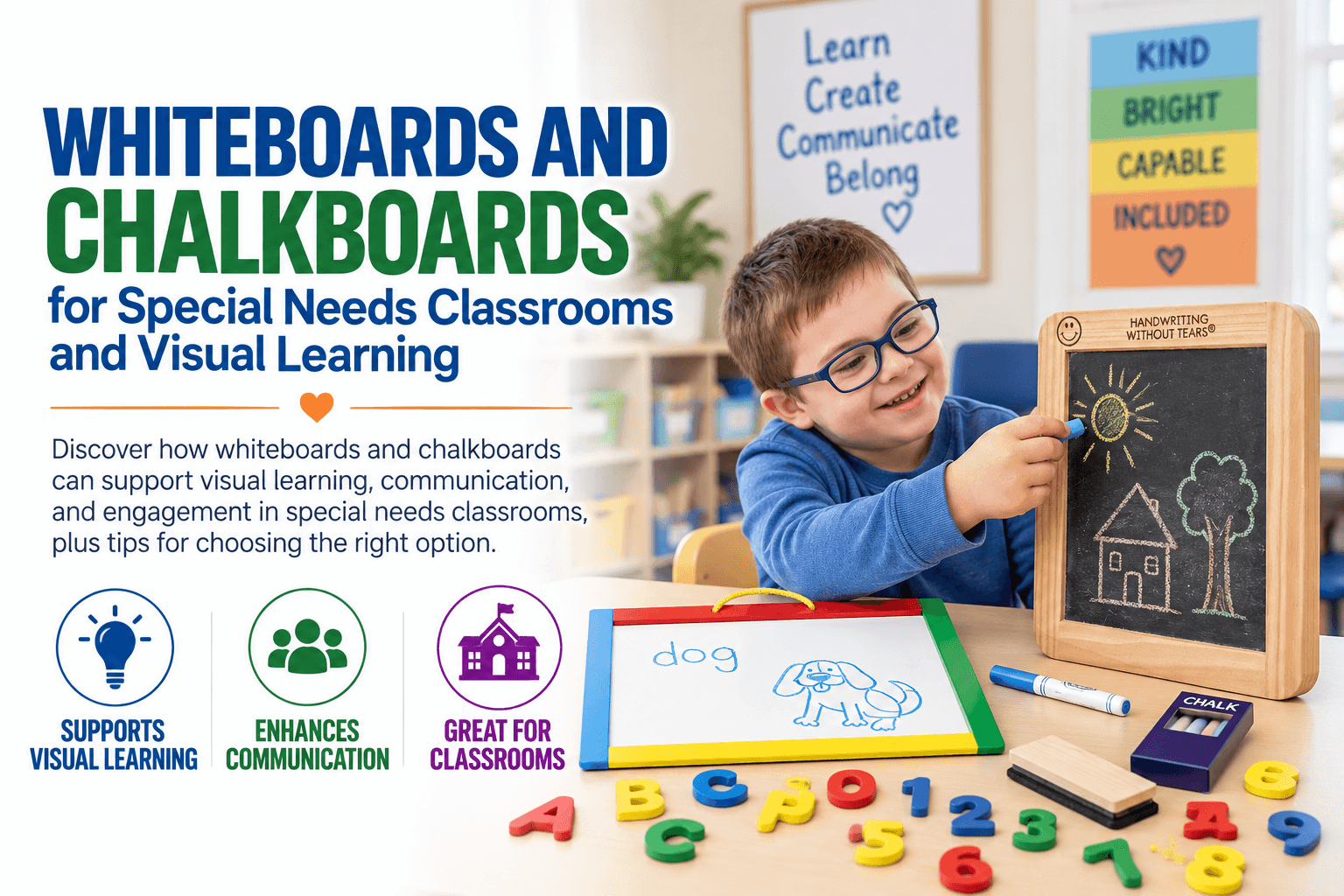
The Melissa & Doug Magnetic Chalkboard and Dry Erase Board combines a chalkboard, dry erase surface, and magnetic activity area in one reusable board.
Students can use it for writing and drawing while also adding magnetic letters, numbers, pictures, or other learning materials.
This type of board can support:
- Letter recognition
- Early spelling
- Number activities
- Matching
- Sequencing
- Creative play
- Fine motor practice
- Visual learning
Because students can interact with the board in several ways, it can be useful in classrooms, therapy rooms, playrooms, and home learning areas.
Whiteboards for Classroom Communication
Writing boards are not limited to academic instruction.
Teachers, therapists, and students can also use them as flexible communication tools.
A board may be used to display:
- Choices
- First and then instructions
- Daily goals
- Classroom expectations
- Questions
- Feelings
- Activity options
- Reminders
- Social prompts
For students who use AAC or other communication supports, visual writing surfaces can complement rather than replace dedicated communication equipment.
Explore AAC and Communication when a student needs more specialized communication access.
The article Inclusive Learning Tools Every Classroom Needs also explains how visual supports, AAC, sensory tools, adaptive seating, and fine motor equipment can work together in an inclusive learning environment.
Whiteboards and Chalkboards in Special Education Classrooms
Reusable boards can be especially useful in special education classrooms because they can quickly adapt to different students and activities.
One student may practice handwriting.
Another may follow a visual schedule.
A teacher may use the same board later for a group math lesson or a classroom reminder.
This flexibility makes whiteboards and chalkboards useful across:
- Independent work stations
- Small group instruction
- Therapy sessions
- Circle time
- Life skills activities
- Communication practice
- Classroom routines
If you are planning an entire room, Special Education Classroom Setup: A Step by Step Guide provides ideas for organizing learning zones, sensory spaces, movement areas, communication supports, and accessible classroom equipment.
Using Writing Boards in Occupational Therapy
Occupational therapists may use vertical or angled writing surfaces during activities involving visual motor skills, hand control, reaching, handwriting, and fine motor coordination.
Working on a board may encourage students to:
- Reach across the body
- Practice larger writing movements
- Strengthen shoulder stability
- Coordinate visual and hand movements
- Practice letter formation
- Participate in tracing activities
An adjustable easel can provide another option when the writing surface needs to be positioned at a specific angle. Browse Tables, Trays and Easels for additional accessible work surfaces.
Whiteboards for Visual Schedules and Daily Routines
One of the simplest ways to use a whiteboard is as a changing visual schedule.
Teachers can write the day's activities and erase or check them off as each activity is completed.
A schedule might include:
- Morning work
- Reading
- Therapy
- Sensory break
- Lunch
- Math
- Art
- Dismissal
This can help make the school day feel more predictable.
For students who need additional structure, boards can be paired with Classroom Management tools such as visual schedules, timers, and organizational supports.
Choosing a Whiteboard or Chalkboard
Think about where and how the board will be used.
Consider:
- Board size
- Wall mounted or portable use
- Chalk or marker preference
- Magnetic functionality
- Individual or group use
- Cleaning requirements
- Available classroom space
- Student reach
- Writing activities
- Fine motor abilities
A small individual board may be ideal for handwriting or communication practice, while a larger board may work better for classroom instruction and group activities.
Shop Whiteboards and Chalkboards at eSpecial Needs
The Whiteboards and Chalkboards collection at eSpecial Needs includes reusable visual learning surfaces for children and adults in classrooms, therapy programs, homes, and educational settings.
You can also explore related learning resources including Education Products, Writing Tools, Classroom Management, Visual Schedules, and Arts and Crafts Supplies.
FAQs
Are whiteboards helpful for students with special needs?
Yes. Whiteboards can support visual learning, handwriting practice, communication, routines, academic instruction, and classroom organization. They are especially useful when students benefit from seeing information instead of relying only on verbal directions.
Why can whiteboards be helpful for students who struggle with handwriting?
Whiteboards allow students to write, erase, and try again without creating a permanent mistake on paper. This can make handwriting practice feel less intimidating while providing repeated opportunities to practice letters, numbers, words, and shapes.
Students who need additional handwriting support may also benefit from the Handwriting Tools collection.
Is a chalkboard better than a whiteboard for sensory feedback?
It depends on the student. Chalk creates more resistance against the writing surface, which may provide noticeable tactile feedback. Dry erase markers generally glide more smoothly. Some students strongly prefer one sensation over the other.
Can larger chalk or markers help children with weak grip?
They may. Larger writing tools can sometimes be easier to grasp because the fingers do not need to close as tightly around the tool.
For additional grip support, explore Grips and Holders.
Can whiteboards help students follow classroom directions?
Yes. Teachers can write short instructions, checklists, or visual reminders on a board and leave them visible while the student completes the activity.
This can reduce the amount of information a student must remember after hearing instructions only once.
Can a whiteboard be used as a visual schedule?
Yes. Teachers and caregivers can list daily activities on a whiteboard and erase, check off, or move through them as they are completed.
This can be especially helpful for students who benefit from predictable routines and knowing what comes next.