Table of Contents
- Quick guide: 5 top special needs strollers for long days in 2026
- How we chose the top special needs strollers for long outings
- The 5 top special needs strollers for long days in 2026
- 1. Convaid Cruiser: Umbrella-style fold for everyday transport
- 2. Convaid EZ Rider: Lightweight design for active families
- 3. Special Tomato EIO Push Chair: Reclining support for younger bigger kids
- 4. Circle Specialty Strive: Adjustable seat depth that grows with your child
- 5. Adaptive Star Axiom Lassen: Indoor-outdoor design for varied terrain
- Comparison table: Top special needs strollers for long days
- How do you measure a student for a special needs stroller?
- What should schools know about theme park stroller policies?
- FAQs
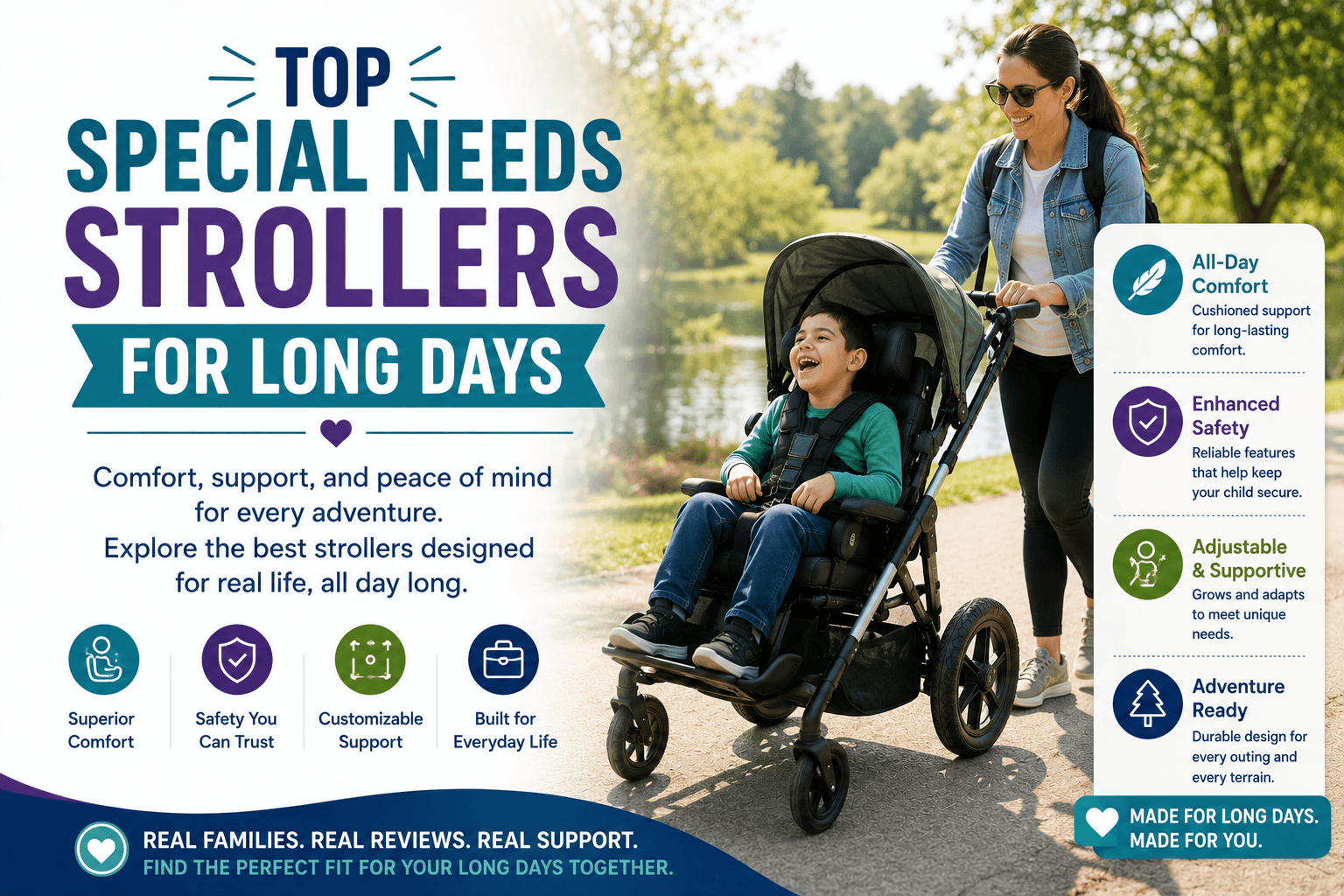
Planning field trips, therapy appointments, or family adventures with a child who needs extra support? Finding the right special needs strollers from eSpecial Needs can turn stressful outings into enjoyable experiences for both you and your student or child. Long days demand more than basic strollers can offer. You need proper postural support, durable frames that handle hours of use, and designs that fold quickly when the school bus arrives.
This guide ranks the top adaptive strollers for 2026 based on what matters most: comfort during extended outings, support for bigger kids, and transport-friendly designs that fit real-world schedules.
Quick guide: 5 top special needs strollers for long days in 2026
- Convaid Cruiser: Umbrella-style fold with built-in positioning for everyday transport
- Convaid EZ Rider: Lightweight aluminum frame for active schedules
- Special Tomato EIO Push Chair: All-terrain wheels with adjustable recline for younger riders
- Circle Specialty Strive: Adjustable seat depth that grows with your child
- Adaptive Star Axiom Lassen 3: Indoor-outdoor design for varied terrain
How we chose the top special needs strollers for long outings
We consulted occupational therapists, physical therapists, and special education coordinators to identify what actually matters during full-day field trips and community outings. Here's what shaped our selections:
- Postural support that lasts: Adjustable harnesses, trunk support, and head positioning keep riders comfortable through hours of activity, not just the first 30 minutes.
- Weight capacity for bigger kids: Many students outgrow standard strollers by age 8. We prioritized options supporting 100+ pounds so equipment grows with your students.
- Quick-fold functionality: School staff need strollers that collapse in seconds for bus loading. Umbrella-style and single-action folds earned extra points.
- Transport certification: WC19 compliance means the stroller meets safety standards for school bus and van transport—a must for field trip planning.
- Caregiver ergonomics: Height-adjustable handles and lightweight frames reduce strain during long zoo visits or theme park days.
- All-terrain capability: Grass, gravel, and uneven sidewalks shouldn't stop a field trip. We looked for larger wheels and sturdy construction.
The 5 top special needs strollers for long days in 2026
1. Convaid Cruiser: Umbrella-style fold for everyday transport
The Convaid Cruiser has been a classroom staple for years, and the current design continues that reliability. Its umbrella-style fold collapses into a narrow profile that stores easily in closets or vehicle trunks. For daily transport between home, school, and therapy, that quick collapse saves precious minutes.
Positioning features include a 30° fixed tilt for postural control and self-tensioning seating that mimics solid seating systems. Students who need head and trunk support benefit from the adjustable calf panel and improved neck support design. The Cruiser carries WC19 certification for school bus transport.
Convaid Cruiser features
- Self-tensioning seating: The seating system adjusts to your student's body, providing pelvic positioning similar to custom solid seats without the added weight.
- Under-seat storage: A storage basket and side bags give caregivers space for medical supplies, snacks, and personal items during extended outings.
- WC19 transport compliance: Meets safety standards for wheelchair transportation, giving peace of mind during bus rides to field trips.
Convaid Cruiser pros and cons
Pros:
- Compact umbrella fold fits in standard closets and vehicle trunks
- Built-in positioning reduces need for additional accessories
- Five sizes accommodate growth from early childhood through adolescence
Cons:
- Fixed tilt angle doesn't adjust for varying positioning preferences
- Heavier than some umbrella-style alternatives
- Larger sizes use a two-piece push handle design
2. Convaid EZ Rider: Lightweight design for active families
The Convaid EZ Rider targets families and caregivers who prioritize portability. Its aluminum frame keeps weight down while maintaining the structural integrity needed for daily use. The compact umbrella fold stores in smaller spaces than traditional adaptive strollers.
This model works well for students who maintain upright body strength but need supportive seating during longer outings. The design focuses on comfort and functionality without the extensive positioning features found in the Cruiser line.
Convaid EZ Rider features
- Lightweight aluminum frame: Easier to lift in and out of vehicles, reducing caregiver fatigue during busy school schedules.
- Quick umbrella fold: Collapses efficiently for storage between uses or during transitions throughout the day.
- WC19 compliance: Meets wheelchair transportation safety standards for school bus use.
Convaid EZ Rider pros and cons
Pros:
- Aluminum construction reduces overall weight for easier handling
- Compact fold fits in limited storage spaces
- Four sizes available for different age ranges
Cons:
- Fewer built-in positioning features than the Cruiser model
- Not designed for students needing extensive trunk support
- Standard accessories may require separate purchase
3. Special Tomato EIO Push Chair: Reclining support for younger bigger kids
The special tomato eio push chair stroller combines mild-to-moderate positioning support with the convenience features parents and caregivers need. Its seat reclines from 25° to 75°, allowing students to rest during long outings without transferring to a separate seating system.
Large airless wheels handle grass, gravel, and uneven surfaces without the maintenance hassles of pneumatic tires. For zoo visits, park days, or outdoor field trips, this all-terrain capability keeps the day moving forward.
Special Tomato EIO Push Chair features
- Adjustable recline: Seat back adjusts from 25° to 75°, letting riders rest comfortably when fatigue sets in during extended outings.
- Padded hip and back laterals: Removable laterals reduce seat width for smaller children, then remove as students grow—extending the stroller's usable life.
- Airless all-terrain wheels: Large wheels handle rough terrain without risk of flats, keeping outdoor adventures on track.
Special Tomato EIO Push Chair pros and cons
Pros:
- Wide recline range accommodates rest periods during long days
- Removable laterals allow the seat to grow with your child
- All-terrain wheels handle outdoor surfaces without maintenance concerns
Cons:
- 90-pound weight limit restricts use for larger students
- Three-wheel design requires curb assist technique for navigation
- Not WC19 certified for bus transport
Special Tomato EIO Stroller Push Chair - Adaptive Stroller
$921.50
$2,062.05
The Special Tomato EIO Stroller Push Chair is a lightweight adaptive stroller designed to provide comfortable mobility and positioning support from early intervention through preadolescence. Built for children who need more support than a standard stroller, the EIO combines everyday… read more

4. Circle Specialty Strive: Adjustable seat depth that grows with your child
The Strive Adaptive Stroller focuses on customization. Adjustable seat depth, tension-adjustable back support, and swing-away footrests adapt to individual student needs. For schools serving students with varying positioning requirements, this flexibility reduces the need for multiple stroller models.
Four sizes cover weight capacities from 75 to 250 pounds, making the Strive suitable for students who've outgrown smaller adaptive strollers. The transit tie-down option (sold separately) adds bus transport capability for field trip planning.
Circle Specialty Strive features
- Adjustable seat depth: Seat depth adjusts up to 4 inches, accommodating growth spurts without requiring a new stroller purchase.
- Tension-adjustable back: Back firmness adjusts to match individual postural needs, providing customized support across different users.
- One-handed folding: Quick collapse mechanism makes transitions between activities efficient for busy caregivers.
Circle Specialty Strive pros and cons
Pros:
- Seat depth adjustment extends usable life as students grow
- 250-pound weight capacity in larger sizes supports adolescents and adults
- Curb assist lever helps navigate uneven terrain
Cons:
- Bus transit tie-downs sold separately
- Heavier than umbrella-style alternatives
- Accessories add to base equipment cost
5. Adaptive Star Axiom Lassen: Indoor-outdoor design for varied terrain
The Axiom Lassen stroller bridges the gap between indoor maneuverability and outdoor durability. Its 16-inch rear wheels and 6-inch front swivel wheels handle both hallway navigation and park pathways. For schools that transition between indoor therapy sessions and outdoor activities, this versatility reduces equipment shuffling.
The design creates a "cocoon" effect with solid sides and an overhead canopy—helpful for students with autism or sensory processing differences who feel more comfortable in enclosed spaces during busy outings.
Adaptive Star Axiom Lassen features
- Dual-terrain wheel setup: Large rear wheels handle grass and gravel while swivel front wheels allow sharp indoor turns.
- Enclosed seating design: Solid sides and canopy create a calming environment for students who need sensory regulation during stimulating activities.
- Quick-fold lever: Single-action fold collapses the stroller for storage in seconds.
Adaptive Star Axiom Lassen pros and cons
Pros:
- Transitions between indoor and outdoor use without wheel changes
- Enclosed design supports sensory regulation needs
- Made in the USA with domestic customer support
Cons:
- Larger footprint than umbrella-style strollers
- Air-filled tire customization requires manufacturer contact
- Three sizes available (no infant or small toddler option)
Comparison table: Top special needs strollers for long days
| Stroller | Max Weight Capacity | WC19 Bus Transport | One-Hand Fold |
|---|---|---|---|
| Convaid Cruiser | 130 lbs | ✓ | ✓ |
| Convaid EZ Rider | 125 lbs | ✓ | ✓ |
| Special Tomato EIO | 90 lbs | ✗ | ✓ |
| Circle Specialty Strive | 250 lbs | ✓ (accessory required) | ✓ |
| Adaptive Star Axiom Lassen | 175 lbs | ✗ | ✓ |
How do you measure a student for a special needs stroller?
Getting accurate measurements prevents ordering mistakes and ensures proper support from day one. Start with these key dimensions while your student sits on a flat surface with feet supported:
Seat width: Measure across the widest part of the hips, then add 1-2 inches for clothing and positioning accessories. Too narrow creates pressure points; too wide reduces lateral support effectiveness.
Seat depth: Measure from the back of the buttocks to the back of the knee. The seat should support the thighs without pressing behind the knees, which restricts circulation during long outings.
Back height: Measure from the seat surface to the desired support level. Students needing head support require taller backs than those with good head control. Account for any headrest accessories in this measurement.
What should schools know about theme park stroller policies?
Theme parks generally welcome adaptive strollers, but size restrictions apply. Walt Disney World and similar parks limit stroller dimensions to 31 inches wide and 52 inches long. Most special needs strollers fit within these limits, but verify your specific model's dimensions before planning field trips.
Parks typically allow adaptive strollers near ride entrances where standard strollers must be parked in designated areas. Bring documentation of your student's disability accommodation needs to Guest Services upon arrival. Staff can provide additional guidance on accessibility services and attraction boarding procedures.
For day-long park visits, choose strollers with sun canopies, storage baskets, and comfortable seating that supports extended use. The recline features on models like the Special Tomato EIO help students rest between activities without leaving the park.
FAQs
Who needs a special needs stroller for long days?
A special needs stroller for long days may help children, teens, or adults who fatigue quickly, have limited walking endurance, need postural support, require caregiver assisted mobility, or need a safe place to rest during outings.
They may be useful for individuals with cerebral palsy, autism, developmental disabilities, muscular dystrophy, Down syndrome, low muscle tone, neurological conditions, mobility limitations, sensory needs, or complex medical needs.
What makes a special needs stroller good for long days?
A stroller that works well for long days should provide comfort, support, durability, and easy caregiver handling.
Important features may include:
- Supportive seating
- Proper weight capacity
- Correct seat width and depth
- Recline options
- Adjustable footrests
- Head and trunk support
- Comfortable harness system
- Sun canopy
- Storage space
- Durable frame
- Easy steering
- Reliable brakes
- Outdoor capable wheels
- Foldability for transport
The best stroller should fit both the user’s body and the caregiver’s daily routine.
What features should I look for in a stroller for long outings?
For long outings, look for:
- Comfortable seat padding
- Recline or tilt options
- Adjustable footrests
- Proper seat depth
- Proper seat width
- Head support if needed
- Trunk support if needed
- Secure harness
- Sun and weather protection
- Large storage basket
- Cup holder or accessory options
- Strong brakes
- Easy pushing
- Stable frame
- Wheels suited to the terrain
- Fold size that fits your vehicle
Comfort and support become more important when the user may be seated for extended periods.
How do I know if a special needs stroller fits correctly?
A stroller should support the user without being too tight or too loose. Check seat width, seat depth, back height, footrest range, harness fit, and overall weight capacity.
A poor fit may cause discomfort, sliding, leaning, pressure, poor foot support, or reduced postural control. For complex needs, ask an occupational therapist, physical therapist, or seating specialist for help with measurements.
Why does seat width matter?
Seat width affects comfort and side support. A seat that is too narrow may create pressure or discomfort. A seat that is too wide may allow the user to lean, slide, or lose needed trunk support.
Measure the widest part of the hips or thighs while seated and compare it with the stroller’s specifications.
Why does seat depth matter?
Seat depth affects thigh support and seated posture. A seat that is too shallow may not support the legs well. A seat that is too deep may press behind the knees and make positioning uncomfortable.
Proper seat depth helps support comfort during long days.
Are reclining special needs strollers better for long days?
Recline can be helpful for users who fatigue easily, need rest breaks, have limited trunk control, or need position changes during long outings.
Not every user needs recline, but it can be an important feature for longer community trips, medical appointments, travel, and all day events.
Do special needs strollers have head support?
Some special needs strollers include headrests or optional head support accessories. Head support may be important for users with limited head control, fatigue, poor trunk stability, low muscle tone, or postural needs.
Check whether the stroller includes head support or whether it can be added as an accessory.
What harness system is best for a special needs stroller?
Harness options may include pelvic belts, five point harnesses, chest straps, shoulder straps, and positioning belts. The best system depends on the user’s postural needs, movement patterns, safety concerns, and comfort.
Harnesses should be used according to the manufacturer’s instructions and should never replace active supervision.
Are special needs stroller restraints safe?
Harnesses and restraints can support positioning and safety when used correctly. They should not be used as punishment or unnecessary restriction.
If the user has complex postural, medical, behavioral, or safety needs, ask an occupational therapist, physical therapist, or qualified provider for guidance.
Are special needs strollers good for parks and outdoor events?
Many special needs strollers are designed for outdoor use, but performance varies by model. For parks, outdoor festivals, zoo trips, sports fields, or uneven sidewalks, look for a durable frame, larger wheels, good brakes, stable handling, sun protection, and comfortable seating.
Always review the manufacturer’s intended use and terrain guidance.
Are special needs strollers good for theme parks?
Special needs strollers may be useful for theme parks when the user needs support during long walking days, crowds, heat, waiting lines, or sensory overload. However, each park has its own accessibility rules and stroller policies.
Before going, check the park’s accessibility policy, stroller as wheelchair rules, size restrictions, and guest services requirements.