Table of Contents
- What Is a Patient Lift Hoyer Lift?
- Why Patient Lifts Matter
- Who May Need a Patient Lift Hoyer Lift?
- Patient Lift Hoyer vs Manual Transfers
- Types of Patient Lifts
- Manual Patient Lift
- Power Patient Lift
- Sit to Stand Lift
- Full Body Patient Lift
- Ceiling Lift
- What Are Hoyer Patient Lift Slings?
- Common Types of Patient Lift Slings
- Full Body Sling
- Toileting Sling
- Bath Sling
- Sit to Stand Sling
- Padded Sling
- Mesh Sling
- How to Choose the Right Hoyer Patient Lift Sling
- Hoyer Patient Lift Parts
- Patient Lift Safety Basics
- Common Transfer Situations
- Bed to Wheelchair Transfers
- Wheelchair to Bed Transfers
- Wheelchair to Commode Transfers
- Wheelchair to Shower Chair Transfers
- Patient Lifts for Home Care
- Patient Lifts for Seniors
- Patient Lifts for Adults with Disabilities
- Patient Lifts for Children with Special Needs
- Patient Lift vs Transfer Board
- Patient Lift vs Sit to Stand Lift
- How to Choose a Patient Lift Hoyer Lift
- Measuring for a Patient Lift and Sling
- Caregiver Training for Patient Lifts
- Patient Lift Maintenance
- Cleaning Patient Lift Slings
- Patient Lift Funding and Insurance
- Letter of Medical Necessity for a Patient Lift
- Buying Patient Lifts for Facilities
- Patient Lift Buying Checklist
- Where to Buy Patient Lift Support Products Online
- FAQs
Patient Lift Hoyer Lift: Safer Transfers and Caregiver Support
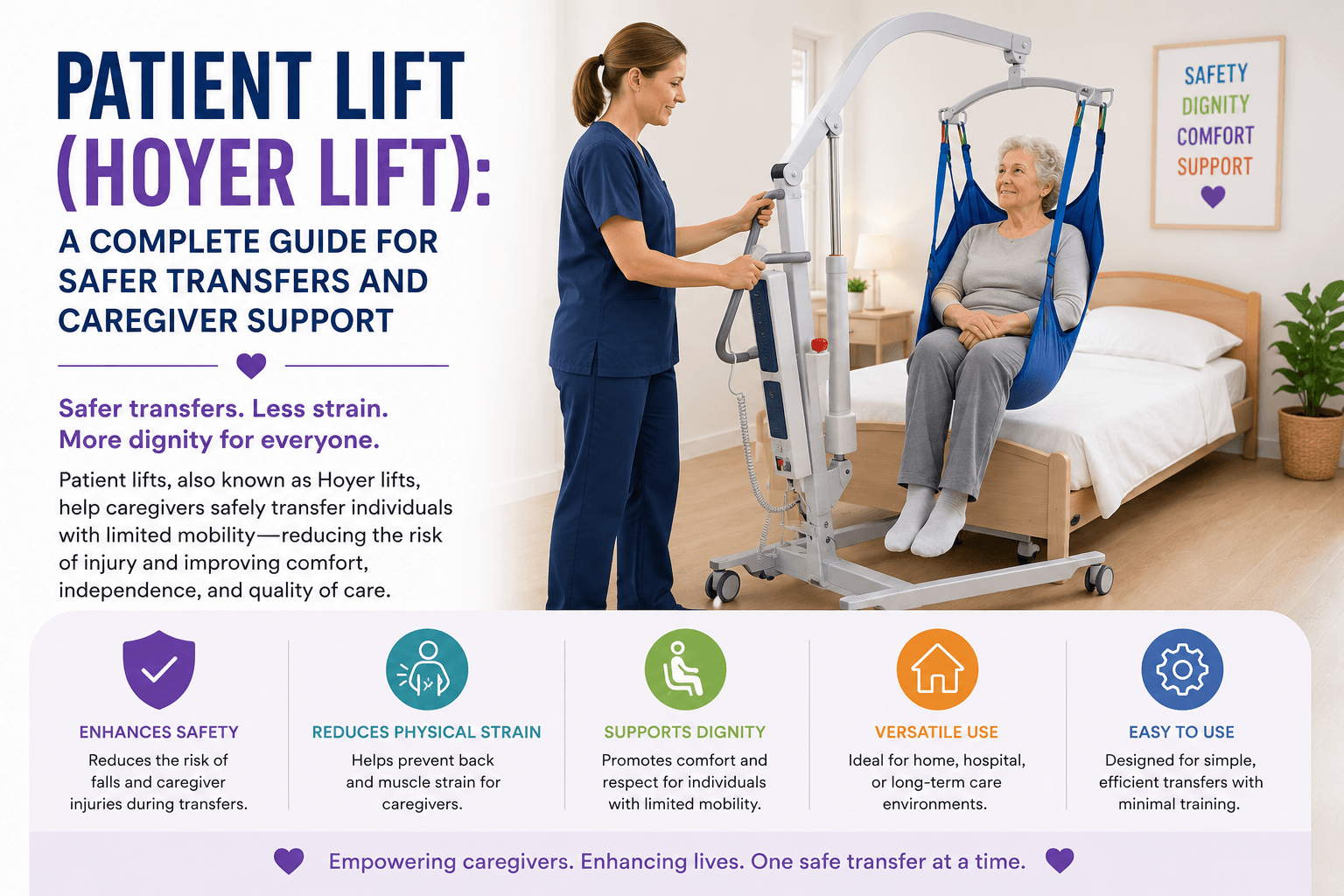
A patient lift hoyer lift is a transfer device designed to help caregivers move a person safely between surfaces, such as a bed, wheelchair, chair, commode, shower chair, or recliner. For adults, seniors, children with special needs, people with disabilities, and individuals with limited mobility, a patient lift can reduce unsafe lifting, support more comfortable transfers, and help protect both the user and caregiver during daily care routines.
Many families search for a patient lift hoyer, hoyer patient lift, Hoyer patient lift slings, or Hoyer patient lift parts when they need a safer way to complete transfers at home, in a school, hospital, rehab center, group home, or long term care setting. A patient lift does not replace proper caregiver training, but it can make transfers safer and more manageable when used correctly.
Families, caregivers, and care teams can explore related support categories through eSpecial Needs, including Mobility Products, Daily Living Aids, Bathing and Toileting Aids, Positioning Products, Shower Chairs, and Over the Toilet Chairs.
What Is a Patient Lift Hoyer Lift?
A Hoyer patient lift is a caregiver operated lifting device used to transfer a person who cannot safely move from one surface to another without significant assistance. The term Hoyer is often used broadly to describe patient lifts, although Hoyer is also a well known brand name associated with transfer lifts.
A hoyer patient lift typically uses a frame, boom, spreader bar, lifting mechanism, base, wheels, and sling. The sling supports the person’s body while the lift raises and moves them between surfaces.
A patient lift may be used for transfers such as:
Bed to wheelchair
Wheelchair to bed
Wheelchair to commode
Wheelchair to shower chair
Bed to recliner
Chair to wheelchair
Floor recovery when appropriate
Care facility transfers
Home care transfers
School or clinic transfers
The goal is to reduce manual lifting and support safer movement during daily care.
Why Patient Lifts Matter
Transfers can be one of the most physically demanding parts of caregiving. Lifting someone manually can create risk for back injuries, falls, skin shearing, pain, fear, and unsafe positioning. A patient lift hoyer lift can help reduce these risks when the right lift, sling, and transfer technique are used.
Patient lifts may support:
Safer transfers
Reduced caregiver strain
Lower lifting demands
Better transfer consistency
Improved dignity during care
More comfortable positioning
Support for heavier users
Assistance during bathing and toileting routines
Reduced fall risk during transfers
More practical home care routines
For many families, a patient lift can make it possible to continue care at home with less physical strain.
BestLift PL400EF Portable Lift
$1,342.00
$1,677.00
The BestLift™ PL400EF represents a new standard in full-body lifts for individuals who travel or have storage issues in their home. It is a unique lifter with a small footprint and foldable design that assembles or folds in 3 simple… read more

Who May Need a Patient Lift Hoyer Lift?
A patient lift hoyer lift may be helpful when a person cannot safely stand, pivot, bear weight, or transfer with standard caregiver assistance.
Common users include people with:
Stroke
Cerebral palsy
Spinal cord injury
Multiple sclerosis
Muscular dystrophy
ALS
Parkinson’s disease
Traumatic brain injury
Severe weakness
Advanced arthritis
Amputation
Progressive neurological conditions
Bariatric mobility needs
Post surgery mobility restrictions
Severe balance impairment
Significant fatigue
Limited trunk control
Long term disability
A physician, physical therapist, occupational therapist, nurse, or mobility specialist can help determine whether a patient lift is appropriate.
BestLift PL400HE Electric Patient Lift
$1,250.00
$1,563.00
The PL400HE is Bestcare’s answer to home care needs. Featuring a 400 lb. maximum weight capacity and Bestcare battery-powered control system for powerlifting, the PL400HE is easily adaptable for a wide range of challenges while still maintaining a high standard… read more

Patient Lift Hoyer vs Manual Transfers
Manual transfers may involve one or more caregivers physically helping a person move between surfaces. This can work for some users, but it may become unsafe when the person cannot assist, has poor balance, is heavier, has unpredictable tone, or has significant weakness.
A patient lift hoyer may be a better option when:
The person cannot stand safely
The person cannot bear weight
The caregiver cannot lift safely
Transfers require two or more people
Falls or near falls have occurred
The person has poor trunk control
The person has pain during transfers
The person needs consistent transfer support
Caregivers are at risk for injury
The lift should be used with proper training and the correct sling.
Types of Patient Lifts
Patient lifts come in several types. The best choice depends on the user’s needs, transfer goals, home layout, caregiver ability, and care setting.
Manual Patient Lift
A manual patient lift uses a hydraulic pump or hand operated mechanism to raise and lower the user. These lifts do not require charging, but they do require caregiver effort to operate.
Manual lifts may be useful for:
Home care
Occasional transfers
Lower equipment cost
Users who do not need frequent transfers
Settings where power access is limited
Caregivers should consider the physical effort needed to use a manual lift.
Power Patient Lift
A power patient lift uses a battery powered motor to raise and lower the user. This can reduce caregiver effort and make frequent transfers easier.
Power lifts may be helpful for:
Daily transfers
Caregivers with limited strength
Heavier users
Facility settings
Frequent bed and wheelchair transfers
Long term care routines
Power lifts require charging and battery maintenance.
Sit to Stand Lift
A sit to stand lift is designed for users who can bear some weight and participate in the transfer. It helps move a person from sitting to standing and may be used for toileting, chair transfers, or standing practice.
Sit to stand lifts may be appropriate when the user:
Can follow directions
Has some weight bearing ability
Has enough trunk control
Can hold handles or be supported safely
Needs help standing but is not fully dependent
A sit to stand lift is not appropriate for users who cannot bear weight or participate safely.
Full Body Patient Lift
A full body patient lift supports users who need full assistance during transfers. It is commonly used with a sling that supports the body under the thighs, trunk, and sometimes head depending on the sling type.
Full body lifts may be used for:
Non weight bearing users
Bed to wheelchair transfers
Wheelchair to commode transfers
Bathing transfers
Users with poor trunk control
Users who cannot assist with standing
Higher support needs
Ceiling Lift
A ceiling lift is mounted to an overhead track system and can move the user along a fixed path. Ceiling lifts are common in hospitals, care facilities, and some homes.
Ceiling lifts may help with:
Smaller rooms
Frequent transfers
Reduced floor clutter
Multi surface transfer paths
Caregiver safety
They require professional installation and planning.
What Are Hoyer Patient Lift Slings?
Hoyer patient lift slings are fabric supports that attach to the patient lift and hold the user during transfer. The sling is one of the most important parts of a lift system because it supports the person’s body and affects comfort, safety, and positioning.
Patient lift slings may vary by:
Size
Shape
Weight capacity
Fabric type
Head support
Leg support
Toileting access
Bathing compatibility
Attachment style
Padding
Full body support
Sit to stand support
The sling must match both the lift and the user. Using the wrong sling can create safety risks.
Common Types of Patient Lift Slings
Different slings are designed for different transfers and support needs.
Full Body Sling
A full body sling supports the trunk, hips, and legs. Some include head support.
Best for users who:
Need full transfer assistance
Have poor trunk control
Cannot bear weight
Need bed to wheelchair transfers
Need strong body support
Toileting Sling
A toileting sling offers access for clothing management and hygiene. It is usually used with users who have enough trunk support and can tolerate a more open sling style.
Best for:
Toileting transfers
Commode access
Users with some seated stability
Caregiver assisted hygiene
Not every user can safely use a toileting sling.
Bath Sling
A bath sling is designed with materials that can tolerate moisture and dry more easily. It may be used for shower or bathing transfers when compatible with the lift and bathing setup.
Best for:
Shower chair transfers
Bathing routines
Moisture exposed care
Hygiene support
Sit to Stand Sling
A sit to stand sling is used with a sit to stand lift. It supports the upper body while the user helps stand.
Best for users who:
Can bear some weight
Can participate in standing
Need support for toileting or transfers
Have enough trunk control
Padded Sling
A padded sling may offer more comfort for users with sensitive skin, bony areas, or discomfort during transfers.
Best for:
Comfort
Longer transfer setup
Sensitive users
Higher support needs
Mesh Sling
A mesh sling may be used for bathing or toileting routines because it can allow water drainage and faster drying.
Best for:
Bathing transfers
Shower chair transfers
Hygiene routines
Moisture management
How to Choose the Right Hoyer Patient Lift Sling
Choosing the right sling is just as important as choosing the lift.
Consider:
User height
User weight
Hip width
Trunk control
Head control
Skin sensitivity
Transfer type
Toileting needs
Bathing needs
Sling compatibility
Lift attachment style
Caregiver training
Therapist recommendation
A sling should fit securely and support the person without causing pressure, sliding, pinching, or discomfort.
Hoyer Patient Lift Parts
Hoyer patient lift parts may include the components needed to keep the lift safe, functional, and properly maintained. Replacement parts should match the lift model and manufacturer requirements.
Common patient lift parts may include:
Slings
Spreader bars
Batteries
Chargers
Hand controls
Actuators
Caster wheels
Brakes
Base components
Mast parts
Boom parts
Sling clips
Hardware
Emergency lowering parts
Replacement straps
Scale attachments when compatible
Never use makeshift parts or incompatible accessories. If a part is damaged, worn, or missing, stop using the lift until it is repaired or inspected.
Patient Lift Safety Basics
Patient lift safety depends on the right equipment, proper sling fit, caregiver training, and careful transfer technique.
Basic safety tips include:
Read the manufacturer instructions
Use the correct sling size
Confirm weight capacity
Inspect the sling before each use
Check lift parts before transfers
Lock wheels only when instructed
Keep the user centered in the sling
Move slowly
Communicate each step
Keep the user close to the base
Avoid swinging or sudden movement
Never exceed weight limits
Do not use damaged equipment
Train all caregivers
Follow care team recommendations
A patient lift should make care safer, not rushed.
Common Transfer Situations
A patient lift hoyer lift may be used in several daily routines.
Bed to Wheelchair Transfers
This is one of the most common uses. The sling is placed under the user in bed, attached to the lift, and used to raise and move the person into the wheelchair.
Important considerations include:
Bed height
Wheelchair position
Brake use
Sling placement
User comfort
Caregiver space
Proper seating after transfer
Wheelchair to Bed Transfers
The lift can help return the person to bed safely. Proper positioning in bed is important after the transfer to reduce discomfort and pressure.
Wheelchair to Commode Transfers
A patient lift may help with toileting when the user cannot safely stand or pivot. A toileting sling may be used only when appropriate and safe.
Related support products may include Over the Toilet Chairs, Bathing and Toileting Aids, and Daily Living Aids.
Wheelchair to Shower Chair Transfers
Bathing transfers can be challenging because of wet surfaces and limited space. A patient lift may support safer movement to a shower chair when the bathroom setup allows.
Explore Shower Chairs, Bathing and Toileting Aids, and Reclining Shower Chairs.
Patient Lifts for Home Care
Patient lifts can help make home care more realistic and sustainable. Families may need a lift when transfers are too difficult or unsafe with manual assistance.
Home care considerations include:
Doorway width
Bed height
Wheelchair height
Floor surface
Space around bed
Space around toilet
Bathroom layout
Caregiver strength
Storage space
Battery charging area
Sling storage
Transfer frequency
Before choosing a lift, measure the home and review transfer pathways.
Patient Lifts for Seniors
Seniors may need patient lifts because of weakness, falls, stroke, arthritis, balance loss, Parkinson’s disease, surgery recovery, or progressive mobility changes.
A patient lift may help seniors:
Transfer with less pain
Reduce fall risk
Avoid unsafe caregiver lifting
Move between bed and wheelchair
Access toileting routines
Participate in bathing routines
Remain at home longer with support
Protect caregiver health
A care team can help decide whether a patient lift, sit to stand lift, transfer board, or other mobility support is best.
Patient Lifts for Adults with Disabilities
Adults with disabilities may use patient lifts for daily transfers at home, in group homes, day programs, clinics, or care facilities.
A patient lift may support adults with:
Cerebral palsy
Spinal cord injury
Multiple sclerosis
Muscular dystrophy
Traumatic brain injury
ALS
Severe mobility limitations
Neuromuscular conditions
Non weight bearing status
Complex care needs
The lift should match the adult’s body size, transfer needs, caregiver support, and environment.
Patient Lifts for Children with Special Needs
Some children with special needs may need transfer support as they grow. A caregiver may be able to lift a small child safely, but as the child gets older or heavier, manual lifting can become unsafe.
A patient lift may help children with:
Cerebral palsy
Muscular dystrophy
Spina bifida
Severe low tone
Limited mobility
Complex medical needs
Non weight bearing status
Poor trunk control
Higher caregiver assistance needs
Families should work with a therapist to choose a safe lift and sling for the child’s size and support needs.
Patient Lift vs Transfer Board
A transfer board helps a person slide between surfaces when they can assist with the transfer. A patient lift supports the person more fully when sliding or standing transfers are not safe.
A transfer board may work when the person:
Has good sitting balance
Can follow directions
Can use arms or trunk to assist
Can tolerate sliding transfers
Has caregiver support
A patient lift may be better when the person:
Cannot assist safely
Cannot sit unsupported
Cannot bear weight
Has poor trunk control
Has high fall risk
Is too difficult to transfer manually
A therapist can help determine which transfer method is safest.
Patient Lift vs Sit to Stand Lift
A full body patient lift and a sit to stand lift serve different needs.
A full body lift is for users who need full support and cannot safely stand.
A sit to stand lift is for users who can bear some weight and participate in moving to a standing position.
Choose based on:
Weight bearing ability
Trunk control
Cognitive ability
Arm function
Transfer goals
Toileting needs
Therapist recommendation
Using a sit to stand lift with someone who cannot safely participate can be dangerous.
How to Choose a Patient Lift Hoyer Lift
Choosing a patient lift hoyer lift starts with the user’s needs and the care environment.
Consider:
User height
User weight
Weight capacity
Transfer type
Bed height
Wheelchair height
Bathroom layout
Caregiver ability
Manual or power operation
Sling type
Sling size
Floor clearance
Storage space
Battery needs
Home or facility use
Repair and parts access
Funding requirements
The right lift should fit the user, home, and caregiver routine.
Measuring for a Patient Lift and Sling
Measurements help prevent unsafe fit.
Important measurements may include:
User weight
User height
Shoulder width
Hip width
Thigh size
Torso length
Head support needs
Bed height
Wheelchair seat height
Space under bed
Doorway width
Bathroom clearance
Sling sizing should follow the manufacturer’s chart.
Caregiver Training for Patient Lifts
Training is essential. Even the best lift can be unsafe if caregivers do not know how to use it properly.
Training should include:
Sling placement
Lift operation
Emergency lowering
Battery charging
Transfer steps
Wheelchair positioning
Bed positioning
Toileting transfers
Bathing transfers
Weight capacity rules
Inspection routine
Communication with the user
What to do if the user becomes uncomfortable
Caregivers should practice with professional guidance whenever possible.
Patient Lift Maintenance
Regular maintenance helps keep the lift safe.
Maintenance tips include:
Inspect the sling for tears
Check straps and stitching
Check wheels and brakes
Charge batteries as directed
Inspect the hand control
Check lift movement
Clean the frame
Store slings properly
Replace worn parts
Follow manufacturer maintenance schedule
Stop use if anything seems unsafe
Facilities should document maintenance and inspections.
Cleaning Patient Lift Slings
Slings should be cleaned according to manufacturer instructions. Some are machine washable, while others need specific care.
General tips include:
Follow label instructions
Remove from lift before washing
Check stitching after washing
Let sling dry fully
Do not use damaged slings
Keep personal slings assigned when possible
Use appropriate hygiene routines in facilities
A clean sling supports comfort, hygiene, and safety.
Patient Lift Funding and Insurance
A patient lift hoyer lift may be eligible for funding when it is medically necessary. Coverage varies by insurance plan, Medicaid program, Medicare rules when applicable, waiver programs, diagnosis, documentation, and equipment type.
Funding may require:
Physician prescription
Therapy evaluation
Letter of medical necessity
Product quote
Diagnosis information
Functional limitations
Transfer safety concerns
Caregiver injury risk
Prior authorization
Documentation that manual transfers are unsafe
Families can also explore Medicaid waiver programs, grants, veterans benefits, health savings accounts, flexible spending accounts, and direct purchase.
Letter of Medical Necessity for a Patient Lift
A letter of medical necessity explains why the lift is needed for safe transfers and daily care.
A strong letter may include:
Diagnosis
Mobility limitations
Transfer limitations
Current transfer method
Fall risk
Caregiver injury risk
User weight and support needs
Requested patient lift
Required sling type
Home or care setting
Why less supportive equipment is not enough
Expected benefits
Provider signature
Product quote
A physician, physical therapist, occupational therapist, nurse, or rehabilitation specialist may help support the request.
Buying Patient Lifts for Facilities
Hospitals, rehab centers, nursing facilities, group homes, schools, adult day programs, and care agencies may need patient lifts for multiple users.
Facility buyers should consider:
Weight capacity range
Sling inventory
Cleaning protocols
Staff training
Maintenance needs
Replacement parts
Battery management
Storage space
Transfer locations
Purchase orders
Product quotes
Multiple user sizing
Caregiver safety policies
Facilities should develop clear lift use policies and training programs.
Patient Lift Buying Checklist
Before choosing a patient lift, ask:
Can the user bear weight?
Does the user need full body support?
What transfers are needed?
What is the user’s weight?
What sling type is required?
Does the lift fit under the bed?
Does it fit through doorways?
Is the bathroom accessible?
Will one caregiver or two caregivers operate it?
Is manual or power operation better?
Are replacement parts available?
Is funding or insurance involved?
Has a therapist recommended the lift?
Are caregivers trained?
A patient lift should be selected around real transfer needs.
Where to Buy Patient Lift Support Products Online
Families, caregivers, therapists, schools, clinics, and care facilities can explore related adaptive equipment and transfer support products through eSpecial Needs.
Helpful categories include:
These categories can help support safer transfers, bathing routines, toileting access, mobility, and daily care.
FAQs
What is a special needs patient lift?
A patient lift is a transfer device designed to help move a person safely from one surface to another. It may be used to transfer someone between a bed, wheelchair, recliner, shower chair, commode chair, or other care surface.
Patient lifts can reduce physical strain on caregivers and may help make transfers safer for people with limited mobility, weakness, balance concerns, paralysis, or complex care needs.
What is a Hoyer lift?
A Hoyer lift is a commonly used term for a patient lift. Hoyer is a well known brand name, but many people use “Hoyer lift” to describe patient lifts in general.
A Hoyer lift usually uses a frame, lifting mechanism, spreader bar, and patient sling to raise and move a person during transfers.
What is the difference between a patient lift and a Hoyer lift?
A patient lift is the general category of transfer equipment. A Hoyer lift is a specific type or commonly used name for a lift used in patient transfers.
In everyday language, people often use the terms interchangeably. When shopping, compare the actual lift type, weight capacity, sling compatibility, power source, base width, and intended use.
Who needs a patient lift?
A patient lift may be helpful for individuals who cannot safely transfer with standing, pivoting, or caregiver assistance alone.
Potential users may include people with:
- Spinal cord injury
- Stroke recovery needs
- Cerebral palsy
- Muscular dystrophy
- Multiple sclerosis
- ALS
- Parkinson’s disease
- Traumatic brain injury
- Severe weakness
- Paralysis
- Limited weight bearing ability
- Poor balance
- High fall risk
- Complex medical needs
- Bariatric care needs
- Post surgery mobility limitations
A healthcare provider, occupational therapist, or physical therapist can help determine whether a patient lift is appropriate.
How does a patient lift help caregivers?
A patient lift may reduce the need for manual lifting, which can help protect caregivers from back strain, shoulder injuries, and unsafe transfer situations. It can also make transfers more consistent and controlled when the user cannot bear weight or help with the transfer.
Patient lifts are especially useful when a caregiver is helping with frequent transfers throughout the day.
Can a patient lift prevent caregiver injuries?
A patient lift may help reduce injury risk by limiting manual lifting and awkward body mechanics. However, no device eliminates all risk.
Caregivers should be trained on the lift, use the correct sling, follow the manufacturer’s instructions, lock brakes when appropriate, and avoid rushing during transfers.
What are the main types of patient lifts?
Common types of patient lifts include:
- Manual hydraulic patient lifts
- Electric patient lifts
- Sit to stand lifts
- Full body lifts
- Bariatric patient lifts
- Portable patient lifts
- Ceiling lifts
- Floor based patient lifts
- Bathing and hygiene transfer lifts
The right type depends on the user’s mobility, weight bearing ability, body size, transfer goals, home layout, and caregiver needs.
How do I choose between a manual and electric patient lift?
A manual lift may be suitable when transfers are less frequent, budget is limited, and the caregiver can safely operate the hydraulic pump. An electric lift may be better for frequent transfers, users who need smoother lifting, or caregivers who need less physical effort.
Compare cost, caregiver strength, transfer frequency, battery needs, emergency lowering features, and maintenance requirements.