Table of Contents
- Why Special Education Classroom Equipment Matters
- Types of Special Education Classrooms
- Special Education Inclusion Classroom Equipment
- Self Contained Special Education Classroom Setup
- Special Education Classroom Layout Ideas
- Special Education Classroom Furniture
- Adaptive Seating for Special Education Classrooms
- Sensory Tools for Special Education Classrooms
- Sensory Room Equipment and Calm Down Spaces
- Assistive Technology for Students With Disabilities
- AAC and Communication Tools
- Fine Motor Tools for Writing, Cutting, and Classroom Tasks
- Visual Supports and Classroom Organization Supplies
- Mobility Equipment for the Classroom
- Positioning Equipment for Classroom Participation
- Daily Living Aids for School Independence
- Feeding and Mealtime Equipment
- Inclusive Learning Tools and Adapted Classroom Materials
- Safety Equipment for Special Education Classrooms
- Classroom Equipment for Students With Autism
- Classroom Equipment for Students With Physical Disabilities
- Classroom Equipment for Students With Communication Needs
- Classroom Equipment for Students With Sensory Processing Needs
- How to Choose Special Education Classroom Equipment
- Special Education Classroom Equipment Checklist
- Special Education Classroom Setup by Area
- Funding, Quotes, and Purchase Orders for Schools
- Shop Special Education Classroom Equipment at eSpecial Needs
- FAQs
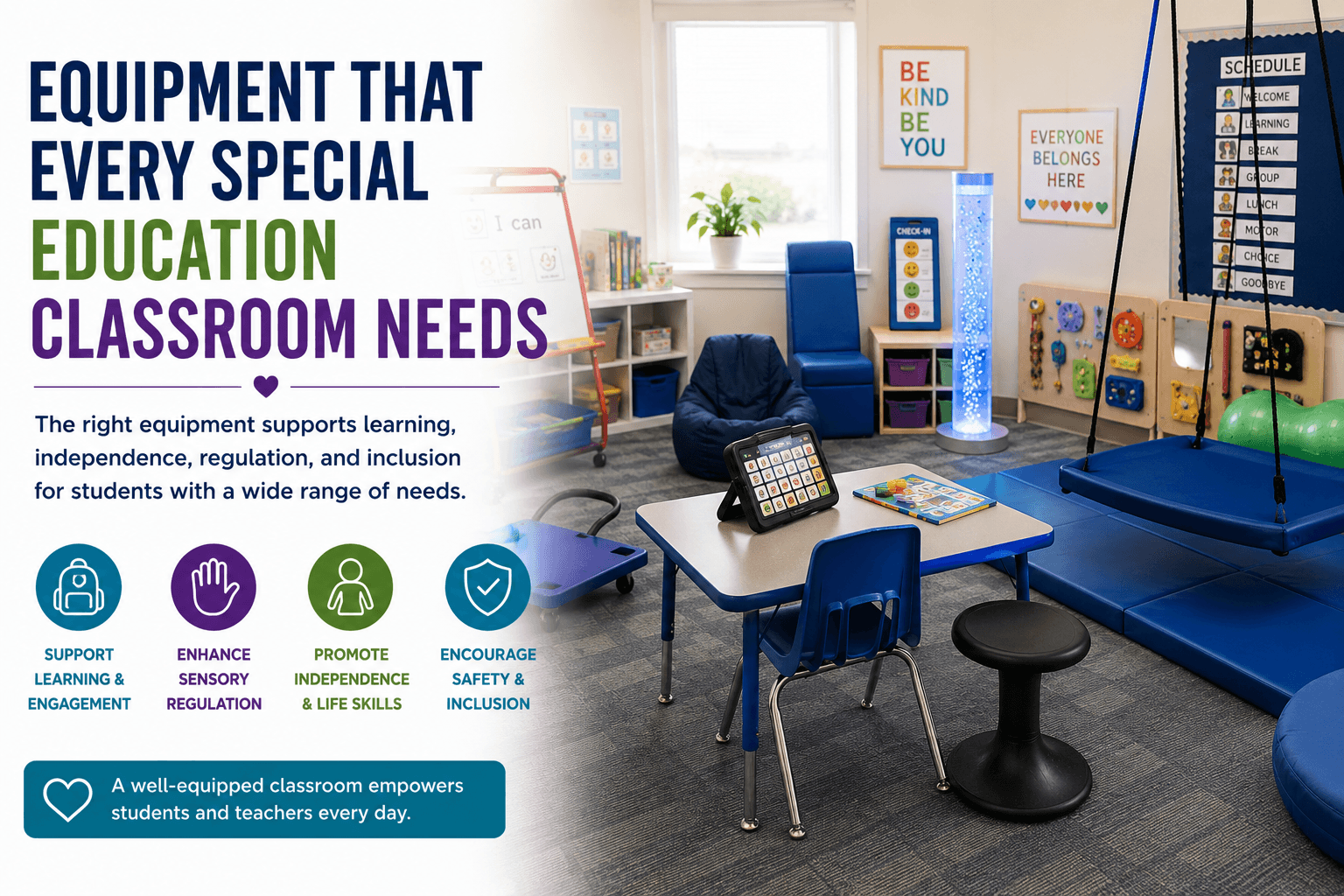
A well planned special education classroom gives students the tools, structure, support, and accessibility they need to learn, communicate, move, regulate, and participate throughout the school day. Whether you are setting up a special education classroom for the first time or improving an existing space, the right equipment can make the room more inclusive, organized, safe, and supportive for students with a wide range of needs.
A special education classroom may serve students with autism, sensory processing needs, cerebral palsy, Down syndrome, developmental delays, intellectual disabilities, communication challenges, ADHD, mobility limitations, emotional regulation needs, or complex medical needs. Because every student is different, the best classroom special education setup should be flexible, student centered, and built around real learning, access, and independence goals.
This guide covers special education classroom must haves, including adaptive seating, sensory tools, assistive technology, communication devices, mobility equipment, positioning products, daily living aids, fine motor tools, visual supports, classroom organization supplies, and special education classroom furniture. It also includes special education classroom ideas for inclusion settings, self contained rooms, therapy areas, life skills classrooms, and sensory support spaces.
Explore Education Products, Sensory Room Equipment, Adaptive Seating, Assistive Technology, AAC and Communication, and Daily Living Aids at eSpecial Needs.
Why Special Education Classroom Equipment Matters
Special education classroom equipment helps reduce barriers so students can access instruction, participate in routines, communicate needs, manage sensory input, and build independence. The right tools can support posture, attention, communication, sensory regulation, mobility, fine motor skills, gross motor skills, safety, and daily living skills.
Adaptive classroom equipment may help students:
Sit with better posture
Access learning materials
Communicate wants, needs, answers, and choices
Transition between activities
Manage sensory overload
Participate in group instruction
Practice daily living skills
Move more safely around the classroom
Build fine motor and gross motor skills
Stay engaged during lessons
Take appropriate sensory breaks
Participate with peers
Develop independence
Access classroom routines with less frustration
The best special education classroom setup does not rely on one product or one area of the room. It uses a thoughtful combination of furniture, sensory supports, communication tools, mobility equipment, visual supports, daily living aids, organization supplies, and accessible learning materials.
Types of Special Education Classrooms
Different types of special education classrooms need different equipment. A classroom design for special education should match the students, staff, goals, space, and daily routines.
Common types of special education classrooms include:
Inclusion classrooms where students with disabilities learn alongside general education peers
Resource rooms for targeted instruction and support
Self contained special education classrooms for students who need more intensive support
Life skills classrooms for daily living, vocational, and functional skill development
Autism support classrooms with sensory, communication, and visual structure
Therapy based classrooms with occupational, physical, or speech therapy support
Early childhood special education classrooms
Transition classrooms for older students preparing for adult life
Each room may need a different layout, but all effective special education classroom design starts with access, safety, communication, regulation, participation, and independence.
Special Education Inclusion Classroom Equipment
A special education inclusion classroom supports students with disabilities in a general education environment. In this setting, equipment should help students participate without feeling separated from their peers.
Inclusion classroom special education supports may include:
Flexible seating
Communication boards
Accessible classroom materials
Choice boards
Portable sensory kits
Mounts for communication devices or tablets
A special education inclusion classroom should make supports easy to access without disrupting classroom flow. Portable, compact, and discreet tools are often helpful in inclusion settings.
TherAdapt Adjustable Angle Easel
$281.70
$313.00
The Adjustable Angle Easel is designed for individuals who need close proximity to their reading and writing materials. The easel provides an ideal work surface for both physically and visually challenged individuals. It can be set at any angle between… read more

Self Contained Special Education Classroom Setup
A self contained special education classroom setup often serves students who need more direct support, specialized instruction, sensory regulation tools, communication access, mobility equipment, personal care support, or daily living instruction.
A self contained classroom may need:
Adaptive seating
Positioning chairs
Sensory tools
Calm down corner supplies
AAC and communication devices
Visual schedules
Daily living aids
Feeding supports
Toileting supports
Mobility equipment
Transfer equipment when needed
Therapy mats
Fine motor tools
Sensory motor equipment
Safety supports
Organized storage for supplies
Clearly defined classroom zones
The best self contained special education classroom setup usually includes separate areas for group instruction, individual work, sensory breaks, communication, personal care, daily living activities, and storage.
Special Education Classroom Layout Ideas
A strong special education classroom layout helps students understand where to go, what to do, and what comes next. Layout affects attention, transitions, independence, safety, and behavior support.
Helpful special education classroom layout ideas include:
Keep walkways clear for wheelchairs, walkers, and staff support
Create a defined group instruction area
Add individual workstations for focused tasks
Set up a calm down corner or sensory break space
Place communication tools where students can reach them
Keep daily supplies organized and labeled
Use visual boundaries such as rugs, shelves, bins, or tape
Keep high interest sensory tools away from areas used for direct instruction
Place adaptive seating where students can see and access materials
Keep personal care supplies private and organized
Store mobility and therapy equipment safely
Make visual schedules easy to see
Arrange furniture so staff can supervise the room
A special education classroom set up should be easy to understand, safe to move through, and flexible enough to change as student needs change.
Special Education Classroom Furniture
Special education classroom furniture should support comfort, access, posture, safety, sensory needs, and learning. Standard classroom furniture may not work for every student, especially students who need positioning support, movement input, wheelchair access, or flexible seating options.
Furniture for special education classroom spaces may include:
Adaptive chairs
Positioning chairs
Adjustable tables
Classroom seating systems
Sensory seating
Wobble chairs
Floor cushions
Bean bags
Floor sitters
Corner chairs
Mobile seating
Therapy mats
Calm down pods
Storage shelves
Labeled bins
Accessible desks
Tables with wheelchair clearance
Special education classroom furniture should be durable, easy to clean, appropriately sized, and matched to student needs.
Explore Adaptive Seating, Chairs and Seating, Classroom Seating, Active Seating and Positioning Products.
Racing Bag Bean Bag Chair
$184.95
The Racing Bag two-tone blue bean bag chair is a stylish and versatile positioning bean bag that can provide two different types of seating. On its wide side, the Racing Bag provides a place to lounge around or lie comfortably.… read more

Adaptive Seating for Special Education Classrooms
Adaptive seating is one of the most important special education classroom must haves. Many students need additional seating support to stay comfortable, stable, and ready to learn.
Adaptive seating may support:
Trunk stability
Head control
Hip positioning
Foot support
Upright posture
Attention
Hand use
Visual focus
Feeding support
Writing access
Communication access
Classroom participation
Examples of adaptive seating include:
Positioning chairs
Activity chairs
Floor sitters
Corner chairs
Adaptive school chairs
Sensory seating
Wobble chairs
Floor cushions
Bean bags
Mobile seating
Seating systems with trays
Students who slide, lean, fatigue, slump, or have difficulty sitting upright may need more structured seating. Students who seek movement may benefit from active seating options when appropriate.
Bouncy Bands for Elementary School Chairs
$15.99
$17.99
Bouncy Bands for Elementary Chairs can be used with most elementary classroom chairs to provide anxious or fidgety children a quiet, distraction-free way to get their wiggles out. and they also stretch to fit up to fifth grade chairs. These… read more

Sensory Tools for Special Education Classrooms
Sensory tools for special education classrooms can help students access calming, alerting, or organizing input during the school day. These tools may be used during sensory breaks, transitions, independent work, therapy sessions, or classroom routines.
Helpful sensory tools may include:
Fidgets
Weighted lap pads
Sensory chew tools when appropriate
Noise reducing headphones
Body socks
Compression tools
Tactile toys
Visual timers
Sensory bins
Calm down kits
Therapy putty
Deep pressure tools
Portable sensory kits
Sensory brushes when professionally recommended
Sensory tools should be matched to each student’s sensory profile. A tool that calms one student may overstimulate another. Occupational therapist input can help schools choose and use sensory equipment safely and effectively.
Explore Sensory Products, Fidget Toys, Deep Pressure Products, Calming Sensory Products, and Sensory Chewies and Oral Stimming Tools.
Sensory Room Equipment and Calm Down Spaces
Many special education classrooms benefit from a sensory area, calm down corner, or access to a sensory room. These spaces give students a predictable place to regulate before returning to learning.
A sensory space may include:
Soft seating
Weighted lap pads
Bubble tubes
Fiber optic lights
Sensory wall panels
Crash pads
Fidgets
Visual timers
Noise reducing headphones
Soft lighting
Tactile tools
Calming visuals
Sensory motor tools
A calming corner can be simple. A small classroom area with a floor cushion, visual supports, quiet fidgets, weighted lap pad, and low lighting may be helpful for many students. Larger schools or therapy programs may need sensory room equipment such as swings, crash mats, bubble tubes, soft play, and sensory wall panels.
Explore Sensory Room Equipment, Sensory Room Packages, Sensory Bundles and Kits, Sensory Wall Panels, Bubble Tubes, and Crash Pads.
Assistive Technology for Students With Disabilities
Assistive technology for students with disabilities helps students communicate, learn, access the curriculum, complete assignments, and participate in classroom routines. Assistive technology can be low tech, mid tech, or high tech.
Examples of assistive technology include:
AAC devices
Single message communicators
Sequential communicators
Choice making devices
Switches
Adapted toys
Mounts
Communication boards
Visual schedules
Writing supports
Reading supports
Accessible computer tools
Tablet mounts
Switch accessible tools
Assistive technology can support students who are non speaking, minimally speaking, have motor limitations, need help making choices, or benefit from alternative access methods.
Explore Assistive Technology, AAC and Communication, Single Message Communicators, Sequential Communicators, Choice Making & Wireless Switches
AAC and Communication Tools
Communication is essential in every special education classroom. AAC and communication tools help students express needs, make choices, answer questions, participate socially, request breaks, reject unwanted activities, and engage in learning.
AAC tools may include:
Speech generating devices
Single message buttons
Multi message communicators
Picture symbols
Choice boards
Communication books
Visual supports
Switch activated communication
Eye gaze supports
Classroom request boards
First then boards
Communication tools should be available throughout the classroom, not only during speech therapy. Students may need communication access during lessons, meals, sensory breaks, bathroom routines, transitions, playground activities, and social interactions.
Fine Motor Tools for Writing, Cutting, and Classroom Tasks
Fine motor tools help students participate in writing, cutting, coloring, tracing, feeding, dressing, art, and hands on classroom activities. Many students in special education classrooms need support with grip strength, hand coordination, bilateral hand use, motor planning, or endurance.
Helpful fine motor classroom tools include:
Pencil grips
Adaptive pencils
Slant boards
Handwriting tools
Adaptive scissors
Spring loaded scissors
Loop scissors
Therapy putty
Grip strength tools
Tongs and tweezers
Fine motor games
Adapted art tools
Page holders
Weighted writing tools when appropriate
Explore Handwriting Tools, Scissors and Cutting Aids, Fine Motor Tools, Grips and Holders, and Education Products.
Visual Supports and Classroom Organization Supplies
Visual supports are essential special education classroom supplies for many students with autism, cognitive disabilities, communication delays, ADHD, anxiety, or transition difficulties. They make routines more predictable and reduce reliance on verbal prompts.
Helpful visual supports and organization tools include:
Visual schedules
First then boards
Picture choice boards
Classroom rules visuals
Calm down visuals
Transition cards
Daily routine charts
Bathroom routine cards
Task checklists
Token boards
Visual timers
Color coded bins
Labeled shelves
Work systems
Picture labels
Turn taking visuals
Finished baskets
Visual supports can help students understand what is happening, what comes next, what choices they have, and when a task is complete.
Mobility Equipment for the Classroom
Mobility equipment helps students access the classroom, therapy spaces, bathrooms, playgrounds, buses, and community activities. Some students need mobility supports full time, while others need them for longer distances, fatigue, balance, or transitions.
Classroom mobility equipment may include:
Wheelchairs
Special needs strollers
Gait trainers
Walkers
Standers
Canes and crutches
Transfer aids
Wheelchair ramps
Mobile standers
Adaptive tricycles for therapy or recreation
Mobility equipment should be selected based on the student’s positioning, safety, access, endurance, and functional goals.
Explore Mobility Products, Wheelchairs, Special Needs Strollers, Gait Trainers, Walkers, Standers and Standing Aids, and Wheelchair Ramps.
Positioning Equipment for Classroom Participation
Positioning equipment helps students maintain safe, comfortable alignment during learning and daily routines. Proper positioning can support breathing comfort, visual attention, hand use, feeding, communication, and access to instruction.
Positioning equipment may include:
Standers
Floor sitters
Wedges
Rolls
Bolsters
Positioning cushions
Lateral supports
Head supports
Foot supports
Adaptive chairs
Seating systems
Therapy mats
Prone positioning tools
Students with cerebral palsy, low tone, high tone, poor trunk control, fatigue, scoliosis, or motor delays may need positioning support as part of the classroom day.
Explore Positioning Products, Seating Systems, Standers and Standing Aids, and Dynamic and Mobile Standers.
Daily Living Aids for School Independence
Special education classrooms often teach daily living skills alongside academics. Daily living aids can help students practice hygiene, dressing, feeding, toileting, organization, and self care skills.
Helpful daily living aids may include:
Adaptive utensils
Scoop dishes
Plate guards
Adaptive cups
Built up handles
Dressing aids
Reachers
Grips and holders
Visual hygiene charts
Toileting supports
Bathing and toileting equipment for school care needs
Adaptive clothing supports
Feeding tools
Explore Daily Living Aids, Utensils, Grips and Holders, Adaptive Clothing, Toileting Products, and Bathing and Toileting.
Feeding and Mealtime Equipment
Many special education classrooms support snack time, lunch routines, feeding therapy carryover, life skills lessons, or daily living instruction. Adaptive feeding tools can help students participate more independently and safely.
Classroom feeding equipment may include:
Adaptive utensils
Built up spoons and forks
Angled utensils
Weighted utensils
Non slip bowls
Scoop dishes
Plate guards
Adaptive cups
Two handled cups
Universal cuffs
Supportive seating
Visual meal routines
Choice boards for food selection
Mealtime supports should be chosen carefully for students with swallowing concerns, oral motor needs, allergies, medical feeding plans, or diet restrictions. Follow the student’s care plan and professional guidance.
Inclusive Learning Tools and Adapted Classroom Materials
Inclusive learning tools help students participate in lessons in ways that match their abilities. These tools can support reading, math, art, science, group work, independent tasks, and play based learning.
Examples include:
Adapted toys
Switch adapted toys
Large grip art tools
Tactile learning materials
Sensory learning tools
Visual timers
Task boxes
Adapted games
Choice making tools
Matching activities
Manipulatives
Slant boards
Accessible classroom supplies
Explore Education Products, Adapted Toys, Games and Equipment, Assistive Technology, and Fine Motor Tools.
Safety Equipment for Special Education Classrooms
Safety equipment helps protect students and staff during daily routines, mobility support, transfers, sensory activities, and personal care. Safety needs vary widely depending on the students in the classroom.
Classroom safety equipment may include:
Transfer aids
Patient lifts when needed
Floor mats
Crash pads
Non slip surfaces
Corner guards
Wheelchair ramps
Gait belts when professionally recommended
Supportive seating
Emergency communication tools
Medical supply storage
Visual safety rules
Personal care equipment
Staff should follow student care plans, school policies, and professional training when using transfer or safety equipment.
Explore Transfer Aids, Lifts and Slings, Wheelchair Ramps, and Crash Pads.
Classroom Equipment for Students With Autism
Autism classroom equipment should support regulation, communication, predictability, sensory needs, transitions, and participation. Many autistic students benefit from visual supports, sensory tools, communication access, and clear routines.
Helpful classroom equipment for students with autism may include:
Visual schedules
First then boards
Choice boards
AAC devices
Fidgets
Weighted lap pads
Noise reducing headphones
Sensory seating
Calm down corner tools
Sensory wall panels
Visual timers
Adapted learning materials
Social story supports
Transition cards
Sensory motor tools
The best autism classroom setup includes both calming supports and communication access so students can express needs before frustration builds.
Classroom Equipment for Students With Physical Disabilities
Students with physical disabilities may need classroom equipment that supports posture, access, mobility, transfers, and participation.
Helpful equipment may include:
Adaptive seating
Wheelchairs
Gait trainers
Standers
Transfer aids
Positioning cushions
Adjustable tables
Slant boards
Mounts
Switch access tools
AAC devices
Adaptive utensils
Daily living aids
Ramps
Therapy mats
Equipment should help students access instruction, not separate them from classroom routines.
Classroom Equipment for Students With Communication Needs
Students with communication needs may require tools that allow them to request, respond, choose, comment, reject, ask for breaks, and participate socially.
Helpful communication equipment may include:
AAC devices
Single message communicators
Sequential communicators
Choice making tools
Switch access tools
Communication boards
Visual supports
Mounts
Eye gaze compatible supports
Picture exchange materials
Classroom request boards
Communication tools should be available throughout the day and across settings.
Classroom Equipment for Students With Sensory Processing Needs
Students with sensory processing needs may require tools for calming, alerting, movement, tactile input, deep pressure, or sensory breaks.
Helpful equipment may include:
Fidgets
Weighted lap pads
Compression tools
Body socks
Crash pads
Swings when available and properly installed
Sensory wall panels
Bubble tubes
Noise reducing headphones
Sensory seating
Visual timers
Deep pressure products
Tactile tools
Sensory equipment should be used intentionally and monitored to see whether it helps the student regulate.
How to Choose Special Education Classroom Equipment
Before purchasing equipment, schools should identify student needs, classroom goals, space limits, staff training needs, and budget. Equipment should support specific outcomes rather than simply filling the room.
Questions to ask include:
What needs are listed in student IEPs or care plans?
Which students need seating or positioning support?
Which students need communication access?
Which students need sensory regulation tools?
Are mobility or transfer supports needed?
What daily living skills are being taught?
What equipment must be cleaned often?
What products will multiple students use?
Is the equipment age appropriate?
Is staff training required?
Is the room large enough?
Is professional input needed?
Is a quote or purchase order required?
Will the classroom layout support safe movement and supervision?
Does the equipment work for inclusion, self contained, or life skills settings?
Occupational therapists, physical therapists, speech language pathologists, teachers, nurses, administrators, and caregivers can all help identify equipment priorities.
Special Education Classroom Equipment Checklist
A strong special education classroom equipment checklist may include:
Adaptive seating
Special education classroom furniture
Sensory tools
Calm down corner supplies
Visual schedules
AAC and communication tools
Assistive technology
Fine motor tools
Handwriting supports
Adaptive scissors
Mobility equipment
Positioning products
Daily living aids
Feeding supports
Classroom organization systems
Safety equipment
Therapy mats
Sensory wall panels
Weighted products
Fidgets
Noise reducing headphones
Accessible learning materials
Storage bins and labels
Portable sensory kits
Visual timers
Choice boards
Not every classroom needs every item. Use this checklist as a planning guide and customize it based on student needs, IEP goals, staff support, and room type.
Special Education Classroom Setup by Area
Setting up a special education classroom is easier when the room is divided into clear, purposeful areas.
Group Instruction Area
This area may include adaptive seating, visual schedules, communication boards, whiteboard access, carpet seating, and flexible seating options.
Individual Work Area
This area may include desks, privacy dividers, task boxes, visual checklists, timers, slant boards, fine motor tools, and accessible learning materials.
Sensory Break Area
This space may include soft seating, weighted lap pads, fidgets, noise reducing headphones, sensory wall panels, bubble tubes, crash pads, and calming visuals.
Communication Area
This area may include AAC devices, choice boards, picture symbols, communication books, mounts, switches, and request boards.
Daily Living Area
This area may include adaptive utensils, dressing aids, hygiene visuals, toileting supports, feeding tools, and life skills materials.
Mobility and Positioning Area
This area may include standers, walkers, gait trainers, wheelchairs, transfer aids, therapy mats, and positioning products.
Storage and Organization Area
This area may include labeled bins, student supply baskets, therapy equipment storage, visual labels, cleaning supplies, and secure storage for medical or personal care items.
Funding, Quotes, and Purchase Orders for Schools
Schools, therapy clinics, government agencies, and organizations may need quotes, purchase order support, or product recommendations before purchasing special education classroom equipment.
eSpecial Needs supports:
A quote request can help schools compare adaptive equipment, prepare budget requests, and select classroom tools that match student needs.
Shop Special Education Classroom Equipment at eSpecial Needs
eSpecial Needs offers a wide range of special education classroom equipment for schools, therapy clinics, families, and care teams. Whether you need special education classroom supplies, adaptive seating, sensory tools, assistive technology, communication devices, mobility equipment, daily living aids, classroom furniture, or sensory room equipment, the right tools can help students participate more comfortably and confidently.
Helpful categories include:
FAQs
What equipment does every special education classroom need?
Every special education classroom should include equipment that supports learning, communication, movement, sensory regulation, safety, and independence. Common special education classroom must haves include adaptive seating, sensory tools, AAC and communication devices, assistive technology, visual supports, fine motor tools, daily living aids, mobility equipment, positioning products, and classroom organization supplies.
The exact equipment list should be based on student needs, IEP goals, classroom layout, staff support, and the type of special education classroom.
What is the best special education classroom setup?
The best special education classroom setup is organized, accessible, flexible, and built around student needs. It should include clear learning areas, accessible pathways, adaptive seating, communication tools, sensory supports, visual schedules, organized supplies, and safe equipment storage.
A strong setup helps students understand routines, access materials, move safely, communicate needs, and participate in learning.
What should I consider when setting up a special education classroom?
When setting up a special education classroom, consider:
- Student IEP goals
- Mobility needs
- Communication needs
- Sensory needs
- Seating and positioning needs
- Classroom size
- Staff supervision
- Safety needs
- Daily routines
- Personal care routines
- Transition supports
- Storage space
- Cleaning needs
- Budget
- Purchase order requirements
The classroom should support both instruction and daily care routines.
What are some special education classroom ideas?
Helpful special education classroom ideas include creating defined zones for group instruction, independent work, sensory breaks, communication, daily living skills, mobility equipment, and storage.
Other ideas include using visual schedules, labeled bins, flexible seating, calm down corners, portable sensory kits, accessible communication boards, visual timers, and adaptive learning materials.
What are good special education classroom layout ideas?
Good special education classroom layout ideas include:
- Keep clear paths for wheelchairs, walkers, and staff support
- Place visual schedules where students can see them
- Create a calm down corner away from high traffic areas
- Keep sensory tools organized and supervised
- Use labeled bins and shelves
- Create individual workstations
- Place AAC tools within reach
- Keep mobility equipment safely stored
- Separate active sensory tools from quiet learning spaces
- Leave space for transfers and positioning equipment
What furniture does a special education classroom need?
Special education classroom furniture may include adaptive chairs, positioning chairs, adjustable tables, floor cushions, bean bags, classroom seating systems, active seating, mobile seating, therapy mats, calm down pods, accessible desks, storage shelves, and labeled bins.
Furniture for special education classroom spaces should be durable, easy to clean, appropriately sized, and matched to student support needs.
Why is adaptive seating important in a special education classroom?
Adaptive seating helps students sit with better stability, comfort, and posture. It may support trunk control, head control, hip positioning, foot support, hand use, writing access, communication access, feeding, attention, and classroom participation.
Explore Adaptive Seating, Classroom Seating, and Positioning Products.
What should be included in a calm down corner?
A calm down corner may include soft seating, weighted lap pads, fidgets, noise reducing headphones, visual timers, calm down cards, breathing visuals, low lighting, tactile tools, and simple communication supports.
The space should be calming, supervised when needed, and used as a supportive regulation area, not as punishment.