Table of Contents
- Understanding Special Needs Strollers for Adults
- What Is a Special Needs Stroller for Adults?
- Who Benefits From an Adult Adaptive Stroller?
- Adult vs. Pediatric Special Needs Strollers: Key Differences
- Essential Features to Evaluate in a Special Needs Stroller for Adults
- Weight Capacity and Frame Construction
- Seating Support, Postural Positioning, and Trunk Stability
- Head and Neck Support Options
- Harness and Safety Restraint Systems
- Portability: Folding Mechanisms and Transport Weight
- Wheel Type, Suspension, and Terrain Adaptability
- Adjustability and Customization for Long Term Use
- Caregiver Ergonomics: Handle Height and Push Comfort
- Choosing the Right Stroller Based on Daily Use Requirements
- Home and Indoor Use
- Community Outings, Shopping, and Travel
- School, Therapy Clinics, and Rehabilitation Settings
- Outdoor and Active Lifestyle Use
- Special Considerations by Diagnosis or Condition
- Strollers for Adults With Cerebral Palsy
- Strollers for Adults With Autism Spectrum Disorder
- Strollers for Adults With Muscular Dystrophy or Low Muscle Tone
- Strollers for Adults With Intellectual or Developmental Disabilities
- Funding and Financing Your Adult Special Needs Stroller
- Insurance and Medicaid Coverage for Adaptive Strollers
- Letters of Medical Necessity: What They Are and How to Get One
- Flexible Financing Options and Budget Planning
- How to Get Expert Guidance and Request a Quote
- Working With Special Needs Professionals to Find the Right Fit
- Price Match Guarantee and Purchase Order Support
- Next Steps: Choosing the Best Walking Stroller for Adults
- FAQs
How to Choose a Special Needs Stroller for Adults
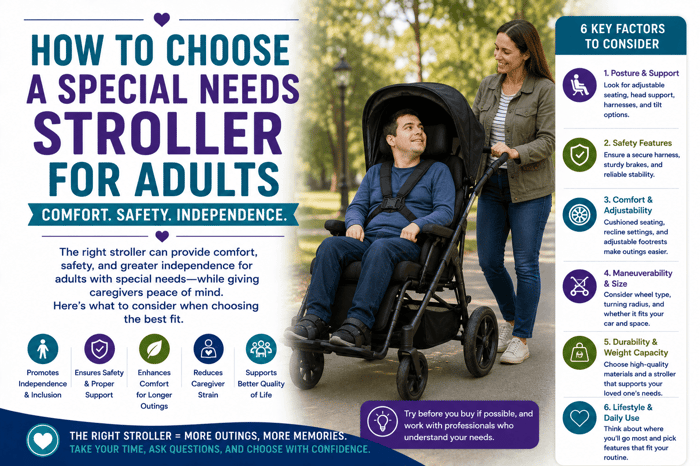
A special needs stroller for adults can provide supportive, caregiver assisted mobility for adults who need more comfort, positioning, safety, and structure than a standard stroller, transport chair, or basic wheelchair can offer. These strollers are designed for adult users who may need help with long distance walking, posture, fatigue, community outings, sensory regulation, or safe transportation throughout the day.
For many families and caregivers, choosing the right adult stroller for special needs can feel overwhelming. There are important differences in seat size, weight capacity, frame strength, recline, head support, harness systems, wheel type, folding style, and caregiver handling. The best stroller for special needs adults is not always the biggest or most expensive option. It is the one that fits the adult user’s body, support needs, daily routine, and environment.
Some adults need a stroller for community outings, appointments, shopping, school programs, adult day programs, therapy visits, travel, or long outdoor events. Others may need an adult stroller because they have outgrown pediatric equipment or because a standard wheelchair does not provide the right combination of portability, positioning, and caregiver control.
Explore Special Needs Strollers, Strollers and Wheelchairs, Mobility Products, Wheelchairs, and Positioning Products at eSpecial Needs.
Understanding Special Needs Strollers for Adults
Special needs strollers for adults are mobility devices built for adult users who need supportive seating and caregiver assisted movement. They may look similar to larger strollers, but they are designed with stronger frames, adult sized seating, larger weight capacities, and supportive features that help meet disability related mobility and positioning needs.
An adult stroller may be used when a person:
Cannot walk safely for long distances
Fatigues quickly during outings
Needs caregiver control in busy environments
Requires trunk, head, or lower body support
Has sensory needs during community activities
Needs a safer place to rest during long days
Has outgrown pediatric special needs equipment
Needs a folding mobility option for transportation
Does not self propel a wheelchair
Needs more support than a standard transport chair
A special needs stroller for adults should be selected around the person’s actual needs, not just their diagnosis or age.
What Is a Special Needs Stroller for Adults?
A special needs stroller for adults is a caregiver pushed adaptive stroller designed for adults with mobility limitations, postural needs, sensory needs, developmental disabilities, or medical conditions that affect safe community access.
Unlike a standard stroller, an adult stroller is made for larger users and may include:
Higher weight capacity
Wider seat
Deeper seat
Taller backrest
Stronger frame
Adult sized harness
Adjustable footrests
Recline options
Head support options
Trunk support options
Outdoor friendly wheels
Caregiver focused brakes
Folding frame for transport
Unlike a manual wheelchair, many adult stroller models are primarily caregiver pushed and may not be designed for self propulsion. A wheelchair stroller for adults may be a helpful option when the user needs wheelchair like support but the caregiver wants a stroller style frame for outdoor use, folding, or long outings.
Who Benefits From an Adult Adaptive Stroller?
An adult stroller for special needs may help individuals who need caregiver supported transportation and seating during daily routines or community activities.
Potential users include adults with:
Cerebral palsy
Autism spectrum disorder
Muscular dystrophy
Low muscle tone
Down syndrome
Intellectual disabilities
Developmental disabilities
Acquired brain injury
Stroke related mobility changes
Multiple sclerosis
Spinal cord injury
Neurological conditions
Severe fatigue
Balance concerns
Limited walking endurance
Complex medical needs
Postural instability
Sensory processing needs
Some users walk short distances but need a stroller for long community outings. Others rely on stroller support for most trips outside the home.
Adult vs. Pediatric Special Needs Strollers: Key Differences
A stroller for special needs big kid users may work well during childhood and teen years, but adult users often need different sizing and support. Once a person outgrows pediatric dimensions, an adult stroller for special needs may provide a safer and more comfortable fit.
Key differences include:
Adult models usually have higher weight capacities
Adult models usually have wider and deeper seats
Adult models often have taller backrests
Adult models may offer longer footrest ranges
Adult models may use stronger frames
Adult models may include adult sized harness systems
Adult models may have more durable wheels and brakes
Adult models may be built for larger body proportions
Adult models may feel more appropriate for adult users
A transition may be needed when the current stroller feels tight, unstable, too short, difficult to push, or no longer supportive.
Essential Features to Evaluate in a Special Needs Stroller for Adults
Choosing a special needs stroller for adults means looking closely at fit, function, support, safety, portability, and caregiver use. Specifications matter because adult users need equipment that can safely handle larger size, longer seating periods, and varied environments.
Weight Capacity and Frame Construction
Weight capacity is one of the first details to check. The stroller must safely support the adult user’s weight according to the manufacturer’s stated limit.
When reviewing weight capacity, consider:
Current user weight
Possible future weight changes
Clothing and outerwear
Positioning accessories
Bags or storage items
Frequency of use
Outdoor terrain
Caregiver pushing demands
Frame construction also matters. A durable frame may be more important for daily use, outdoor use, adult day programs, schools, clinics, travel, and longer outings. Lightweight frames may be easier to lift, but stronger frames may provide better stability for some users.
Seating Support, Postural Positioning, and Trunk Stability
Seating support affects comfort, posture, breathing comfort, head control, hand use, fatigue, and safety. A stroller for adults should fit the user’s body and provide the right level of support without being too tight or too loose.
Important seating details include:
Seat width
Seat depth
Back height
Seat angle
Recline range
Cushioning
Lateral trunk supports
Pelvic support
Foot support
Harness fit
Pressure support
Ability to use accessories
Trunk stability is especially important for adults who lean, slump, slide, fatigue quickly, or have limited postural control. For complex seating needs, work with an occupational therapist, physical therapist, seating clinic, or qualified product specialist.
Head and Neck Support Options
Some adults need head and neck support to maintain a safer, more comfortable position during outings. Head support may be useful for adults with low muscle tone, fatigue, poor head control, cerebral palsy, muscular dystrophy, neurological conditions, or complex postural needs.
Head and neck support options may include:
Adjustable headrests
Padded head supports
Lateral head supports
High back seating
Recline options
Positioning accessories
The head support should fit properly and should not force the head into an uncomfortable position. A therapist or seating specialist can help determine whether head support is needed.
Harness and Safety Restraint Systems
Harnesses and restraint systems can help support positioning and safety when used correctly. They may be important for adults with poor trunk control, involuntary movement, impulsive movement, elopement risk, limited self positioning, or sensory safety needs during outings.
Common options may include:
Pelvic belt
Five point harness
Chest harness
Shoulder straps
Positioning belt
Foot straps when appropriate
Calf strap
Ankle supports when needed
Harnesses should be used according to the manufacturer’s directions and any care team recommendations. They should never be used as punishment or unnecessary restriction.
Portability: Folding Mechanisms and Transport Weight
Portability can make the difference between using the stroller often and leaving it at home. A stroller may offer excellent support but still be difficult to manage if it is too heavy, too large when folded, or hard for the caregiver to lift.
Before choosing a stroller, review:
Product weight
Folded dimensions
Folding steps
Whether wheels detach
Whether accessories must be removed
Handle folding
Vehicle trunk space
Storage space at home
Public transportation needs
Travel requirements
Caregiver lifting ability
A lightweight adult stroller may be easier to transport, but it may not provide enough support for every user. A stronger frame may offer better stability but may be heavier. The right choice depends on daily use.
Wheel Type, Suspension, and Terrain Adaptability
Wheel configuration affects how the stroller handles on different surfaces. A stroller that works well indoors may not handle grass, gravel, cracked sidewalks, ramps, or parks as easily.
Consider:
Wheel size
Front wheel swivel
Locking front wheels
Rear wheel size
Tire type
Suspension
Turning radius
Brake system
Outdoor stability
Indoor maneuverability
Curb handling
Push effort
A special needs jogging stroller for adults or outdoor focused stroller may be helpful for families who spend time on sidewalks, trails, parks, sports fields, or community events. However, not every jogging style stroller offers the postural support every adult needs, so compare both terrain features and seating features.
Adjustability and Customization for Long Term Use
Adjustability can help the stroller remain useful as the adult’s needs change. This is especially important for people with progressive conditions, changing posture, weight changes, fatigue, or evolving support needs.
Adjustable features may include:
Seat width
Seat depth
Back angle
Recline
Footrest height
Leg support angle
Headrest placement
Harness position
Handle height
Lateral support placement
Accessory options
Customization can be valuable when the stroller must support posture, transportation, sensory needs, and caregiver handling across multiple settings.
Caregiver Ergonomics: Handle Height and Push Comfort
A stroller for special needs adults must work for the caregiver as well as the user. If the handle is too low, the brakes are hard to use, or the stroller is difficult to push, caregivers may experience strain.
Caregiver friendly features include:
Adjustable handle height
Comfortable handle grips
Smooth steering
Manageable push effort
Reliable parking brake
Hand brake when needed
Stable wheelbase
Easy folding
Manageable lifting weight
Accessible storage
Easy access to user supports
Good visibility while pushing
Caregivers should think about their own height, strength, vehicle, home storage, and daily route.
Choosing the Right Stroller Based on Daily Use Requirements
The best special needs stroller for adults depends heavily on how and where it will be used. A stroller for indoor appointments may need different features than a stroller for parks, shopping centers, travel, therapy clinics, or long outdoor days.
Home and Indoor Use
For home and indoor use, prioritize maneuverability and compact handling.
Helpful features include:
Smaller turning radius
Smooth indoor wheels
Lightweight frame when appropriate
Compact width
Easy brakes
Simple transfers
Comfortable seating
Easy cleaning
Ability to fit through doorways
Storage compatibility
Indoor use may matter for apartments, medical offices, schools, adult day programs, therapy clinics, and homes with narrow hallways.
Community Outings, Shopping, and Travel
For community outings and travel, portability and comfort become especially important. Families and caregivers may need to load the stroller into a car, unfold it quickly, move through crowds, navigate stores, manage supplies, and support the user for long periods.
Helpful features include:
Folding frame
Manageable transport weight
Strong brakes
Storage basket
Sun canopy
Recline
Comfortable padding
Easy steering
Good wheel performance
Accessories for weather or supplies
Compatibility with vehicle cargo space
For air travel, public transportation, or amusement parks, check rules and size requirements before the trip.
School, Therapy Clinics, and Rehabilitation Settings
Schools, therapy clinics, rehabilitation settings, adult day programs, and care facilities may need stroller features that support daily programming and staff use.
Helpful features include:
Durable frame
Easy cleaning
Adjustable supports
Positioning accessories
Safe transfers
Staff friendly brakes
Storage for supplies
Compatibility with therapy goals
Clear product specifications
Purchase order support
Quote documentation
Institutional buyers should consider multiple caregivers, storage rooms, hallways, transportation, and cleaning procedures.
Outdoor and Active Lifestyle Use
For outdoor activities, stroller durability and terrain handling become more important. Families who visit parks, sports fields, farms, festivals, trails, or outdoor events may need larger wheels and stronger suspension.
Outdoor features may include:
Larger rear wheels
Locking front wheel
Suspension
Durable tires
Strong frame
Sun canopy
Weather accessories
Reliable brakes
Stable handling
Comfortable recline
Storage for supplies
A special needs jogging stroller for adults may be appropriate for some active families, but make sure the model is designed for the user’s size, support needs, and intended activity.
Special Considerations by Diagnosis or Condition
Diagnosis can help guide the search, but the stroller should be selected based on the user’s body, posture, mobility, sensory needs, and daily routines. Two adults with the same diagnosis may need very different equipment.
Strollers for Adults With Cerebral Palsy
Adults with cerebral palsy may need an adult stroller that supports muscle tone, trunk control, head positioning, pelvic stability, lower body alignment, fatigue, and caregiver assisted mobility.
Helpful features may include:
Strong postural support
Recline
Lateral trunk supports
Headrest options
Pelvic support
Adjustable footrests
Supportive harness
Pressure conscious seating
Durable frame
Easy caregiver braking
Therapist recommended accessories
For complex tone, scoliosis, pressure concerns, or posture needs, involve a seating and positioning specialist.
Strollers for Adults With Autism Spectrum Disorder
Adults with autism spectrum disorder may benefit from a stroller during long outings, crowded spaces, sensory overload, fatigue, or transitions. A stroller can provide a consistent and familiar seated space when the environment feels overwhelming.
Helpful features may include:
Comfortable seating
Canopy for reduced visual input
Secure harness when appropriate
Smooth ride
Storage for sensory tools
Low noise operation
Easy caregiver control
Familiar accessories
Adult appropriate design
Recline for rest breaks
Respect, comfort, dignity, and personal preference should guide the decision whenever possible.
Strollers for Adults With Muscular Dystrophy or Low Muscle Tone
Adults with muscular dystrophy, low muscle tone, or progressive weakness may need more support for fatigue, posture, head control, breathing comfort, and rest.
Helpful features may include:
Recline
Supportive backrest
Head and neck support
Lateral supports
Adjustable footrests
Pressure support
Comfortable padding
Easy transfers
Stable frame
Low push effort for caregivers
Because needs may change over time, adjustability can be especially important.
Strollers for Adults With Intellectual or Developmental Disabilities
Adults with intellectual or developmental disabilities may need a stroller for safety, fatigue, supervision, sensory support, medical appointments, or community participation.
Helpful features may include:
Comfortable supportive seat
Simple safe harness system
Durable frame
Easy cleaning
Smooth ride
Caregiver friendly brakes
Storage for communication or sensory tools
Adult appropriate design
Recline when needed
Good visibility and access for caregivers
Communication needs should also be considered. Some users may need a place to mount or store AAC tools, picture supports, or personal comfort items.
Funding and Financing Your Adult Special Needs Stroller
An adult stroller for special needs can be a significant investment. Funding depends on the user’s diagnosis, mobility needs, documentation, insurance plan, Medicaid program, waiver rules, product type, and location.
Potential funding options may include:
Medicaid
Medicaid waivers
Private insurance
Durable medical equipment benefits
Disability grants
Nonprofit programs
State assistive technology programs
Vocational rehabilitation
Community fundraising
Health savings accounts
Flexible spending accounts
Direct purchase
Financing
Institutional purchase orders
Coverage is not guaranteed. Confirm requirements before ordering equipment.
Insurance and Medicaid Coverage for Adaptive Strollers
Some insurance plans or Medicaid programs may review adaptive strollers as durable medical equipment when they are medically necessary and documentation requirements are met. Coverage varies widely.
A funding request may require:
Prescription
Letter of medical necessity
Therapy evaluation
Mobility assessment
Diagnosis documentation
Product quote
Prior authorization
Supplier information
Explanation of why standard alternatives are not sufficient
Documentation of daily functional need
Ask the payer whether an adult stroller is covered, whether a wheelchair must be considered first, who must write the documentation, and whether a specific supplier is required.
Letters of Medical Necessity: What They Are and How to Get One
A letter of medical necessity is a provider written document explaining why the stroller is needed for mobility, positioning, safety, transportation, caregiver support, sensory needs, participation, or daily function.
A strong letter may include:
User diagnosis
Functional limitations
Mobility needs
Postural support needs
Safety concerns
Current equipment problems
Why a standard wheelchair or transport chair is not enough
Why the requested stroller is appropriate
Required accessories
Expected functional benefits
Caregiver support needs
Provider credentials
Product quote
Supporting evaluations
Families can review Letters of Medical Necessity for general template guidance. Requirements vary, and approval is never guaranteed.
Flexible Financing Options and Budget Planning
Some families use financing when equipment is needed quickly, when coverage is unavailable, or while waiting for funding decisions.
eSpecial Needs offers Affirm Financing for eligible purchases. Financing is not insurance coverage or financial assistance. Review eligibility, total cost, payment schedule, and any applicable interest or fees before choosing this option.
Budget planning tips include:
Compare stroller features carefully
Measure before purchase
Ask about accessories
Review shipping costs
Request a quote if needed
Confirm return policies
Check warranty details
Ask about price match eligibility
Keep funding documents organized
How to Get Expert Guidance and Request a Quote
Adult special needs strollers can be difficult to compare because size, support, folding, terrain performance, accessories, and funding requirements vary by model. A quote request can help families, caregivers, schools, clinics, and agencies compare options based on the adult user’s needs and budget.
Before requesting a quote, gather:
User height
User weight
Seat width needs
Seat depth needs
Back height needs
Diagnosis or functional needs when relevant
Postural support needs
Mobility level
Recline needs
Transport vehicle information
Primary use setting
Budget range
Funding source requirements
Accessories needed
Timeline
Request help through eSpecial Needs Quote Requests.
Working With Special Needs Professionals to Find the Right Fit
Occupational therapists, physical therapists, seating specialists, rehabilitation professionals, and product specialists can help match stroller features to the adult user’s needs.
They may help with:
Measurements
Seating support
Posture review
Transfer planning
Mobility goals
Terrain needs
Caregiver training
Funding documentation
Product comparison
Accessory recommendations
Determining whether a wheelchair is more appropriate
Professional input is especially important for complex positioning, pressure concerns, medical needs, or progressive conditions.
Price Match Guarantee and Purchase Order Support
eSpecial Needs offers a Price Match Guarantee, subject to current policy terms and product eligibility. Review the policy before purchasing to confirm requirements.
Schools, clinics, government agencies, adult day programs, hospitals, and care organizations may also need purchase order support. eSpecial Needs supports Purchase Orders, Schools and Government Agencies, and B2B Solutions.
Next Steps: Choosing the Best Walking Stroller for Adults
Choosing the best walking stroller for adults or adult stroller for special needs starts with the user’s needs and the caregiver’s daily routine. Measure carefully, compare support features, think about where the stroller will be used, and involve professionals when support needs are complex.
Before buying, review:
User height and weight
Seat width and depth
Back height
Weight capacity
Postural support
Head support
Foot support
Harness system
Recline
Wheel type
Brakes
Folded size
Transport weight
Caregiver comfort
Outdoor use needs
Funding documentation
Explore Special Needs Strollers, Strollers and Wheelchairs, Mobility Products, Wheelchairs, and Quote Requests at eSpecial Needs.
For families, caregivers, schools, clinics, and agencies, eSpecial Needs can help with product options, quotes, purchase orders, financing options, and adaptive mobility support.
FAQs
What is a special needs stroller for adults?
A special needs stroller for adults is a caregiver pushed adaptive stroller designed for adults who need support with mobility, positioning, comfort, safety, or community access. It may be used by adults who cannot walk long distances, fatigue quickly, need postural support, or require caregiver assisted transportation.
Adult special needs strollers typically offer larger seats, stronger frames, higher weight capacities, adjustable footrests, harness options, recline features, and outdoor friendly wheels.
Who should use a special needs stroller for adults?
A special needs stroller for adults may help individuals with limited walking endurance, poor trunk control, balance concerns, fatigue, sensory needs, elopement risk, developmental disabilities, neurological conditions, or mobility limitations.
Potential users may include adults with cerebral palsy, autism, muscular dystrophy, low muscle tone, Down syndrome, intellectual disabilities, acquired brain injuries, spinal cord injuries, multiple sclerosis, stroke related mobility changes, or complex medical needs.
How is an adult stroller for special needs different from a regular stroller?
A regular stroller is designed for babies or young children. An adult stroller for special needs is built for larger users and may include higher weight capacity, wider seating, deeper seat depth, taller back support, adult sized harnesses, stronger frame construction, and more durable wheels.
It is designed to support adult mobility and positioning needs, not typical child transport.
How is a special needs adult stroller different from a wheelchair?
A wheelchair may allow self propulsion or custom seated mobility depending on the model. A special needs stroller is usually caregiver pushed and often chosen for community outings, travel, fatigue support, sensory support, and stroller style transport.
A wheelchair may be better for someone who self propels or needs highly customized seating. A special needs stroller may be better for caregiver assisted outings, long days, parks, travel, or users who need folding stroller style mobility.
When should a big kid or teen move to an adult special needs stroller?
A transition may be needed when the user exceeds the stroller’s weight capacity, the seat becomes too narrow, the seat depth is too short, the backrest is too low, the footrests no longer fit, the harness is too small, or the stroller no longer supports posture safely.
Other signs include discomfort, increased leaning, sliding, difficulty with transfers, and the caregiver having more difficulty pushing or handling the stroller.
Can adults with cerebral palsy use special needs strollers?
Yes. Adults with cerebral palsy may use special needs strollers when they need support for posture, muscle tone, fatigue, mobility, trunk control, head support, or caregiver assisted community access.
Helpful features may include lateral supports, pelvic support, adjustable footrests, recline, headrests, supportive harnesses, pressure conscious seating, and durable frames.
What stroller features are helpful for adults with autism?
Adults with autism may benefit from a stroller when outings involve long walking distances, crowds, sensory overload, fatigue, transitions, or safety concerns.
Helpful features may include comfortable seating, smooth ride, secure harness when appropriate, canopy for reduced visual input, storage for sensory tools, low noise operation, recline for rest breaks, and an adult appropriate design.
What features should I look for in a special needs stroller for adults?
Important features include:
- Weight capacity
- Seat width
- Seat depth
- Back height
- Frame durability
- Recline options
- Head and neck support
- Trunk support
- Lateral supports
- Harness system
- Footrests
- Leg supports
- Wheel size
- Suspension
- Brakes
- Handle height
- Folding design
- Transport weight
- Storage
- Cleaning needs
- Warranty information
The best stroller should fit the adult user and be manageable for the caregiver.