Table of Contents
- Quick guide: 6 adaptive mobility equipment types for adults compared
- How we chose the adaptive mobility equipment for this comparison
- 6 adaptive mobility equipment types for adults compared by use case
- 1. Gait Trainers from Rifton and Meywalk: Best for supported walking practice
- 2. Manual Wheelchairs from Drive Medical and Circle Specialty: Daily mobility for adults
- 3. Reclining Wheelchairs from Drive Medical: Adjustable positioning during daily mobility
- 4. Posterior Walkers from Inspired by Drive and Circle Specialty: Upright walking with balance support
- 5. Rollators: Wheeled walking support with built-in seating
- 6. Standing Aids and Standers: Supported upright positioning for therapy and daily engagement
- Comparison table: Adaptive mobility equipment for adults by use case
- How do you choose between a gait trainer and a walker for an adult with a disability?
- What should school teams consider when evaluating adaptive mobility equipment for adult students?
- Why eSpecial Needs is the best source for adaptive mobility equipment for adults
- FAQs
Finding the right adaptive mobility equipment for an adult with a disability is a practical, high-stakes decision. The equipment needs to match the user's physical abilities, daily routine, and the environments they move through. eSpecial Needs carries walkers, gait trainers, wheelchairs, rollators, standers, and transfer aids from trusted manufacturers, giving you a single place to compare options by use case and find the right fitThis guide compares the main categories of adaptive mobility equipment available at eSpecial Needs, organized by use case and brand. If you support adults in a school, therapy clinic, group home, or family setting, you can use the breakdowns below to match equipment to real-world needs.
Quick guide: 6 adaptive mobility equipment types for adults compared
- Gait Trainers (Rifton, Meywalk): The best option for adults who need body-weight support during walking practice
- Manual Wheelchairs (Drive Medical, Circle Specialty): Reliable daily mobility for users who cannot walk independently
- Reclining Wheelchairs (Drive Medical): Adjustable positioning for users who need postural changes throughout the day
- Posterior Walkers (Inspired by Drive, Circle Specialty): Upright walking support for adults with moderate balance challenges
- Rollators (Drive Medical): Wheeled walking support with built-in seating for adults who need rest breaks
- Standing Aids and Standers: Supported upright positioning for weight-bearing therapy and daily engagement
How we chose the adaptive mobility equipment for this comparison
We selected these product categories and brands because they represent the core mobility solutions that school-based special education teams, therapists, and caregivers ask about most often. Each category addresses a distinct set of physical needs, and the brands featured are ones eSpecial Needs carries from manufacturers with established track records in adaptive equipment.
- Weight-bearing ability: Can the user support their own body weight while standing or walking? This determines whether a walker, gait trainer, or wheelchair is the right starting point for you.
- Postural support needs: Does the user require trunk, pelvic, or head support? Products range from minimal support walkers to full-body harness gait trainers depending on what the user needs.
- Environment and setting: Will the equipment be used indoors at school, outdoors in the community, or during therapy sessions? Some products work across all three settings.
- Caregiver ease: How much physical effort does the equipment require from the caregiver during transfers, transport, and daily use? This matters for staff in school and clinical settings.
- Growth and adaptability: Can the equipment adjust to accommodate changes in the user's size, weight, or physical condition over time?
- Durability for daily use: Is the equipment built to handle repeated use across multiple settings and users, which is common in schools and care facilities?
6 adaptive mobility equipment types for adults compared by use case
1. Gait Trainers from Rifton and Meywalk: Best for supported walking practice
Gait trainers are designed for adults who cannot walk independently but can benefit from guided stepping practice. Unlike standard walkers, gait trainers carry a portion of the user's body weight through trunk, pelvic, and harness supports. This makes it possible to practice walking even when balance, muscle tone, or weight bearing is limited.
eSpecial Needs carries gait trainers from two well-known manufacturers in this category. The Rifton Dynamic Pacer is available in medium and large sizes and includes both standard and dynamic frame options. The dynamic frame accommodates natural side-to-side and up-and-down body movements during stepping, which can help users develop a more natural gait pattern.
For adults with greater support needs, the Rifton E-Pacer offers an electric sit-to-stand lift that removes the need for manual caregiver lifting during transfers. It supports users up to 6'5" and 350 lbs, making it a practical option for larger adults in school or clinical environments. The Meywalk 2000 Large Gait Trainer provides spring suspension in the seat and trunk support to encourage a more natural walking pattern, with adjustable components for indoor and outdoor use.
Gait trainer features
- Body-weight support systems: Trunk harnesses, pelvic supports, and seat options allow users who cannot bear full weight to practice stepping safely.
- Dynamic frame technology (Rifton): The Rifton Pacer's dynamic frame moves with the user's body, supporting more natural gait development during therapy sessions.
- Electric sit-to-stand transfer (Rifton E-Pacer): A built-in electric lift helps larger or more dependent users transition from sitting to standing without manual lifting from caregivers.
- Spring suspension (Meywalk 2000): The Meywalk's spring-based support system encourages a smoother, more natural walking rhythm during indoor and outdoor practice.
- Adjustable sizing: Both Rifton and Meywalk gait trainers offer height, width, and support adjustments to accommodate a range of adult body sizes and changing needs.
Gait trainer pros and cons
Pros:
- eSpecial Needs offers gait trainers that provide the highest level of walking support available in adaptive mobility equipment, making walking practice possible for users who cannot use a standard walker.
- Rifton's E-Pacer can reduce caregiver strain during transfers with its electric lift, which is especially valuable in schools and therapy clinics with multiple users.
- Both Rifton and Meywalk products are built for long-term, repeated use across home, school, and clinical settings.
Cons:
- Gait trainers are larger than walkers and may require more storage space, which can be a consideration for smaller therapy rooms.
- Setup and adjustment may require guidance from a therapist or trained professional to achieve the correct positioning for each user.
- These products are designed for walking practice and therapy rather than all-day independent mobility, so they are typically used during scheduled sessions.
2. Manual Wheelchairs from Drive Medical and Circle Specialty: Daily mobility for adults
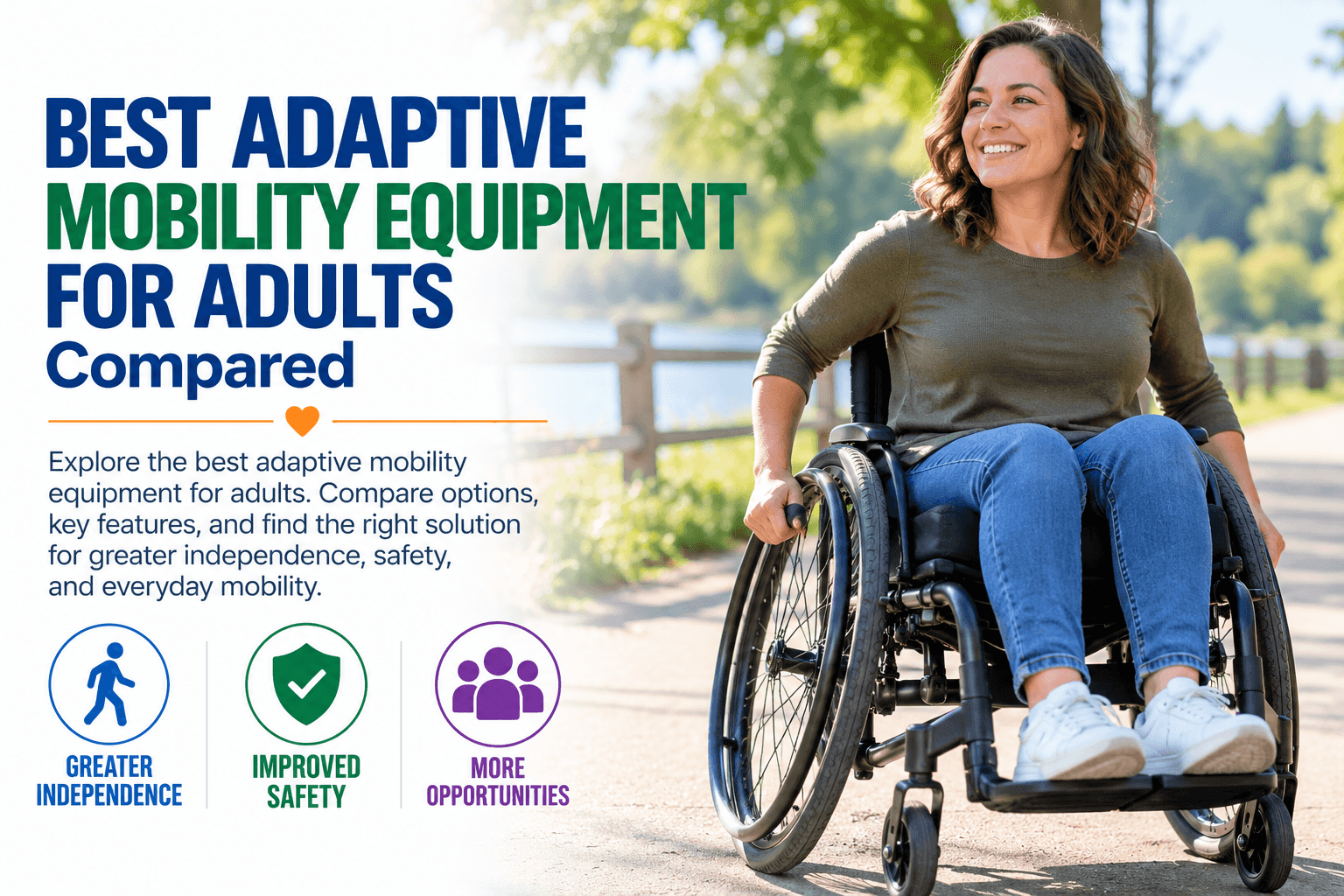
Manual wheelchairs are the most common adaptive mobility solution for adults who cannot walk independently and need reliable transportation throughout the day. eSpecial Needs carries manual wheelchairs from Drive Medical and Circle Specialty, two manufacturers that offer a range of frame styles, sizes, and support levels for adults with varying needs.
Drive Medical's Steel Transport Chair is a lightweight option designed for caregiver-assisted transport, with composite wheels and a foldable back for easy storage. For users who need self-propulsion, Drive Medical also offers standard manual wheelchairs with larger rear wheels and adjustable components.
Manual wheelchair features
- Lightweight frames: Steel and aluminum construction options help balance durability with easier transport and maneuverability for caregivers.
- Folding design: Most models fold for storage and vehicle transport, which is important for school buses, vans, and smaller spaces.
- Adjustable sizing: Multiple seat widths, height settings, and footrest options let you match the chair to the user's body dimensions for comfort and safety.
Manual wheelchair pros and cons
Pros:
- Drive Medical and Circle Specialty wheelchairs from eSpecial Needs come in multiple sizes and configurations, making it easier to find the right fit for individual users.
- Folding frames and lightweight construction make these chairs practical for environments where storage and transport are daily considerations.
- Standard manual wheelchairs require minimal maintenance and are built for consistent daily use.
Cons:
- Manual wheelchairs provide transportation but do not offer the postural support of specialty or reclining models, which may be important for some users.
- Self-propelled models require sufficient upper body strength from the user, which may not be appropriate for all adults with disabilities.
- Standard models may not include advanced positioning features, so additional accessories may be needed for users with complex postural needs.
3. Reclining Wheelchairs from Drive Medical: Adjustable positioning during daily mobility
Reclining wheelchairs are designed for adults who benefit from periodic position changes throughout the day. The Drive Medical Viper Plus Reclining Wheelchair available at eSpecial Needs features a hydraulic reclining mechanism, high-back support, and elevating leg rests. It is available in seat widths from 12" to 20", serving pediatric through adult users with a weight capacity up to 300 lbs.
For school settings and care facilities, the Viper Plus can help reduce discomfort from extended sitting. The dual-axle design allows the seat height to transition between standard and hemi height, which can be helpful for adults of different statures.
Reclining wheelchair features
- Hydraulic recline: Smooth, controlled position changes allow caregivers to adjust the user's angle for comfort and pressure relief without full transfers.
- Dual-axle adjustment: The ability to set the wheelchair at hemi or standard height gives you more flexibility for users of different sizes.
- Padded flip-back armrests: These help make transfers into and out of the chair easier for both the user and the caregiver.
Reclining wheelchair pros and cons
Pros:
- eSpecial Needs carries reclining wheelchairs that combine mobility with positioning support, reducing the need for multiple pieces of equipment during the day.
- The Viper Plus offers a wide range of seat widths and a high weight capacity, accommodating a broad range of adult users.
- The recline function can help with pressure relief and comfort during longer periods of use, which is common in school and care environments.
Cons:
- Reclining wheelchairs are heavier than standard manual chairs, which may affect portability and ease of loading into vehicles.
- The recline mechanism adds to the chair's overall footprint, requiring more space for storage and maneuvering in tight areas.
- Some users may need additional trunk support accessories beyond what the standard reclining frame provides.
4. Posterior Walkers from Inspired by Drive and Circle Specialty: Upright walking with balance support
Posterior walkers are designed for adults who can bear their own weight but need balance and stability support while walking. Unlike gait trainers, walkers do not carry the user's body weight. They provide a frame behind the user that encourages upright posture and forward movement.
The Nimbo Posterior Walker from Inspired by Drive is available at eSpecial Needs in multiple sizes, including models with fold-down seats for rest breaks. Its aluminum frame is lightweight yet durable, and the swiveling front wheels make it easy to maneuver in hallways, classrooms, and community environments. Circle Specialty also offers posterior walkers with directional-lock casters for users who need additional stability control.
Posterior walker features
- Rear-positioned frame: Walking behind the user promotes upright posture and a more natural gait pattern compared to front-wheeled walkers.
- Optional fold-down seat (Inspired by Drive): The Nimbo's integrated seat lets the user rest without needing a separate chair, which is useful during longer outings or therapy sessions.
- Anti-reverse brackets: Available on the Nimbo, this feature can be set to allow forward movement only or both forward and backward, depending on the user's needs.
Posterior walker pros and cons
Pros:
- Posterior walkers from eSpecial Needs encourage upright posture and independent walking, which can support both therapy goals and daily mobility.
- The Nimbo's lightweight aluminum frame and folding design make it easy to store and transport between school, home, and community settings.
- Multiple size options and adjustable heights help ensure a proper fit as the user's needs change over time.
Cons:
- Walkers are designed for users who can fully bear their own weight, so they are not appropriate for adults who need body-weight support during walking.
- Standard walkers do not include trunk or pelvic harnesses, which means they provide less support than gait trainers for users with significant balance challenges.
- Outdoor use on uneven terrain may require additional wheel accessories for stability, depending on the model selected.
5. Rollators: Wheeled walking support with built-in seating
Rollators at eSpecial Needs provide four-wheeled walking support with features that standard walkers typically do not include, such as hand brakes, padded seats, and storage baskets. These are designed for adults who can walk with some assistance but benefit from the option to sit and rest during longer outings or daily routines.
Rollators can be especially practical for adults with reduced endurance or balance concerns who need a mobility aid that supports both walking and resting. Many models include ergonomic hand grips, locking brakes, adjustable heights, and backrests that make extended use more comfortable.
Rollator features
- Built-in seating: Padded seats and backrests provide a resting option without needing a separate chair, which is helpful for adults with limited endurance.
- Hand brakes: User-controlled braking helps manage speed on slopes and provides added safety during transitions between walking and sitting.
- Storage options: Built-in baskets and pouches help users carry personal items, therapy materials, or supplies during daily routines.
Rollator pros and cons
Pros:
- Rollators from eSpecial Needs offer a combination of walking support, seating, and storage that can help adults maintain independence during daily routines and outings.
- Adjustable heights and ergonomic grips make it possible to customize the fit for individual users.
- Four-wheeled designs roll more smoothly than standard walkers, reducing the physical effort required during movement.
Cons:
- Rollators are the least stable type of walker and are not recommended for adults who need to fully off-load a lower limb during walking.
- Four-wheeled designs may roll on sloped surfaces if brakes are not engaged, so proper training on brake use is important.
- Rollators are typically wider than standard walkers, which may limit maneuverability in narrow doorways or hallways.
6. Standing Aids and Standers: Supported upright positioning for therapy and daily engagement
Standers and standing aids at eSpecial Needs are designed for adults who benefit from time in an upright position but cannot stand independently. These devices provide structured support for weight-bearing practice, improved positioning, and greater engagement with daily activities in home, school, and therapy environments.
The collection includes vertical standers, sit-to-stand standers, and dynamic mobile standers. For adults who need standing support with movement, dynamic standers allow the user to shift weight and explore their environment from an upright position rather than remaining static.
Standing aid features
- Weight-bearing support: Adjustable harnesses, knee pads, and foot positioning systems help users stand safely while receiving structured support.
- Dynamic movement options: Mobile standers allow users to move and explore while in a supported standing position, encouraging active engagement rather than passive standing.
- Adjustable components: Trays, lateral supports, and height settings can be customized for individual users and adjusted as needs change.
Standing aid pros and cons
Pros:
- eSpecial Needs carries standing aids that support weight-bearing therapy, which may help maintain bone density, improve circulation, and support posture.
- Dynamic and mobile stander options encourage active participation rather than static positioning, which can support engagement in classroom and therapy activities.
- Adjustable designs accommodate a range of adult sizes and support needs, with options for home, school, and clinical use.
Cons:
- Standing aids require more setup and adjustment than walkers or wheelchairs, and a therapist's input is recommended for initial positioning.
- These products are designed for supported standing sessions rather than mobility, so they complement other equipment rather than replacing it.
- Larger stander models may require dedicated space in a classroom or therapy area.
Comparison table: Adaptive mobility equipment for adults by use case
| Equipment Type | Weight-Bearing Support | Independent Movement | Multi-Environment Use |
|---|---|---|---|
| Gait Trainers (Rifton, Meywalk) | ✓ Partial to full | ✗ Caregiver-guided | ✓ Indoor and outdoor |
| Manual Wheelchairs (Drive Medical) | ✗ Seated transport | ✓ Self-propelled or assisted | ✓ Indoor and outdoor |
| Reclining Wheelchairs (Drive Medical) | ✗ Seated with recline | ✓ Self-propelled or assisted | ✓ Indoor and outdoor |
| Posterior Walkers (Inspired by Drive) | ✗ User bears full weight | ✓ Independent walking | ✓ Indoor and outdoor |
| Rollators | ✗ User bears full weight | ✓ Independent walking | ✓ Indoor and outdoor |
| Standing Aids and Standers | ✓ Structured support | ✗ Stationary or limited | ✓ Indoor settings |
How do you choose between a gait trainer and a walker for an adult with a disability?
The choice depends on how much of their own body weight the adult can support during walking. A walker is appropriate when the user can fully bear weight through their legs and primarily needs help with balance. A gait trainer is designed for users who cannot consistently support their own weight and need trunk, pelvic, or harness support to step safely.
Gait trainers like the Rifton Dynamic Pacer and Meywalk 2000 provide structured body-weight support during walking practice. Walkers like the Nimbo Posterior Walker from Inspired by Drive offer balance and stability support while encouraging upright posture. If the user is between these levels, a therapist's evaluation can help determine which type of support matches their current abilities and goals.
In school settings, this distinction is especially important. An adult student using a gait trainer during physical therapy sessions may also use a wheelchair for hallway navigation during the rest of the day. Matching equipment to specific activities is a practical way to support both therapy and daily participation. According to the World Health Organization, more than 2.5 billion people globally need one or more assistive products, and proper device selection plays a key role in supporting independence.
What should school teams consider when evaluating adaptive mobility equipment for adult students?
School-based special education teams need to evaluate adaptive equipment with both the student's functional goals and the school environment in mind. Hallway widths, classroom doorways, bus loading areas, and storage space all affect which equipment works in practice.
Consider the daily schedule. If a student transitions between classrooms, therapy rooms, and common areas, the equipment needs to be maneuverable, transportable, and quick to set up. A lightweight folding wheelchair may work for transitions, while a gait trainer stays in the therapy room for scheduled walking sessions.
Durability matters when equipment is used by multiple students or across multiple school years. Brands like Rifton and Drive Medical build products for repeated institutional use, and eSpecial Needs supports both individual and professional buyers with quote requests and purchase order options.
Why eSpecial Needs is the best source for adaptive mobility equipment for adults
eSpecial Needs gives you access to adaptive mobility equipment from trusted manufacturers like Rifton, Drive Medical, Inspired by Drive, Circle Specialty, and Meywalk, all in one place. Rather than searching across multiple suppliers, you can compare gait trainers, wheelchairs, walkers, rollators, and standing aids side by side and match products to specific use cases.
For school-based teams, the ability to request quotes, place purchase orders, and access product guidance from a specialist can simplify the equipment selection process. eSpecial Needs carries specialty wheelchairs, gait trainers and walkers, and positioning accessories that address the specific needs of adult users with physical disabilities, developmental conditions, and complex mobility requirements.
When you need reliable equipment that supports real-world goals like safer transfers, better posture, and more confident movement, eSpecial Needs can help you find the right solution. Browse the full mobility collection to compare products, request a quote, or contact the team directly for purchasing support.
FAQs
What is the difference between a gait trainer and a wheelchair?
A gait trainer supports walking practice by carrying part of the user's body weight during stepping. A wheelchair provides seated mobility for users who cannot walk independently. eSpecial Needs carries both, and many adults use a combination depending on the activity and setting.
Can adults use the same gait trainers as children?
Some gait trainers are available in sizes that span pediatric through adult use, but proper sizing is essential. The Rifton Dynamic Pacer and Meywalk 2000, both available at eSpecial Needs, come in larger sizes specifically designed for adult users. A therapist can help determine the correct size and configuration.
What type of wheelchair does eSpecial Needs recommend for school settings?
For school environments, lightweight folding wheelchairs and transport chairs can be practical because they are easier for staff to maneuver, fold, and store. eSpecial Needs carries options from Drive Medical and Circle Specialty that include folding frames, adjustable sizing, and safety features suited for daily school use.
Are rollators safe for adults with significant balance challenges?
Rollators are designed for adults who can bear their own weight and need moderate balance support. For users with significant balance challenges, a posterior walker or gait trainer from eSpecial Needs may provide more appropriate stability. A physical therapist can assess which level of support matches the user's abilities.
How do you choose between a standing frame and a dynamic stander?
A standing frame holds the user in a fixed upright position, which is useful for weight-bearing therapy. A dynamic stander allows the user to shift weight and move while standing. eSpecial Needs carries both types, and the choice depends on whether the goal is structured standing practice or active engagement during standing.