Table of Contents
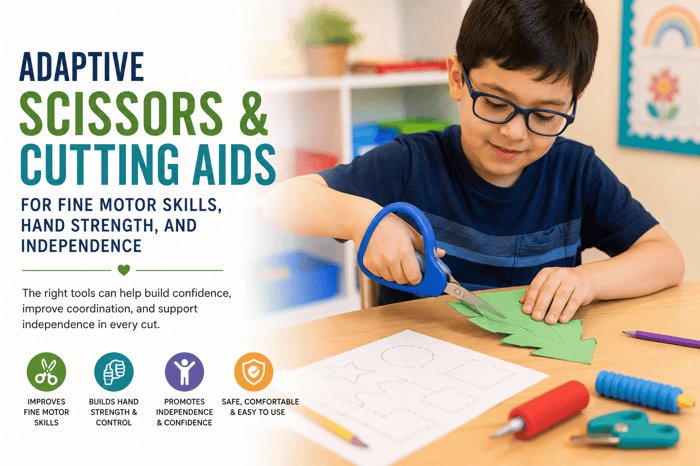
Adaptive scissors and cutting aids can help children and adults build confidence with cutting tasks at home, school, therapy, and daily living settings. For individuals with special needs, weak grip strength, limited dexterity, tremors, arthritis, low hand mobility, developmental delays, or fine motor challenges, standard scissors may be difficult to control. Adaptive scissors and cutting tools are designed to make cutting more accessible, comfortable, and successful.
At eSpecial Needs, the adaptive Scissors and Cutting Aids collection includes supportive tools for students, therapists, caregivers, teachers, and adults who need easier ways to cut paper, complete craft projects, practice school skills, or participate in everyday activities.
What Are Adaptive Scissors?
Adaptive scissors are scissors designed to reduce the effort, coordination, or grip strength needed for cutting. They may include spring assisted reopening, loop handles, tabletop designs, larger gripping surfaces, lightweight construction, or right handed and left handed options.
Adaptive scissors may support users who need help with:
Fine motor skills
Hand strength
Dexterity
Bilateral coordination
Hand eye coordination
Cutting practice
Classroom participation
Occupational therapy goals
Daily living tasks
Art and craft activities
Confidence with hand tools
These tools are often used in special education classrooms, occupational therapy sessions, early learning spaces, rehab settings, and home routines.
Why Cutting Skills Matter
Cutting is an important fine motor skill. It requires the hands, eyes, fingers, wrists, arms, and brain to work together. A child cutting paper must hold the scissors, open and close the blades, stabilize the paper with the other hand, follow a line, and control the direction of movement.
Cutting activities may support:
Finger strength
Hand control
Bilateral hand use
Visual motor coordination
Motor planning
Focus
Prewriting skills
Classroom readiness
Craft participation
Independence
For some users, traditional scissors are too difficult or tiring. Adaptive scissors can reduce frustration and make cutting practice more achievable.
Easi Grip Scissors
Peta Easi Grip Scissors are designed for users with weakened grip, arthritis, low hand mobility, or difficulty using conventional scissors. They feature a continuous loop handle that automatically reopens when pressure is released, reducing the effort needed for repeated cutting.
These scissors can be used with the thumb and fingers or with the palm, requiring only a gentle squeeze. They are lightweight, latex free, and available in right handed and left handed styles. Blue is for right handed users, and green is for left handed users.
Easi Grip Scissors may be helpful for:
Children learning scissor skills
Students with weak hands
Adults with arthritis
Users with limited hand mobility
Occupational therapy activities
Classroom cutting practice
Self Opening Scissors
Self Opening Scissors are designed for children who need extra help using scissors in a classroom or therapy setting. The self opening feature helps the scissors reopen after each cut, so the user can focus on squeezing and guiding the scissors instead of coordinating both opening and closing movements.
Self opening scissors may support:
Early scissor skill development
Fine motor delays
Hand fatigue
Coordination challenges
Classroom participation
Craft activities
Cutting practice with adult support
These scissors can be a helpful bridge for students who are not ready for standard scissors but still need practice with cutting activities.
Mini Easi Grip Scissors
Mini Easi Grip Scissors are self opening scissors that require less effort than regular scissors. They may be useful for users with weak hands or those who are unable to use conventional scissors comfortably.
Because the cutting action has minimal bias, these scissors can often be used in either the right or left hand. Their smaller size can make them helpful for young users, fine motor practice, and therapy activities where a lighter cutting tool is needed.
Mini Easi-Grip Scissors

$5.50
Develop early scissors skills with the ultra lightweight Mini Easi-Grip® Scissors. These self-opening scissors require only half the effort of regular scissors, so they are also suited for special needs due to weak hands or those who are unable to… read more
Tabletop Spring Scissors
Tabletop Spring Scissors are designed for users with weak grip, tremors, or poor hand control. Instead of requiring a traditional scissor grasp, the user presses down on a large T shaped handle. A hidden spring automatically reopens the scissors after each cut.
This type of cutting aid can be especially helpful when a user has difficulty holding scissors in the hand. The scissors can move along the paper, or the scissors can stay in place while the paper is moved toward the blade.
Tabletop scissors may support:
Users with limited grip
Users with tremors
One handed cutting support
Reduced hand strain
Classroom or therapy cutting activities
Adult daily living tasks
Craft and paper activities
Tabletop Spring Scissors

$15.05
Recommended for those with weak grip, tremors, or poor hand control, these Push Down Table Top Scissors are easy to use with just a pushing down action on the “T” shaped handle. The spring will automatically reopen the scissors once… read more
Scissors and Cutting Aids for Classrooms
In classrooms, cutting is used for art, worksheets, crafts, bulletin boards, projects, task boxes, and fine motor centers. Students who struggle with scissors may avoid these activities or need constant adult assistance.
Adaptive scissors can help students participate more independently in:
Art projects
Classroom crafts
Fine motor centers
Special education activities
Early childhood learning
Occupational therapy carryover
Seasonal projects
Cutting worksheets
Matching and sorting activities
For related classroom support, browse Education Products, Fine Motor Tools, Handwriting Tools, and Grips and Holders.
How to Choose the Right Cutting Aid
Choosing the right cutting aid depends on the user’s hand strength, coordination, dominant hand, activity goals, safety needs, and comfort level.
Before choosing adaptive scissors, consider:
Can the user open and close standard scissors?
Does the user need spring assisted reopening?
Does the user need right handed or left handed scissors?
Is grip strength limited?
Is hand fatigue a concern?
Does the user have tremors?
Would a tabletop cutting aid be safer or easier?
Is the user practicing early scissor skills?
Will the scissors be used at home, school, or therapy?
Does the user need rounded tips or added safety features?
When possible, an occupational therapist, teacher, or caregiver can help select the best tool and teach safe cutting habits.
Safety Tips for Adaptive Scissors
Adaptive scissors can make cutting easier, but they still require supervision and safe use. Children and users with limited motor control should be supported closely until they can use scissors safely.
Helpful safety tips include:
Use age appropriate scissors
Supervise cutting activities
Teach scissors stay pointed away from the body
Cut only approved materials
Store scissors safely after use
Use blade guards when included
Check scissors for damage
Use a stable seated position
Keep the work surface clear
Stop if the user becomes frustrated or unsafe
Safety, comfort, and success should guide every cutting activity.
Shop Scissors and Cutting Aids at eSpecial Needs
The Scissors and Cutting Aids collection at eSpecial Needs includes adaptive scissors and cutting tools for children, adults, therapists, teachers, caregivers, and care teams. These tools can support fine motor development, daily living participation, classroom activities, craft projects, and greater independence.
You can also explore related categories, including Fine Motor Tools, Handwriting Tools, Grips and Holders, Hand Strength and Manipulatives, Daily Living Aids, and Education Products.
FAQs
How do self opening scissors work?
Self opening scissors automatically reopen after the user squeezes them closed. This reduces the effort needed to open and close the scissors repeatedly and can make cutting easier for users who fatigue quickly or struggle with coordination.
Are adaptive scissors helpful for occupational therapy?
Yes. Occupational therapists often use adaptive scissors to support fine motor skills, hand strength, bilateral coordination, motor planning, visual motor skills, and cutting confidence. The right scissors can help make therapy activities more accessible.
What is the difference between adaptive scissors and regular scissors?
Regular scissors require coordinated finger placement, grip strength, opening, closing, and hand control. Adaptive scissors are designed to reduce one or more of those demands so users can participate more successfully in cutting activities.
What materials can adaptive scissors cut?
Most adaptive scissors are used for paper, craft paper, light card stock, or similar classroom and therapy materials. Always check the product details and only cut materials that are appropriate for the specific scissors.
Should children be supervised when using adaptive scissors?
Yes. Children should be supervised during cutting activities, especially when learning new skills or using scissors for the first time. Adaptive scissors can make cutting easier, but they still have blades and require safe handling.
Where can I buy scissors and cutting aids?
You can shop Scissors and Cutting Aids at eSpecial Needs. You can also browse related categories like Fine Motor Tools, Handwriting Tools, Grips and Holders, Hand Strength and Manipulatives, Daily Living Aids, and Education Products.