Table of Contents
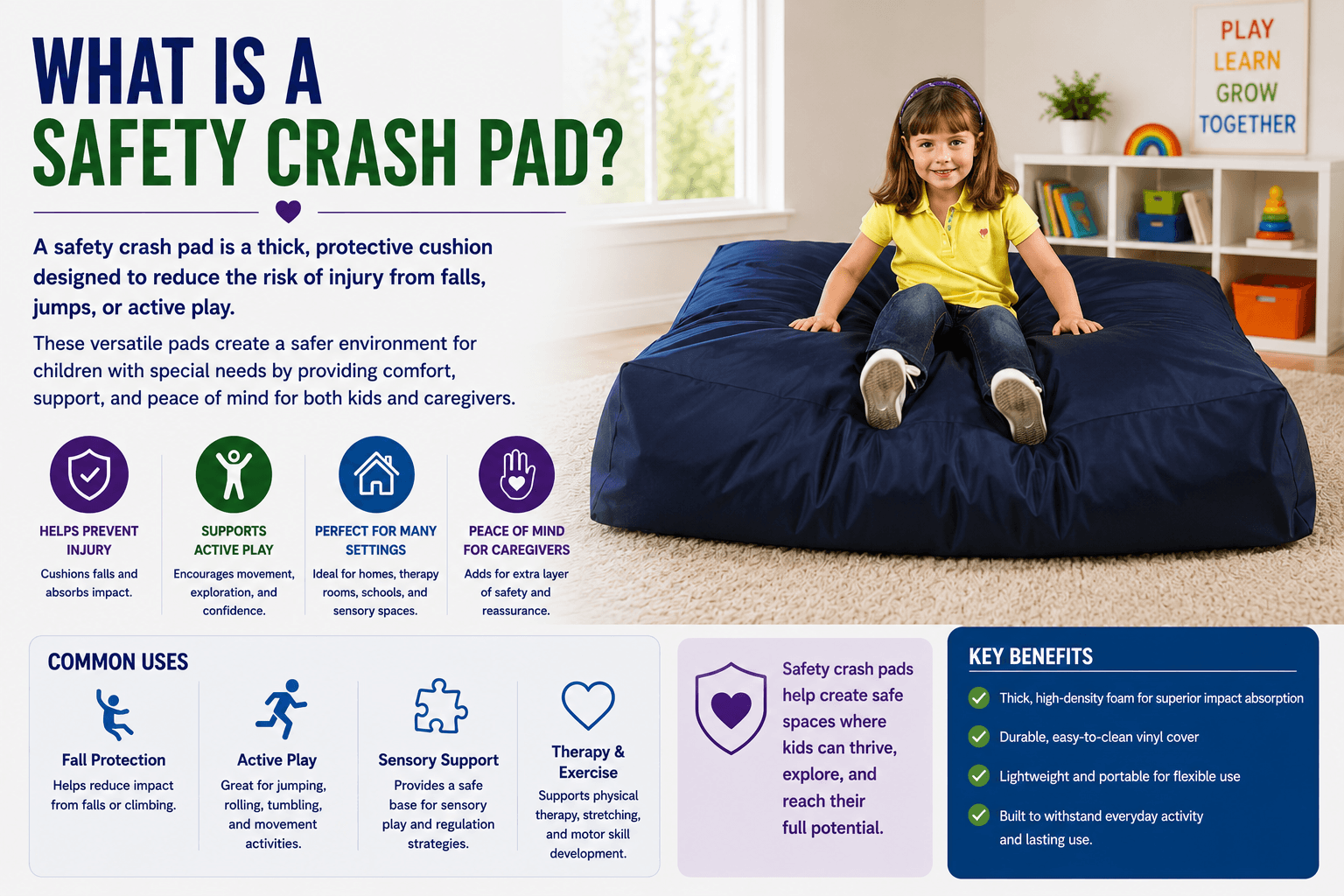
A safety crash pad is a soft, impact absorbing mat designed to give children a more supportive place to jump, land, roll, sit, rest, or “crash” during sensory motor play. Crash pads are often used in sensory rooms, therapy spaces, classrooms, calm corners, and home play areas for children who seek strong movement input or need a safe place for active floor based play.
The Skil Care Crash Pad is designed as a protective safety mat and sensory motor tool. It is packed with impact absorbing foam and covered in durable rip stop nylon. The foam filling helps cushion jumping and landing activities, while the soft surface is also comfortable enough for sitting or resting.
Why Children Use Safety Crash Pads
Some children naturally seek big movement. They may jump onto furniture, roll on the floor, fall into cushions, climb, bounce, or crash into soft surfaces because their bodies are looking for strong sensory input. A safety crash pad gives them a designated place for that type of movement.
Crash pads may be helpful for children who benefit from:
Jumping and landing activities
Proprioceptive input
Sensory motor play
Body awareness activities
Motor planning practice
Balance activities
Calming movement breaks
Heavy work routines
Floor based play
Resting after active play
Proprioceptive input comes from muscles and joints. Activities like jumping, pushing, climbing, crawling, rolling, and crashing into a soft surface may help some children feel more aware of where their body is in space. For many sensory seeking children, this type of input can be organizing and satisfying when used safely.
How Safety Crash Pads Support Sensory Motor Play
A crash pad can be used in many simple ways. Children may jump from a low surface with adult supervision, roll across the pad, fall back gently into it, crawl over it, use it at the end of an obstacle course, or rest on it after movement activities.
In therapy settings, crash pads are often used for motor planning and balance activities. Motor planning is the ability to figure out how to move the body to complete a task. For example, a child may need to plan how to climb over soft blocks, step onto a balance tool, jump onto the crash pad, and then crawl to the next activity.
A crash pad can make these movement based routines more engaging and comfortable.
Skil Care Crash Pad Features
The Skil Care Crash Pad is built for active sensory motor use. Its durable construction is designed to stand up to jumping, while the ample foam filling helps absorb impact. The pad can also be used as a comfortable spot for sitting, lounging, or resting.
Product features include:
Impact absorbing foam filling
Durable rip stop nylon cover
Comfortable surface for sitting or resting
Designed for motor planning and balance activities
Wipes clean
Can be disinfected with spray disinfectant
Extra outer covers available
Blue nylon cover option
Plush polyester cozy cloth cover option
Machine washable outer covers
The extra cover options can be helpful for schools, clinics, and homes that want an additional layer of protection or a softer sensory texture.
Where Can a Safety Crash Pad Be Used?
Safety crash pads can be used in many environments where children need active movement opportunities. They are especially useful in spaces where caregivers want to support safe sensory play while reducing the need for children to crash into furniture, floors, or unsafe surfaces.
Common places to use a crash pad include:
Home sensory rooms
Playrooms
Therapy clinics
Occupational therapy rooms
Special education classrooms
Sensory gyms
Calm down areas
Indoor therapy gyms
Gross motor spaces
School movement rooms
Crash pads also pair well with other Sensory Motor Tools, Crash Pads, Soft Play Products, Indoor Therapy Gyms, and Sensory Room Equipment.
Safety Tips for Using a Crash Pad
A safety crash pad should always be used with adult supervision, especially when children are jumping, climbing, or using it as part of an obstacle course. The pad should be placed on a flat surface with enough open space around it.
Helpful safety tips include:
Use the crash pad on a clear, flat floor
Keep hard furniture and sharp objects away from the landing area
Supervise jumping and crashing activities
Avoid unsafe heights
Check the pad and cover for damage before use
Follow product care instructions
Use only as intended
Stop activity if the child becomes tired, dizzy, upset, or unsafe
A crash pad can help make movement play more controlled, but it does not replace supervision or safe setup.
Who May Benefit From a Safety Crash Pad?
A safety crash pad may be useful for children with sensory processing needs, autism, ADHD, developmental delays, motor planning challenges, balance difficulties, or strong movement seeking behaviors. It can also be helpful for therapy activities, classroom movement breaks, and home sensory routines.
Not every child needs the same type of sensory input. Some children may love crashing and jumping, while others may prefer swings, weighted products, fidgets, tactile toys, or quiet seating. The best sensory tools should match the child’s needs, comfort level, age, size, and safety requirements.
Shop Safety Crash Pads at eSpecial Needs
The Skil Care Crash Pad is a practical sensory motor tool for children who need a soft place for jumping, landing, rolling, sitting, or resting. With impact absorbing foam, durable rip stop nylon, easy cleaning, and optional outer covers, it can be a useful addition to homes, schools, therapy rooms, and sensory spaces.
You can also explore related eSpecial Needs categories, including Crash Pads, Sensory Motor Tools, Soft Play Products, Movement Equipment, Toys, and Sensory Products.
Why Safety Crash Pads Are Important
A safety crash pad gives children a soft, supportive place to crash, jump, roll, move, and rest. For sensory seeking children, it can provide strong body input in a more appropriate space. For families, teachers, and therapists, it can help create a safer and more organized movement area.
Whether used at home, in a special education classroom, or in a therapy setting, a crash pad can be a valuable part of sensory motor play, movement breaks, and active learning routines.
FAQs
Is a crash pad the same as a regular floor mat?
No. A regular floor mat is usually thinner and may be designed for basic cushioning, exercise, or floor protection. A safety crash pad is thicker and filled with impact absorbing material to better support jumping, landing, rolling, and sensory motor play.
Can a crash pad help children who jump on furniture?
A crash pad may help provide a safer and more appropriate place for children who seek jumping, crashing, or heavy movement input. It should be paired with clear rules, adult supervision, and guidance on where jumping is allowed.
What age is a crash pad best for?
The best age depends on the specific product, the child’s size, activity level, and supervision needs. Always review the product details and use the crash pad only in ways that match the child’s abilities and safety needs.
Can a crash pad be used in an obstacle course?
Yes. Crash pads are often used at the end of indoor obstacle courses for jumping, crawling, rolling, or landing activities. Make sure the course is set up with enough space, safe surfaces, and adult supervision.