Table of Contents
- What Is the Rifton Activity Chair?
- Why Adaptive Seating Matters
- Who May Benefit from a Rifton Activity Chair?
- Rifton Activity Chair for Special Needs Seating
- Rifton Hi Lo Activity Chair
- Benefits of Hi Lo Seating
- Rifton Activity Chair With Tray
- Why Tray Position Matters
- Activity Chair Rifton Uses at Home
- Rifton Activity Chair for Schools
- Rifton Activity Chair for Therapy Clinics
- Rifton Activity Chair for Feeding
- Rifton Activity Chair and Communication Access
- Rifton Activity Chair and Fine Motor Skills
- Rifton Activity Chair Accessories
- Choosing Rifton Activity Chair Accessories
- Postural Support Features to Consider
- Foot Support and Stability
- Rifton Activity Chair for Cerebral Palsy
- Rifton Activity Chair for Autism
- Rifton Activity Chair for Low Muscle Tone
- Rifton Activity Chair for Feeding Therapy
- Rifton Activity Chair for Adults
- Rifton Activity Chair vs Standard School Chair
- Rifton Activity Chair vs Regular High Chair
- How to Choose the Right Rifton Activity Chair
- Measuring for an Activity Chair
- Working With an Occupational Therapist or Physical Therapist
- Rifton Activity Chair and IEP Support
- Cleaning and Maintenance
- Funding and Insurance for a Rifton Activity Chair
- Letter of Medical Necessity for a Rifton Activity Chair
- Buying a Rifton Activity Chair for Schools and Clinics
- Rifton Activity Chair Buying Checklist
- Where to Buy Rifton Activity Chairs and Accessories Online
- FAQs
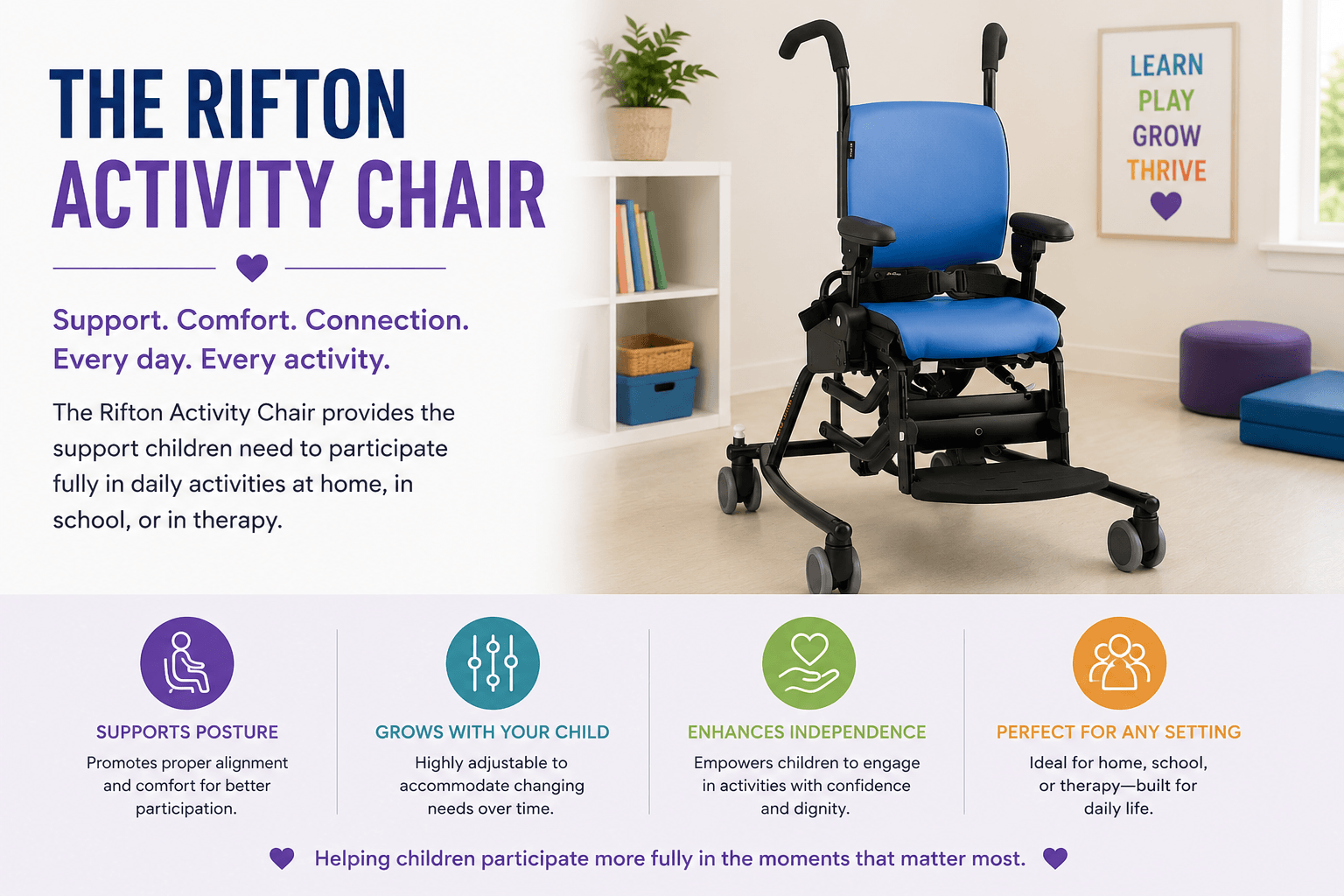
The Rifton Activity Chair is a supportive adaptive seating option designed to help children, teens, and some adults participate more comfortably in daily routines such as feeding, classroom work, therapy activities, communication, fine motor tasks, and social interaction. For individuals with special needs, cerebral palsy, developmental delays, low muscle tone, poor postural control, mobility challenges, or difficulty sitting safely in a standard chair, the Rifton Activity Chair can provide adjustable support for positioning, function, and participation.
Families, schools, therapists, and care teams often search for a Rifton Hi Lo Activity Chair, Rifton Activity Chair with tray, activity chair Rifton options, or Rifton Activity Chair accessories because they need seating that can adapt to the user, the task, and the environment. A standard school chair, dining chair, or therapy chair may not offer the right mix of postural support, adjustability, durability, and caregiver access. That is where adaptive seating can make a meaningful difference.
At eSpecial Needs, families and professionals can explore supportive seating and related products through Rifton Adaptive Equipment, Adaptive Furniture, Classroom Seating, Positioning Products, Adaptive Eating Utensils, and Assistive Technology.
What Is the Rifton Activity Chair?
The Rifton Activity Chair is an adaptive activity chair designed to support upright sitting and functional participation. It is commonly used in homes, schools, therapy clinics, hospitals, early intervention programs, special education classrooms, and care settings.
The chair may be used for:
Feeding
Classroom learning
Therapy sessions
Communication practice
Fine motor activities
Handwriting
Tabletop play
Sensory activities
Grooming routines
Social participation
Daily living skill practice
Assisted seating during care routines
The purpose of the Rifton Activity Chair is not simply to provide a place to sit. It helps position the user so they can engage more fully with meals, learning, therapy, and daily activities.
Why Adaptive Seating Matters
Good seating affects nearly every seated task. When a child or adult is not properly supported, they may slide, lean, slump, fatigue quickly, or use extra effort just to stay upright. This can make eating, writing, reaching, playing, communicating, or learning more difficult.
Adaptive seating may help support:
Posture
Trunk stability
Pelvic positioning
Head control
Foot placement
Hand use
Attention
Feeding access
Communication access
Comfort
Safety
Caregiver assistance
Classroom participation
Therapy goals
A well chosen activity chair can help the user spend less energy trying to stay seated and more energy participating in the task.
Who May Benefit from a Rifton Activity Chair?
The Rifton Activity Chair may be considered for children, teens, or adults who need more postural support than a standard chair can provide.
Common users may include individuals with:
Cerebral palsy
Developmental delays
Low muscle tone
Down syndrome
Autism
Spina bifida
Traumatic brain injury
Muscular dystrophy
Motor planning challenges
Poor trunk control
Poor sitting balance
Feeding challenges
Physical disabilities
Neurological conditions
Limited endurance
Need for supported classroom seating
A therapist can help determine whether a Rifton chair is the right fit based on posture, body size, mobility, daily routines, and functional goals.
Rifton Activity Chair for Special Needs Seating
Special needs seating must do more than fit under a table. It should support the user’s posture, safety, comfort, and ability to participate. The Rifton Activity Chair is often chosen because it can be configured for different body types, abilities, and environments.
It may help users who:
Slide forward in a standard chair
Lean to one side
Need foot support
Need trunk support
Need a tray for activities or feeding
Have difficulty sitting at school
Need adaptive seating for therapy
Need caregiver assistance during meals
Need better access to communication tools
Need support during fine motor activities
For broader seating needs, explore Adaptive Furniture, Classroom Seating, and Positioning Products.
Rifton Hi Lo Activity Chair
A Rifton Hi Lo Activity Chair is designed to adjust in height, allowing the user to be positioned lower to the floor or higher for table, caregiver, classroom, or therapy access. This can be especially helpful when one chair needs to support multiple activities across the day.
Hi Lo adjustability may help with:
Feeding at different table heights
Floor level play
Therapy activities
Caregiver access
Transfers
Classroom participation
Peer interaction
Desk or table work
Home routines
Clinic use
The Rifton Hi Lo Activity Chair can be especially useful in settings where the chair needs to move between meals, play, learning, and therapy activities.
Benefits of Hi Lo Seating
Hi Lo seating gives caregivers, therapists, and teachers more flexibility. Instead of moving the user to a different chair for every task, the chair height can be adjusted to fit the activity.
This may support:
Better caregiver body mechanics
Easier feeding assistance
Improved table access
More inclusive peer interaction
More flexible therapy positioning
Better access to classroom desks
Reduced need for multiple seating systems
Easier daily routine planning
For users who spend time in multiple environments, height adjustability can make the chair more practical and useful.
Rifton Activity Chair With Tray
A Rifton Activity Chair with tray can provide a stable surface for meals, therapy tasks, communication tools, sensory play, schoolwork, or fine motor activities. The tray may be especially useful when the user cannot easily sit at a standard table or when the activity requires a defined work surface.
A tray may support:
Feeding
Snacks
Handwriting
Fine motor play
AAC access
Choice making
Sorting activities
Therapy tasks
Grooming routines
Sensory activities
Classroom work
Home learning
A tray should be positioned correctly so it supports function without restricting breathing, posture, transfers, or comfort.
Why Tray Position Matters
Tray height and depth can affect posture and participation. If the tray is too high, the user may lift their shoulders or fatigue quickly. If it is too low, they may slump forward. If it is too far away, they may struggle to reach food, toys, writing tools, or communication devices.
A well positioned tray should allow:
Relaxed shoulders
Comfortable arm position
Clear access to materials
Stable posture
Safe feeding position
Easy caregiver access
Enough space for adaptive utensils or AAC tools
An occupational therapist or physical therapist can help adjust tray placement for the user’s goals.
Activity Chair Rifton Uses at Home
At home, an activity chair Rifton setup may help families build safer, more consistent routines. A child may use the chair at mealtime, during homework, for sensory play, or during therapy carryover. An older user may use it for daily care routines, tabletop activities, or communication practice.
Home uses may include:
Breakfast and dinner
Snack time
Feeding therapy
Homework
Art projects
Tablet or AAC access
Reading
Grooming tasks
Fine motor practice
Calm seated activities
Caregiver assisted routines
The goal is to create a seating solution that supports real family life, not just therapy exercises.
Rifton Activity Chair for Schools
Schools often use adaptive activity chairs to help students access learning and participate more comfortably in classroom routines. A Rifton chair may support students who need postural support during lessons, writing, communication, feeding, therapy, or group activities.
School uses may include:
Classroom desk work
Circle time
Feeding support
Snack time
Occupational therapy
Physical therapy
Speech therapy
AAC access
Art and music activities
Life skills instruction
Special education seating
Inclusive classroom participation
Schools can explore Classroom Seating, Education Products, and Rifton Adaptive Equipment.
Rifton Activity Chair for Therapy Clinics
Therapy clinics need seating that can support many kinds of goals. A Rifton Activity Chair may be used by occupational therapists, physical therapists, speech language pathologists, feeding therapists, and early intervention providers.
Therapy uses may include:
Postural support
Feeding practice
Reaching activities
Hand strengthening
Fine motor tasks
Visual motor work
Speech and communication practice
AAC access
Sensory play
Tabletop therapy
Strength and endurance activities
Caregiver training
Because therapy goals can change, adjustability is an important feature.
Rifton Activity Chair for Feeding
Feeding support is one of the most common reasons families and clinicians consider a Rifton Activity Chair. A supported seated position may help the user stay upright, access the tray or table, use adaptive utensils, and participate more comfortably in mealtime.
Feeding chair support may be helpful when the user:
Slides during meals
Leans forward or sideways
Needs foot support
Needs trunk support
Has poor endurance
Needs caregiver assisted feeding
Uses adaptive utensils
Needs a tray
Needs consistent mealtime positioning
Has difficulty sitting at a standard dining table
Families may also want to explore Adaptive Eating Utensils, Daily Living Aids, and Grips and Holders.
Rifton Activity Chair and Communication Access
Seating can make a major difference for communication. If a user is poorly positioned, they may have trouble reaching an AAC device, pointing to pictures, using a switch, making choices, or maintaining visual attention.
A Rifton Activity Chair may help support:
AAC device access
Switch access
Picture communication
Eye contact during interaction
Tabletop communication tools
Choice making
Speech therapy activities
Social participation
Mealtime communication
Helpful related categories include AAC and Communication, Assistive Technology, Single Message Communication Devices, Choice Making Tools, and Mounts.
Rifton Activity Chair and Fine Motor Skills
Fine motor work is easier when the body is supported. A student who is slumping or using both hands to brace their body may struggle to write, cut, grasp, sort, or manipulate small objects.
A supportive activity chair may help with:
Handwriting
Coloring
Cutting
Reaching
Grasp and release
Bilateral coordination
Hand strengthening
Sorting
Puzzle play
Peg activities
Tabletop therapy
Pairing adaptive seating with Fine Motor Tools, Handwriting Tools, and Scissors and Cutting Aids can help support classroom and therapy goals.
Rifton Activity Chair Accessories
Rifton Activity Chair accessories can help customize the chair to the user’s body, support needs, and daily activities. Accessories are often chosen based on therapist recommendations and functional goals.
Common accessory types may include:
Tray
Footboard or foot supports
Arm supports
Lateral supports
Head support
Pelvic supports
Seat belt or positioning belt
Chest support when appropriate
Abductor
Adductors
Sandals or foot positioners
Push handles
Mobility base options
Different seat or back components
The right accessories can make the chair more supportive and functional. The wrong accessories may be unnecessary or uncomfortable, so professional guidance is helpful.
Choosing Rifton Activity Chair Accessories
When choosing Rifton Activity Chair accessories, start with the user’s needs rather than ordering every available option.
Ask:
Does the user need help keeping their pelvis stable?
Does the user lean to one side?
Do feet need support?
Is the tray needed for feeding or activities?
Does the user need head support?
Does the user need arm support?
Does the user need help preventing sliding?
Will the chair be moved between rooms?
Will it be used at school and home?
Is caregiver access easy?
Is the accessory required for safe positioning?
A therapist can help match accessories to posture, safety, comfort, and participation goals.
Postural Support Features to Consider
Postural support is one of the main reasons to choose an adaptive activity chair.
Support features may address:
Pelvic position
Trunk alignment
Head control
Foot placement
Arm support
Seat depth
Seat height
Hip positioning
Leg positioning
Tilt or recline needs
Table access
Good positioning should support the user without feeling overly restrictive. The user should be able to participate as actively as possible.
Foot Support and Stability
Foot support is essential for seated stability. When feet dangle, the user may slide, slump, or struggle to use their hands. A properly positioned footboard or foot support can help create a stable base.
Foot support may help with:
Better posture
Reduced sliding
Improved hand use
Better attention
More comfortable meals
Safer seated positioning
Better table access
This is especially important during feeding, handwriting, fine motor tasks, and communication activities.
Rifton Activity Chair for Cerebral Palsy
Individuals with cerebral palsy may need adaptive seating because muscle tone, posture, movement control, and balance can affect sitting. The Rifton Activity Chair may help support alignment during meals, classroom activities, communication, and therapy.
Potential seating needs may include:
Pelvic stability
Trunk support
Foot support
Head support when needed
Lateral supports
Tray access
Tilt or recline options when appropriate
Support for tone management
Caregiver access
Adjustable positioning
A therapist should guide setup when tone, posture, swallowing, or safety concerns are present.
Rifton Activity Chair for Autism
Some autistic children benefit from supportive seating because it creates a predictable place for meals, schoolwork, therapy, or sensory activities. The seating goal should be comfort, participation, and regulation, not unnecessary restriction.
A Rifton Activity Chair may help some autistic users with:
Seated stability
Mealtime routines
Tabletop activities
Defined personal space
Communication access
Fine motor tasks
Predictable classroom seating
Support during therapy
Sensory preferences matter. Some users may need soft supports, movement breaks, or calming tools paired with seating. Explore Sensory Seating, Sensory Motor Tools, and Fidget Toys.
Rifton Activity Chair for Low Muscle Tone
Low muscle tone can make sitting upright difficult and tiring. A user may slide forward, lean on the table, round the back, or fatigue quickly. Adaptive seating can help create a more stable base for activity.
Helpful supports may include:
Foot support
Proper seat depth
Supportive back
Pelvic positioning
Lateral support
Tray at the right height
Arm support when needed
The goal is to help the user stay engaged without spending all their energy trying to remain upright.
Rifton Activity Chair for Feeding Therapy
Feeding therapy often requires stable, consistent positioning. If posture changes throughout the session, feeding work can become harder for both the therapist and the user.
A Rifton Activity Chair with tray may support feeding therapy by helping with:
Upright seated posture
Tray access
Caregiver or therapist positioning
Adaptive utensil use
Visual attention
Hands at midline
Stability during oral motor tasks
Reduced sliding
Better session consistency
A speech language pathologist, occupational therapist, or feeding therapist may help determine the best feeding position.
Rifton Activity Chair for Adults
Some adults may use adaptive activity chairs when standard seating does not provide enough support. This may include adults with developmental disabilities, cerebral palsy, traumatic brain injury, neurological conditions, or long term care needs.
Adult use may support:
Meals
Therapy
Communication
Daily living activities
Tabletop participation
Caregiver assisted routines
Group home seating
Day program activities
Rehab activities
Sizing, weight capacity, transfer needs, and dignity are especially important when choosing adaptive seating for adults.
Rifton Activity Chair vs Standard School Chair
A standard school chair may work well for many students, but it may not support children with poor posture, fatigue, low tone, or physical disabilities.
A standard school chair may lack:
Foot support
Seat depth adjustment
Pelvic support
Lateral trunk support
Tray option
Head support
Tilt or recline options
Growth adjustability
Support for transfers
A Rifton Activity Chair may be a better option when seating affects safety, learning, feeding, communication, or therapy participation.
Rifton Activity Chair vs Regular High Chair
A regular high chair is generally designed for infants and toddlers with typical development. It may not provide enough support for children who need adaptive positioning or who have outgrown infant seating.
A Rifton Activity Chair may offer:
More adjustability
Better postural support
Larger sizing options
Therapy friendly positioning
Tray options
Foot support
School and home use
Support for daily activities beyond meals
Families looking for a long term adaptive seating solution may need more than a standard high chair.
How to Choose the Right Rifton Activity Chair
Choosing the right Rifton Activity Chair starts with the user’s measurements, support needs, daily activities, and setting.
Consider:
Height
Weight
Hip width
Seat depth
Trunk control
Head control
Foot positioning
Transfer ability
Feeding needs
Tray use
Classroom needs
Therapy goals
Home space
Caregiver access
Accessory needs
Growth needs
Funding requirements
A therapist or seating professional can help make sure the chair and accessories match the user’s needs.
Measuring for an Activity Chair
Proper measurements help ensure safe and comfortable seating.
Important measurements may include:
Hip width
Seat depth
Lower leg length
Back height
Overall height
Weight
Table or desk height
Foot support needs
Room clearance
A chair that is too large may not provide enough support. A chair that is too small can create discomfort and limit function.
Working With an Occupational Therapist or Physical Therapist
An occupational therapist or physical therapist can help evaluate seating needs and recommend the right chair setup.
A therapist may assess:
Sitting posture
Muscle tone
Trunk control
Head control
Foot placement
Pelvic alignment
Hand use
Feeding position
Transfer safety
Classroom needs
Home routines
Accessory needs
Therapist input is especially important when the chair will be used for feeding, positioning, or school accommodations.
Rifton Activity Chair and IEP Support
Students may need adaptive seating included in an IEP when seating affects access to education, therapy, communication, feeding, or classroom participation.
An IEP may include:
Adaptive chair use
Tray use
Foot support
Seating for feeding
Seating for AAC access
Classroom positioning plan
Staff training
Therapy consultation
Seating schedule
Safety instructions
The school team should document when the chair is used and how it supports the student’s goals.
Cleaning and Maintenance
Adaptive seating used for meals, therapy, and school routines should be cleaned regularly.
General care tips include:
Wipe surfaces after meals
Clean tray after each use
Inspect straps and supports
Check moving parts
Lock wheels when needed
Follow manufacturer instructions
Avoid harsh cleaners unless approved
Check accessory placement
Review fit as the user grows
Report damaged parts promptly
Schools and clinics should establish a consistent cleaning routine for shared equipment.
Funding and Insurance for a Rifton Activity Chair
A Rifton Activity Chair may be considered for funding when it is medically or functionally necessary. Coverage depends on the user’s needs, insurance plan, Medicaid program, school district, waiver program, diagnosis, documentation, and product configuration.
Possible funding pathways include:
Medicaid
Private insurance
Medicaid waiver programs
School funding
Grants
Nonprofit support
Health savings accounts
Flexible spending accounts
Facility budgets
Purchase orders
Direct purchase
Funding requests often require documentation showing why standard seating is not enough.
Letter of Medical Necessity for a Rifton Activity Chair
A letter of medical necessity explains why the Rifton Activity Chair is needed for posture, feeding, therapy, safety, daily function, or school participation.
A strong letter may include:
Diagnosis
Functional limitations
Current seating problems
Postural needs
Feeding or activity needs
Requested chair model
Requested accessories
Why standard seating is not enough
Expected benefits
Home or school use
Therapist recommendation
Product quote
Provider signature
An occupational therapist, physical therapist, physician, speech language pathologist, or seating specialist may help support the request.
Buying a Rifton Activity Chair for Schools and Clinics
Schools, hospitals, therapy clinics, early intervention programs, and care facilities may purchase adaptive activity chairs for multiple users.
Facility buyers should consider:
Size range
Adjustability
Cleaning needs
Durability
Tray options
Accessory needs
Multiple student use
Staff training
Purchase orders
Quote support
Replacement accessories
Storage and transport
Adaptive seating should be selected based on user needs and daily routines rather than only by classroom furniture standards.
Rifton Activity Chair Buying Checklist
Before choosing a Rifton Activity Chair, review this checklist.
| What to Check | Why It Matters |
|---|---|
| User height and weight | Helps confirm chair size |
| Seat width and depth | Supports comfort and posture |
| Foot support needs | Improves stability |
| Tray needs | Supports feeding and activities |
| Trunk support | Helps users who lean or fatigue |
| Head support | Needed for some users |
| Accessories | Customizes the chair |
| Home or school use | Affects configuration |
| Transfer needs | Supports caregiver safety |
| Funding source | May require documentation |
Where to Buy Rifton Activity Chairs and Accessories Online
Families, caregivers, schools, therapists, and organizations can explore Rifton seating and related adaptive equipment through eSpecial Needs.
Helpful categories include:
These collections can help families and professionals compare seating, positioning, feeding, communication, and therapy support products.
FAQs
Who is the Rifton Activity Chair designed for?
The Rifton Activity Chair is designed for children and students with special needs who require extra support for sitting, posture, access, and participation. It may be used for children with cerebral palsy, developmental delays, low tone, high tone, poor trunk control, motor delays, neurological conditions, or other physical support needs.
How does the Rifton Activity Chair support functional sitting?
Functional sitting means the chair supports the child enough to participate while still encouraging active use of their own postural muscles. Instead of simply holding the body in one fixed position, the chair can help children build sitting skills, improve access to activities, and participate more comfortably in daily routines.
Can the Rifton Activity Chair be used in the classroom?
Yes. The Rifton Activity Chair is commonly used as an adaptive classroom chair. It can help students sit with support during group learning, table work, communication activities, feeding routines, therapy carryover, and other classroom tasks.
The chair’s adjustability makes it useful for special education classrooms, therapy rooms, inclusion classrooms, and home learning spaces.
Why is adjustability important in an adaptive activity chair?
Adjustability helps the chair match the child’s body, growth, activity needs, and daily routines. Seat depth, back height, armrest position, foot support, trunk support, and accessory placement can all affect comfort, posture, hand use, attention, and participation.
An adjustable chair may also help caregivers and therapists make changes as the child grows or as goals change.