Table of Contents
- Key Takeaways: Sensory vs Postural Support Seating for Children
- What Is Sensory Seating for Children?
- What Is Postural Support Seating for Children?
- How Do Sensory Needs Differ from Postural Needs?
- When Should You Choose Sensory Seating?
- When Should You Choose Postural Support Seating?
- How to Assess a Child's Seating Needs Step by Step
- Can You Combine Sensory and Postural Support Seating?
- What Role Does the Classroom Environment Play?
- How Do Therapists and Educators Collaborate on Seating Decisions?
- Common Mistakes to Avoid When Choosing Adaptive Seating
- What Products Are Available for Each Seating Category?
- How Sensory Seating Supports Focus in the Classroom
- How Postural Support Seating Impacts Daily Function
- Building a Sensory-Friendly Classroom with the Right Seating Mix
- How to Choose the Right Adaptive Seating for Your Students
- FAQs
Choosing the right chair for a child in a school or therapy setting goes far beyond picking something that fits. The seating a child uses can directly affect their posture, focus, sensory regulation, and ability to participate in learning. For special education coordinators, occupational therapists, and school-based therapy teams, understanding the difference between sensory seating and postural support seating is a foundational step in creating an environment where every student can thrive.
This guide breaks down both categories, explains when each type of seating is the right fit, and walks you through a decision-making process you can use with your team. eSpecial Needs offers adaptive seating options that span both sensory and postural support, so you can match each child's needs to the right product.
Key Takeaways: Sensory vs Postural Support Seating for Children
- Sensory seating promotes movement and sensory input to help children self-regulate and maintain focus during learning activities.
- Postural support seating stabilizes the trunk, pelvis, and head to maintain proper alignment for children with physical disabilities.
- A thorough assessment of each child's motor, sensory, and functional needs should guide every seating decision your team makes.
- eSpecial Needs carries both sensory and postural support seating designed for classroom and therapy environments.
- Many children benefit from a combination of both seating types used at different times throughout the school day.
What Is Sensory Seating for Children?
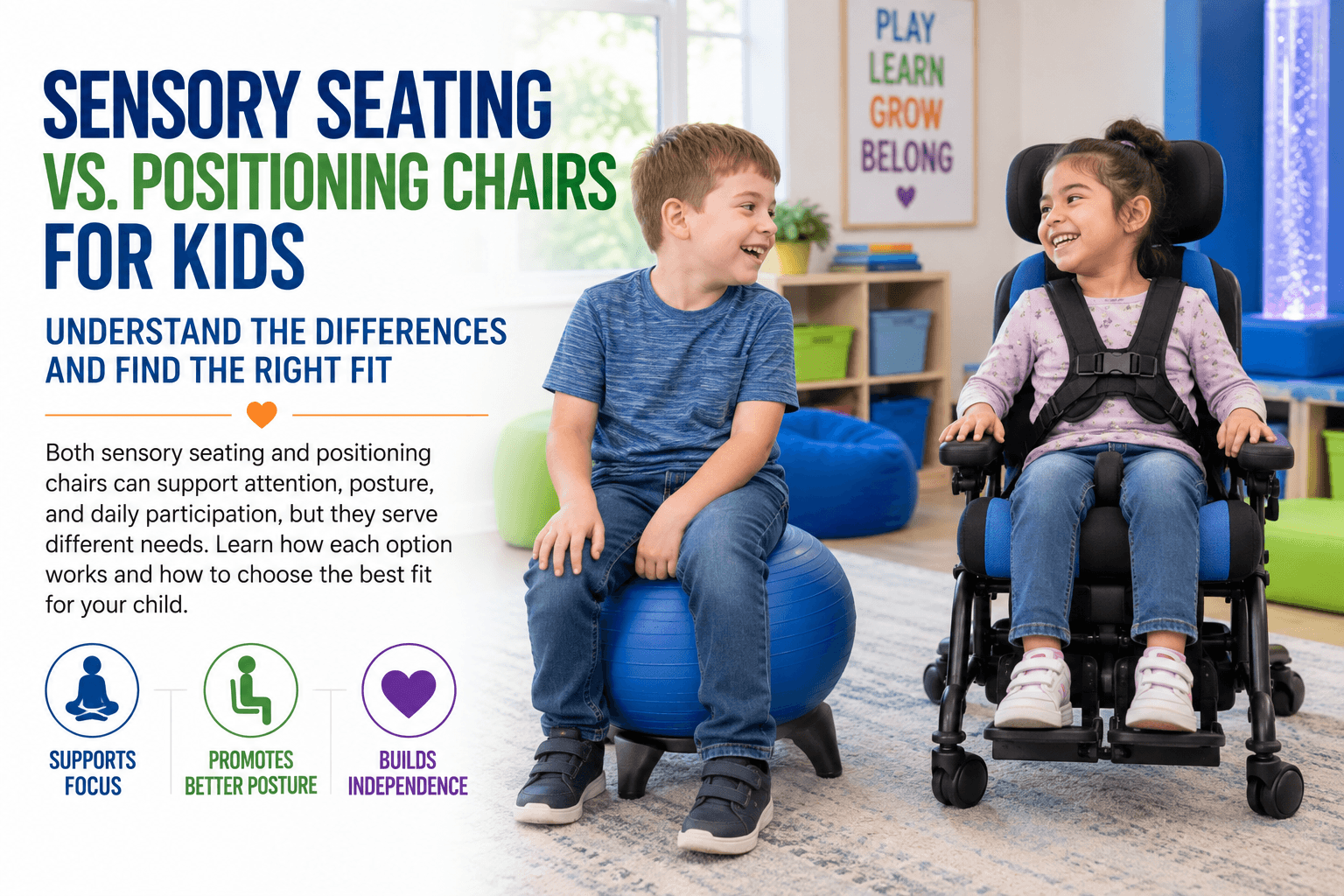
Sensory seating refers to chairs, cushions, and alternative seating surfaces that allow controlled movement while a child sits. These products are designed to give sensory input through rocking, bouncing, wobbling, or vibration. The goal is to meet a child's sensory-motor needs so they can stay focused and engaged.
Common examples include wobble stools, balance disc cushions, ball chairs, rocking chairs, and compression-style seats like the Sensory Pea Pod. These options are often recommended by occupational therapists for children with autism, ADHD, sensory processing differences, or general difficulty staying seated during classroom activities.
Sensory seating works because it channels a child's need for movement into a safe, contained motion. Instead of getting up, fidgeting, or losing attention, the child gets the proprioceptive and vestibular input their nervous system is looking for.
StayN'Place Ball
$61.95
The StayN'Place Ball is a seating solution that you don't have to chase down every time it rolls away, since the ball is filled with sand. The StayN'Place Ball is great for sitting at a table or engaging in ball-centric… read more

What Is Postural Support Seating for Children?
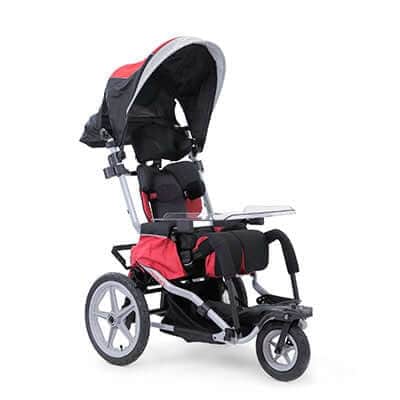
Postural support seating is designed to hold a child's body in an aligned, functional position. These seats include external supports for the trunk, pelvis, head, and sometimes the extremities. The goal is to give the child enough physical stability that they can focus their energy on learning, communicating, and interacting rather than on staying upright.
Products in this category include activity chairs with hip guides and lateral trunk supports, corner chairs, floor-level positioning systems, and molded seating systems. These seats are typically recommended after an evaluation by a therapist who assesses the child's trunk control and pelvic stability.
For children with cerebral palsy, muscular dystrophy, spinal cord conditions, or low muscle tone, postural support seating can be the single most impactful piece of adaptive equipment in their school day. It frees up cognitive and physical resources that would otherwise go toward simply maintaining an upright position.
How Do Sensory Needs Differ from Postural Needs?
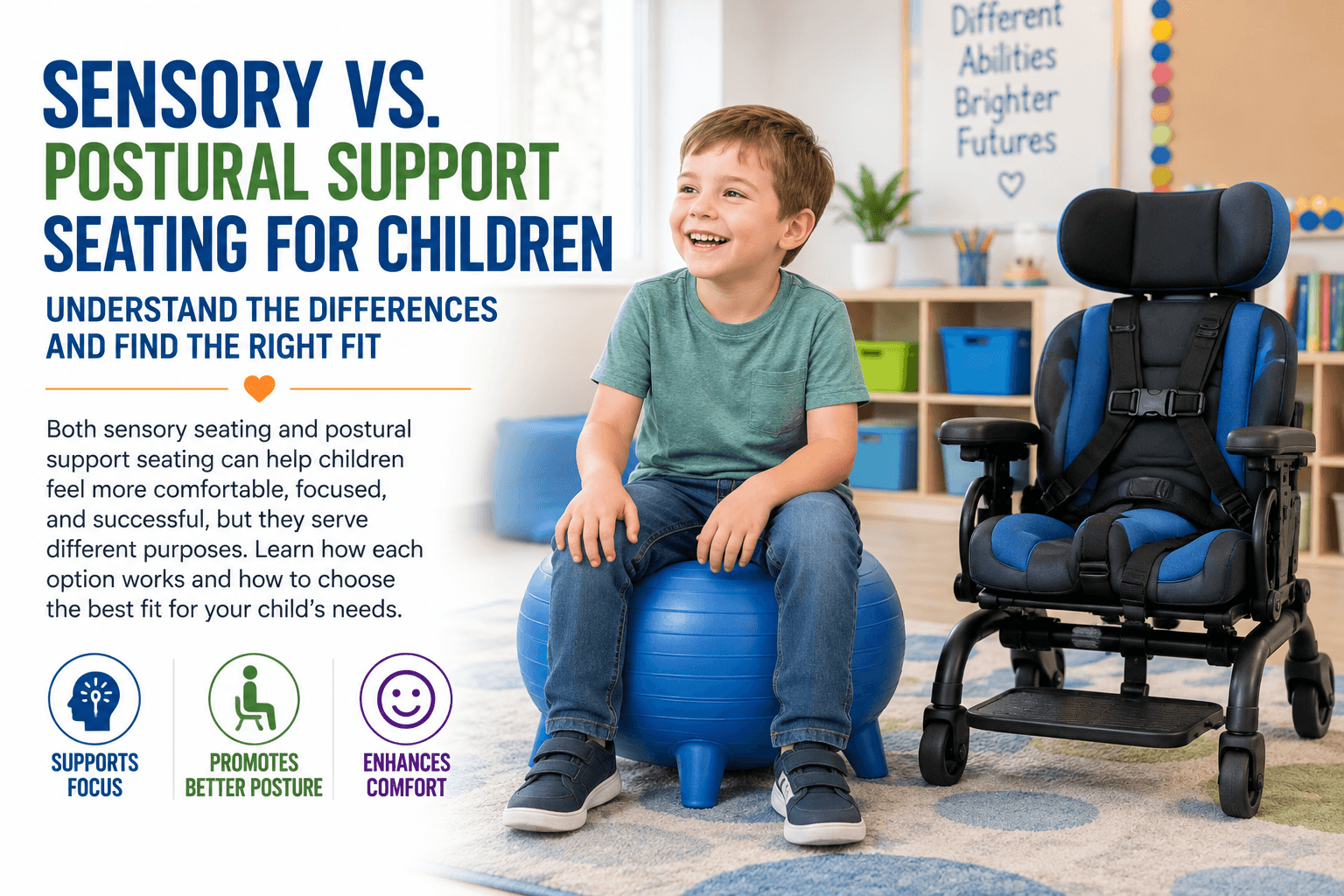
The core distinction is straightforward. Sensory seating addresses a child's need for movement and sensory input. Postural support seating addresses a child's need for physical stability and alignment. Both are forms of adaptive seating, but they solve very different problems.
A child who can sit upright independently but can't stay still long enough to focus on a task has a sensory need. A child who has difficulty holding their head or trunk upright without external support has a postural need. Some children have both, and that's where your clinical assessment becomes especially important.
Occupational therapists often use tools like the Segmental Assessment of Trunk Control (SATCo) and the Posture and Postural Ability Scale (PPAS) to determine where a child falls on this spectrum. These assessments help pinpoint whether a child needs more movement, more stability, or a combination of the two.
When Should You Choose Sensory Seating?
Sensory seating is a strong fit when a child shows patterns like excessive fidgeting, frequent position changes, wrapping legs around chair legs, or getting up from their seat repeatedly. These behaviors often signal that the child's nervous system is under-stimulated, and they're looking for input through movement.
You'll also see sensory seating work well for children with ADHD who need an outlet for restlessness, children on the autism spectrum who benefit from proprioceptive feedback, and children with mild motor differences who can sit independently but need extra engagement to stay on task.
In classroom settings, options like wobble chairs and balance disc cushions are popular because they integrate into a standard desk setup with minimal disruption. A wobble stool, for example, lets a child shift weight and bounce gently while still facing forward at their workspace.
When Should You Choose Postural Support Seating?
Postural support seating is the right choice when a child cannot maintain an upright sitting position independently, or when the effort to do so significantly reduces their ability to participate in learning. You'll observe signs like slumping over the desk, propping the head on one hand, leaning heavily to one side, or sliding out of a standard chair.
Children with moderate to significant motor involvement often need structured support at the pelvis, trunk, and sometimes the head and lower extremities. Products like the Rifton Compass Chair and the Special Tomato MPS Seating System offer growth-adjustable components that a therapist can configure to match each child's alignment needs.
Postural support seating also plays a role in preventing the development of asymmetries and contractures over time. For a child who spends six or more hours a day in school, correct alignment during seated activities has long-term orthopedic implications.
How to Assess a Child's Seating Needs Step by Step
Step 1: Observe the Child in Their Current Seating
Watch the child during typical classroom activities for at least 15 to 20 minutes. Note how often they shift position, whether they can keep their feet on the floor, and how much effort they appear to use just to stay seated. Look for compensatory movements like leaning on the desk or wrapping legs around chair legs.
Step 2: Evaluate Trunk Control and Pelvic Stability
A hands-on assessment by an occupational therapist or physical therapist should follow. The SATCo test is a reliable tool for determining the level of trunk support a child needs. It progressively removes support from the shoulders down to the pelvis to identify where independent control breaks down.
Step 3: Identify Sensory Preferences and Sensitivities
Use a sensory profile tool or structured observation to determine whether the child is a sensory seeker, a sensory avoider, or somewhere in between. Children who seek movement will benefit from active seating options. Children who are hypersensitive to movement may need a stable surface with gentle tactile input instead.
Step 4: Match the Seating to the Activity
Not every activity calls for the same seating solution. A child might use a wobble stool during independent work, a postural support chair during group instruction, and a beanbag or Sensory Pea Pod during sensory breaks. Mapping seating to daily routines helps you get the most out of each product.
Step 5: Re-evaluate on a Regular Schedule
Children grow. Their needs shift. A seating solution that works in September may need adjustment by January. Build quarterly check-ins into the IEP process so your team can reassess fit, alignment, and effectiveness.
Can You Combine Sensory and Postural Support Seating?
Yes, and in many cases you should. Some children need both stability and sensory input throughout the school day. A child with low muscle tone, for example, may need a postural positioning seat during desk work but could also benefit from a rocking chair or therapy swing during sensory break times.
The key is to avoid treating these as mutually exclusive categories. Think of them as two ends of a spectrum, with many children falling somewhere in the middle. eSpecial Needs offers products across both categories, making it easier to build a seating plan that covers multiple parts of a child's day.
Some products even bridge both worlds. Vibrating cushions, for instance, can be placed on a supportive chair to add sensory input without sacrificing postural alignment. Vibrating sensory cushions are a low-profile way to add tactile feedback in any seating setup.
What Role Does the Classroom Environment Play?
Seating does not exist in isolation. The desk height, the angle of the work surface, the distance to the teacher, and the noise level in the room all affect how well a child can engage. A perfectly fitted chair won't do its job if the desk is too high or the room is over-stimulating.
Consider pairing seating changes with environmental adjustments. A height-adjustable table ensures that the child's arms rest comfortably at the desk without shoulder elevation. Reducing visual clutter near the child's workspace can also amplify the benefits of sensory seating by cutting down on competing stimuli.
For children who use postural support chairs, positioning the chair so the child has a clear sightline to the teacher and peers supports both physical alignment and social engagement. The placement matters as much as the product.
How Do Therapists and Educators Collaborate on Seating Decisions?
The most effective seating decisions happen when occupational therapists, physical therapists, special education teachers, and parents work as a team. The therapist brings clinical assessment skills and knowledge of adaptive equipment. The teacher brings insight into daily classroom routines and behavioral patterns. The parent brings context from home.
Start by sharing observation notes across the team. If a teacher notices that a student slumps every afternoon, that's data the therapist needs to see. If the therapist recommends a wobble cushion, the teacher needs clear guidance on when and how to use it during the school day.
Documenting seating recommendations in the child's IEP or 504 plan ensures continuity. When a child changes classrooms or teachers, the seating plan travels with them. This reduces the chance that a child loses access to equipment that was working well.
Common Mistakes to Avoid When Choosing Adaptive Seating
One frequent error is assuming that one type of seating will work for every child with a particular diagnosis. Autism, ADHD, and cerebral palsy are broad categories. Two children with the same diagnosis can have very different seating needs depending on their individual motor and sensory profiles.
Another mistake is selecting a chair based on the product alone without factoring in the classroom context. A ball chair might be a great choice in a small, structured resource room but could become a distraction in a large general education classroom with 25 students.
Skipping the reassessment step is also common. Growth spurts, changes in medication, and shifts in classroom expectations can all change a child's seating needs over the course of a school year. Regular follow-up is part of the process, not an afterthought.
What Products Are Available for Each Seating Category?
Sensory Seating Options
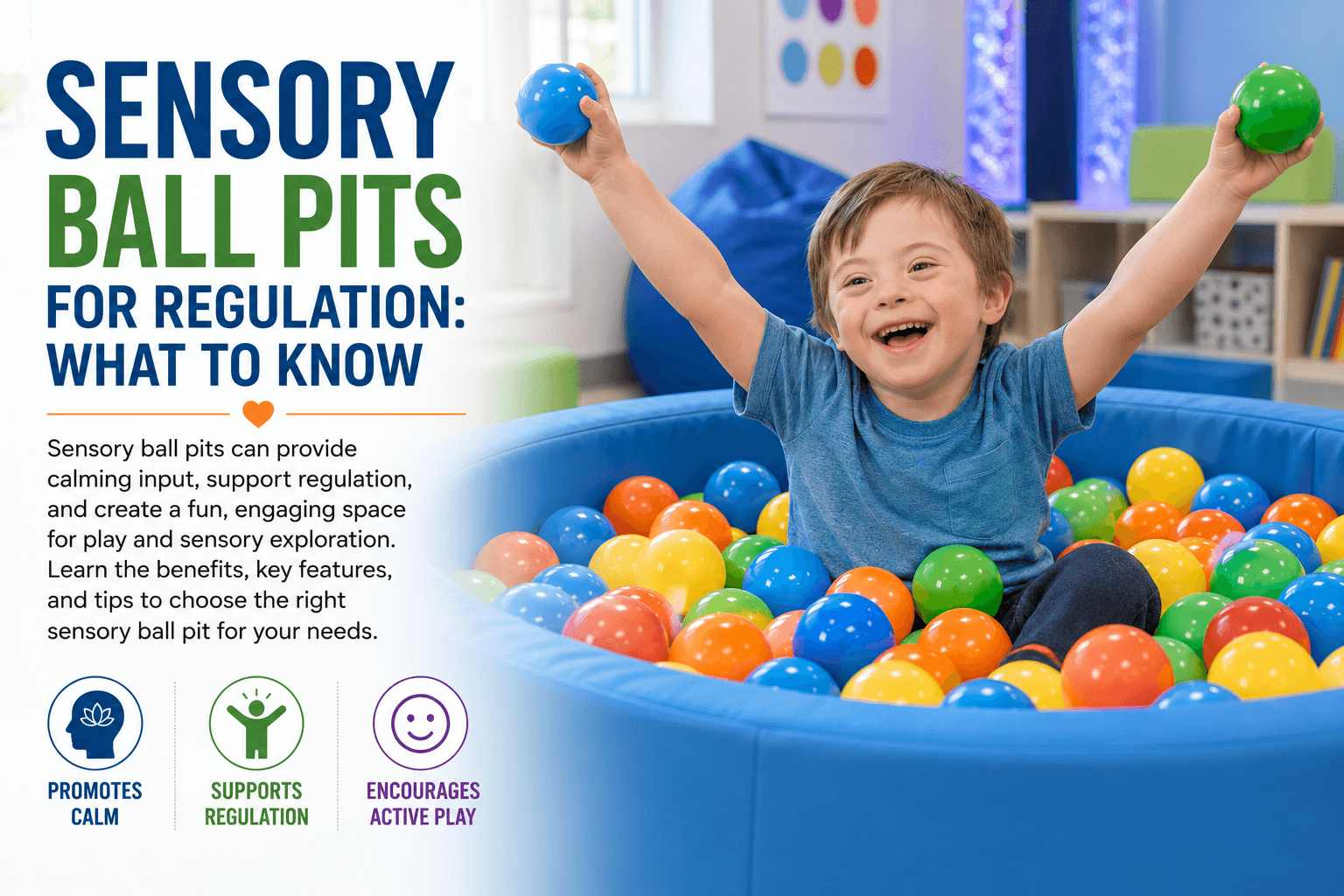
Wobble stools and active sitting chairs let children shift weight and bounce gently while seated. Balance disc cushions add movement to a standard classroom chair. Chill-out chairs and compression seating give deep-pressure input for children who feel calmer when enclosed. Vibrating pillows and cushions add tactile feedback without changing the seating surface itself.
Postural Support Seating Options
Activity chairs with hip guides, lateral supports, and adjustable footrests offer structured alignment. Corner chairs give trunk and head support for children with significant motor involvement. Floor-level positioning systems like the P-Pod allow comfortable, supported seating outside of a wheelchair. Tilting therapy benches help therapists work on trunk activation while still giving the child a stable base.
How Sensory Seating Supports Focus in the Classroom
Research supports the connection between active seating and improved attention. A study published in the journal Learning and Individual Differences found that children who used stability balls in the classroom showed improved attention span and reduced hyperactivity compared to those in standard chairs.
The mechanism is relatively simple. Movement activates the vestibular and proprioceptive systems, which play a direct role in arousal and attention regulation. For a child whose nervous system is under-responsive, a wobble stool or balance cushion delivers the input they need to reach an alert, ready-to-learn state.
This is not about letting children bounce freely. It's about giving them a controlled outlet. When sensory seating is introduced with clear expectations, most children learn to use it as a tool rather than a toy.
How Postural Support Seating Impacts Daily Function
For children who need physical support to sit upright, the right seating system can change almost everything about their school experience. Proper pelvic and trunk alignment frees up the upper extremities for reaching, grasping, and writing. It supports better head control for visual tracking and eye contact. It can even improve breathing and swallowing.
A systematic review in Developmental Medicine and Child Neurology confirmed that adaptive seating interventions for children with cerebral palsy can positively affect function across multiple domains, including activity performance and participation.
The right chair becomes the foundation that all other classroom activities are built on. Without it, a child may spend so much energy fighting gravity that they have little left for learning. With it, they can direct their attention where it matters most.
Building a Sensory-Friendly Classroom with the Right Seating Mix
The goal isn't to pick one type of seating and apply it across the board. A truly inclusive classroom offers a range of options that students and staff can draw from based on individual needs and daily activities.
Start with a baseline: standard chairs that fit the majority of your students. Then add a few wobble stools or balance cushions for children who benefit from active seating. For students with more significant needs, work with your therapy team to select postural support chairs that can be configured for each child.
eSpecial Needs makes this process easier by offering adaptive furniture designed specifically for school and therapy environments. From therapy swings for sensory integration sessions to activity chairs for classroom instruction, you can build a seating plan that covers the full range of student needs.
How to Choose the Right Adaptive Seating for Your Students
Sensory seating and postural support seating are not competing options. They're complementary tools that serve different purposes. When you understand what each type does and assess each child as an individual, you can build a seating plan that genuinely supports learning, participation, and comfort.
Start with a clinical assessment. Collaborate with your team. Match the seating to the child and the activity, not just the diagnosis. And remember to reassess regularly as children grow and their needs evolve.
Your students deserve seating that works as hard as they do. With the right approach, every child in your classroom or therapy space can have a seat that helps them do their best work.
FAQs
What is the main difference between sensory seating and postural support seating?
Sensory seating allows movement to help a child self-regulate and focus. Postural support seating holds a child's body in alignment so they can participate in activities. eSpecial Needs carries both types, giving your team flexible options for every student's needs.
Can a child use both sensory and postural support seating?
Absolutely. Many children benefit from postural support during desk work and sensory seating during breaks. eSpecial Needs offers products in both categories, so you can create a seating plan that shifts with a child's daily routine and activity demands.
How do I know which type of adaptive seating a child needs?
Start with a clinical assessment of the child's trunk control, pelvic stability, and sensory profile. Tools like the SATCo and PPAS help determine whether the child needs movement, stability, or both. An occupational therapist or physical therapist should lead this evaluation.
Are wobble stools safe for children with physical disabilities?
Wobble stools require a baseline level of trunk control and balance. For children with significant motor involvement, a stable postural support chair is a safer and more functional choice. eSpecial Needs carries adaptive seating for every level of physical ability.
How often should adaptive seating be reassessed?
Plan for quarterly check-ins at minimum, with additional reviews after growth spurts, medication changes, or shifts in classroom expectations. Documenting seating needs in the IEP ensures the plan stays current and travels with the child from year to year.