Table of Contents
- Why Puzzles Are Helpful Learning Tools
- Puzzles for Special Needs
- Peg Puzzles and Knob Puzzles
- Matching and Sorting Puzzles
- Jigsaw Puzzles
- Wooden Puzzles
- Sound Puzzles and Auditory Sensory Puzzles
- Patterns and Sequencing Activities
- Puzzle Storage and Organization
- Using Puzzles in Special Education Classrooms
- Shop Puzzles at eSpecial Needs
- FAQs
Puzzles can be much more than a simple play activity. For children and adults with autism, developmental delays, cognitive differences, sensory processing needs, or fine motor challenges, puzzles can support learning, focus, coordination, confidence, and everyday participation through hands on play.
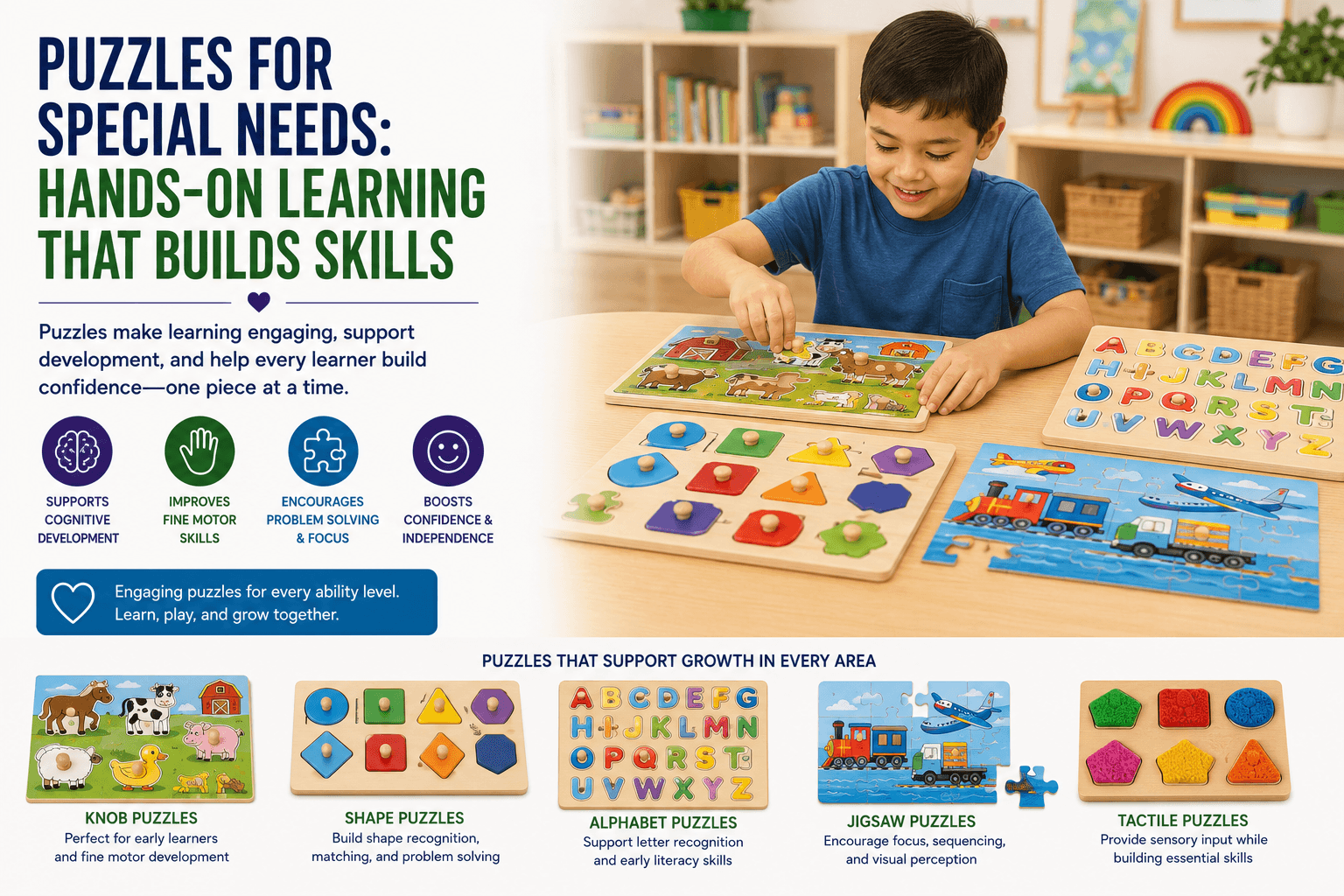
At eSpecial Needs, the Puzzles collection includes supportive learning tools for home, school, therapy, and care settings. From peg puzzles and knob puzzles to matching puzzles, jigsaw puzzles, sound puzzles, wooden puzzles, and sequencing activities, these products give users meaningful ways to practice thinking skills while staying engaged.
Why Puzzles Are Helpful Learning Tools
Puzzles encourage users to look closely, think through a problem, make a choice, try a piece, adjust, and try again. This process can support persistence, attention, visual motor skills, hand eye coordination, and problem solving.
For many children, puzzle play feels approachable because it has a clear goal. A piece either fits or it does not. A picture slowly comes together. A match becomes visible. A sequence starts to make sense. This kind of structured activity can be especially helpful for learners who benefit from visual cues, predictable steps, and hands on feedback.
Puzzles may support:
Problem solving
Fine motor skills
Hand eye coordination
Visual discrimination
Matching
Sorting
Sequencing
Memory
Attention
Persistence
Independent play
Turn taking
Communication
Confidence
Because puzzles can be used in so many ways, they are useful for classrooms, therapy rooms, sensory spaces, early learning programs, home routines, and quiet activity areas.
Puzzles for Special Needs
Puzzles for special needs should match the user’s abilities, interests, motor skills, vision, attention span, and frustration tolerance. A puzzle that is too easy may not hold attention, while a puzzle that is too difficult may lead to frustration.
The right puzzle gives the user a challenge they can work through with success.
For some learners, that may mean a simple knob puzzle with large pieces and clear shapes. For others, it may mean a matching and sorting activity, a sound puzzle, a pattern puzzle, or a more advanced jigsaw puzzle.
When choosing puzzles, consider:
Piece size
Number of pieces
Grip style
Visual contrast
Theme or interest
Sound or sensory features
Amount of support needed
Storage needs
Cleaning needs
Age and safety guidelines
Individual motor abilities
Peg Puzzles and Knob Puzzles
Peg puzzles and knob puzzles are often a good starting point for younger children or users who are working on grasp, reach, hand control, and simple matching. The raised peg or knob gives the user something easier to hold, which can help support fine motor participation.
Knob puzzles may help users practice:
Grasping
Releasing
Wrist control
Finger coordination
Matching shapes
Visual scanning
Hand placement
Cause and effect
Early problem solving
Explore Knob Puzzles for fine motor and early learning activities.
Matching and Sorting Puzzles
Matching and Sorting Puzzles can help users practice comparing items, recognizing similarities, sorting by category, and following simple rules. These activities can be useful for early learning, cognitive development, therapy sessions, and classroom centers.
Matching and sorting activities may include:
Color matching
Shape matching
Object matching
Category sorting
Size comparison
Pattern recognition
Memory practice
Visual discrimination
Language development
These puzzles are especially useful when adults want to build learning into play. A teacher, therapist, or caregiver can ask questions, name objects, describe colors, model choices, or encourage the user to request a piece.
Jigsaw Puzzles
Jigsaw Puzzles are classic problem solving tools that can be adapted for many ability levels. They support visual reasoning, patience, attention, and planning. Users must study shapes, colors, edges, pictures, and how pieces connect.
Jigsaw puzzles can support:
Spatial awareness
Visual closure
Planning
Memory
Finger coordination
Persistence
Attention to detail
Independent play
Shared play
For beginners, choose jigsaw puzzles with fewer pieces, larger pieces, clear images, and strong color contrast. For advanced users, gradually increase the number of pieces or complexity.
Wooden Puzzles
Wooden Puzzles are durable, hands on learning tools for home, school, and therapy settings. They are often easy to handle and can stand up well to repeated use in classrooms, clinics, and play spaces.
Wooden puzzles may be helpful for:
Early learning
Shape recognition
Object naming
Fine motor practice
Visual matching
Turn taking
Independent play
Therapy activities
They can also feel more stable for users who benefit from firmer materials and clearer piece placement.
Sound Puzzles and Auditory Sensory Puzzles
Some learners are more engaged when puzzle play includes sound. Sound Puzzles and Auditory Sensory Puzzles can add listening, attention, and cause and effect learning to puzzle activities.
Sound puzzles may support:
Auditory attention
Cause and effect
Listening skills
Object recognition
Motivation
Turn taking
Language development
Engagement during tabletop play
For children who are sensitive to sound, start slowly and choose activities that allow adults to control the amount of auditory input.
Patterns and Sequencing Activities
Patterns and Sequencing activities help users recognize order, predict what comes next, and understand relationships between items. These skills are important for early math, reading readiness, daily routines, and problem solving.
Sequencing activities may support:
First, next, last concepts
Pattern recognition
Memory
Planning
Visual attention
Cognitive flexibility
Direction following
Classroom readiness
These tools can be especially helpful for learners who benefit from structure and repeated practice.
Puzzle Storage and Organization
Puzzles are easier to use when they are easy to find and keep organized. Puzzle Storage can help classrooms, therapy rooms, and homes keep pieces together and reduce lost materials.
Good puzzle storage can help:
Keep learning areas organized
Protect puzzle pieces
Save classroom time
Make rotation easier
Support independent cleanup
Reduce clutter
Keep therapy tools accessible
For shared spaces, clear labels and simple storage routines can make puzzle activities easier for both students and staff.
Using Puzzles in Special Education Classrooms
Puzzles can be used in many special education classroom routines. They work well for morning work, centers, quiet time, choice time, small group lessons, occupational therapy carryover, language practice, and reward activities.
Classroom puzzle ideas include:
Matching colors during a small group lesson
Using knob puzzles for fine motor practice
Pairing sound puzzles with vocabulary work
Using jigsaw puzzles during quiet choice time
Sorting objects by category
Practicing turn taking with a partner puzzle
Using puzzle storage for independent cleanup
Adding puzzle activities to a calm down area
Puzzles can also be used with visual schedules, first then boards, timers, AAC devices, or simple verbal prompts.
Shop Puzzles at eSpecial Needs
The Puzzles collection at eSpecial Needs includes hands on learning tools designed for children and adults with different developmental, sensory, motor, and cognitive needs. Whether you are looking for peg puzzles, knob puzzles, matching puzzles, sorting puzzles, jigsaw puzzles, sound puzzles, wooden puzzles, or puzzle storage, this collection can help support meaningful play and learning.
You can also browse related categories, including Toys, Games, Education Products, Fine Motor Tools, Handwriting Tools, and Sensory Products.
FAQs
What type of puzzle should beginners start with?
Beginners often do best with puzzles that have fewer pieces, larger shapes, clear images, and easy to grasp handles or knobs. A knob puzzle, peg puzzle, or simple matching puzzle can help build confidence before moving to more complex jigsaw puzzles or sequencing activities.
How do puzzles support fine motor development?
Puzzles encourage children to pick up, hold, turn, place, press, and release pieces. These movements can support finger strength, hand control, hand eye coordination, and visual motor skills during play based learning.
Are puzzles helpful for children with autism?
Puzzles may be helpful for some children with autism because they offer structure, visual cues, predictable steps, and a clear goal. They can also support focus, matching, sequencing, problem solving, and independent play when matched to the child’s interests and abilities.
What makes a puzzle sensory friendly?
A sensory friendly puzzle should match the user’s comfort level with texture, sound, color, and visual detail. Some children may prefer simple wooden puzzles with clear shapes, while others may enjoy sound puzzles, bright colors, or textured pieces.
How can I reduce frustration during puzzle play?
Start with easier puzzles, offer fewer pieces at a time, model the first step, give short prompts, and celebrate small progress. If a child becomes frustrated, take a break or switch to a simpler puzzle before returning to a more challenging one.