Table of Contents
- What Are Mobility Aids?
- Why the Right Mobility Device Matters for Independence and Quality of Life
- Who Uses Mobility Aids?
- Complete List of Mobility Aid Examples by Category
- Mobility Aids for Walking: Canes, Crutches, and Forearm Supports
- Types of Mobility Aid Canes and When to Use Each
- Assisted Walking Devices for Adults: Walkers, Rollators, and Gait Trainers
- Mobility Aids for Standing Up: Sit to Stand Lifts and Transfer Boards
- Manual Wheelchairs: Lightweight, Transport, and Tilt in Space Models
- Power Wheelchairs: Best Mobility Devices for Seniors and Disabled Adults
- Mobility Scooters: Indoor vs. Outdoor Use
- Mobility Aids for Hands: Grip Aids, Adaptive Gloves, and Hand Supports
- Specialty Mobility Equipment: Standers, Prone Boards, and Adaptive Strollers
- Mobility Devices for Disabled Children: A Caregiver's Guide
- Pediatric Wheelchairs and Adaptive Seating for Kids
- Mobility Aids for Young Adults Transitioning From Pediatric Care
- Adaptive Strollers vs. Wheelchairs: Which Is Right for Your Child?
- What Is the Best Walking Aid for Elderly and Senior Users?
- Comparing Walkers, Rollators, and Canes for Older Adults
- Power Chairs vs. Scooters for Seniors: Pros and Cons
- What Mobility Aid Is Right for Me? A Step by Step Decision Guide
- Assessing Your Mobility Needs: Strength, Balance, and Environment
- Indoor vs. Outdoor Mobility Considerations
- How an Occupational or Physical Therapist Can Help You Choose
- Mobility Equipment Rental vs. Purchase: What to Consider
- When Renting a Mobility Device Makes Sense
- Long Term Ownership: Warranties, Maintenance, and Upgrades
- How to Fund Your Mobility Device: Insurance, Medicaid, and Grants
- Shop Mobility Devices for Disabled Individuals at eSpecial Needs
- FAQs
Mobility Devices for Disabled Individuals Explained
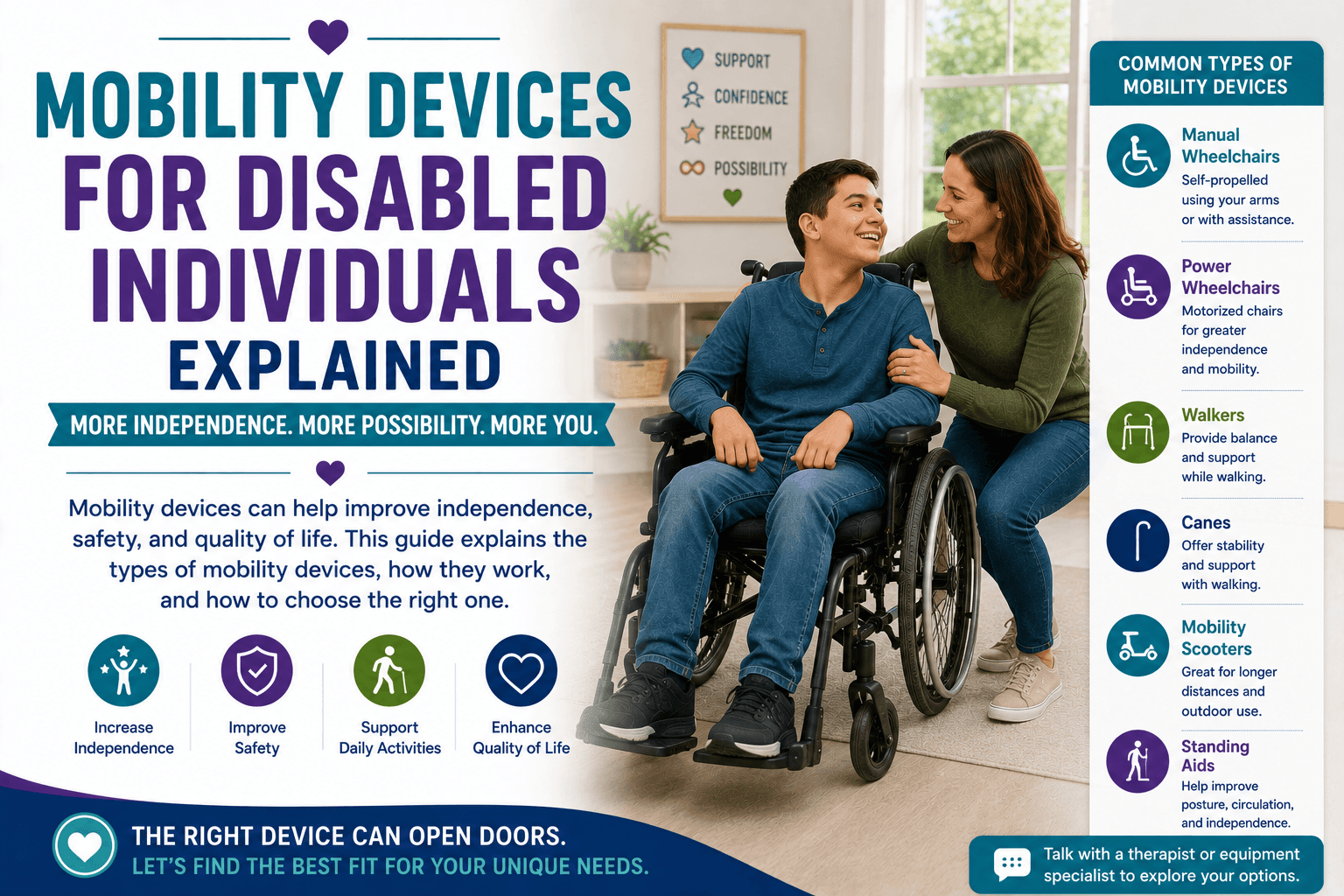
Mobility devices for disabled individuals can support safer movement, greater independence, more comfortable positioning, and stronger participation in daily life. The right mobility device may help a child get around school, help a young adult access work or community activities, help an older adult move more safely at home, or reduce physical strain for caregivers during transfers and transportation.
Mobility needs can change over time. A person may need a cane for occasional balance support, a walker for more consistent stability, a wheelchair for longer distances, a gait trainer for supported stepping, or transfer equipment for safer movement between a bed, chair, toilet, shower, or wheelchair. Choosing the right equipment is about more than getting from one place to another. It is about safety, comfort, posture, energy conservation, independence, dignity, and access to everyday routines.
Families, caregivers, therapists, schools, clinics, and care programs can explore Mobility Products, Wheelchairs, Adaptive Strollers, Gait Trainers and Walkers, Canes and Crutches, Power Scooters, Transfer Aids, and Standers and Standing Aids through eSpecial Needs.
What Are Mobility Aids?
Mobility aids are devices that help people move more safely, independently, or comfortably. They can support walking, standing, transferring, sitting, traveling, navigating school or work, and participating in home and community activities.
Mobility devices for disabled individuals may include:
Power wheelchairs
Mobility scooters
Transfer boards
Sit to stand lifts
Patient lifts
Wheelchair ramps
Grip aids and hand supports
The best device depends on the person’s strength, balance, endurance, coordination, posture, upper body function, daily activities, environment, and support needs.
Why the Right Mobility Device Matters for Independence and Quality of Life
The right mobility device can help reduce unnecessary effort during daily movement. It may help a person conserve energy, move more safely, access school or work, take part in family outings, use the bathroom with more support, or travel through the community with greater confidence.
A well matched device may support:
Safer walking
Better balance
More stable posture
Reduced fatigue
Greater independence
Easier access to school or work
More comfortable transportation
Safer caregiver transfers
Community participation
Social connection
Daily living routines
Reduced fall risk
Better access to therapy goals
A device that is too large, too small, too heavy, too lightly supportive, or not designed for the user’s needs can create new barriers. Proper fit and professional guidance are especially important for children, people with complex mobility needs, and anyone using equipment for long periods each day.
Who Uses Mobility Aids?
Mobility aids can be useful for children, young adults, adults, and seniors with many different conditions or functional needs.
People may use mobility devices because of:
Cerebral palsy
Spina bifida
Muscular dystrophy
Autism with motor planning or safety needs
Developmental delays
Down syndrome
Arthritis
Stroke recovery
Brain injury
Multiple sclerosis
Parkinson’s disease
Spinal cord injury
Balance challenges
Low muscle tone
Muscle weakness
Chronic pain
Temporary injury or surgery recovery
Aging related mobility changes
Neurological conditions
Orthopedic conditions
A person does not need to fit into one diagnosis category to benefit from mobility support. The goal is to match the equipment to the individual’s daily function.
Complete List of Mobility Aid Examples by Category
Mobility aid examples can be grouped by the type of support they provide.
Walking Support
Standard canes
Quad canes
Folding canes
Offset canes
Forearm crutches
Underarm crutches
Standard walkers
Two wheel walkers
Rollators
Posterior walkers
Gait trainers
Walk Easy Pediatric Tripod Cane
$0.00
Walk Easy Pediatric Tripod Canes are easy to use for small children who need extra assistance. Tripod canes provide increased stability, boosting kids' confidence and sense of security while walking. Features Optional Pivoflex crutch tips with "Flex" action are available… read more

Wheeled Mobility
Transport wheelchairs
Manual wheelchairs
Pediatric wheelchairs
Tilt in space wheelchairs
Lightweight wheelchairs
Power wheelchairs
Mobility scooters
Adaptive strollers
Push chairs
Fly-Lite Aluminum Transport Chair
$252.95
The Fly-Lite Aluminum Transport Chair is a lightweight wheelchair that can travel anywhere your special needs user can imagine. The adaptive equipment is only 14.5 lbs. and comes with many standard features, including convenient back release, swing-away footrests, wheel locks,… read more

Transfer and Standing Support
Transfer boards
Transfer belts
Sit to stand lifts
Patient lifts
Slings
Standers
Standing frames
Prone boards
Positioning systems
Hand and Grip Support
Grip aids
Built up handles
Adaptive gloves
Hand supports
Wrist supports
Universal cuffs
Reachers
Dressing aids

Environmental Mobility Support
Wheelchair ramps
Threshold ramps
Portable ramps
Bathroom safety equipment
Bed transfer supports
Vehicle transfer aids
ADA Border Ramp
$3,044.53
$3,107.00
This sturdy attractive ADA Border Ramp offers easy access for infants and physically challenged kids for playgrounds, play areas, and more. Our special needs play ground ramps are made from thick, sturdy polyethylene, and they're complaint with the American with… read more

Mobility Aids for Walking: Canes, Crutches, and Forearm Supports
Mobility aids for walking can range from light support for occasional balance concerns to more structured devices that help a person bear weight, control posture, and move through daily environments.
Walking aids may be considered when someone has:
Mild to significant balance changes
Leg weakness
Pain during walking
Reduced endurance
Difficulty recovering after a stumble
Temporary injury
Neurological movement differences
Difficulty with coordination
A need to reduce weight through one leg
A need for more stability during community walking
A physical therapist can help determine how much support is needed and whether a cane, crutch, walker, rollator, or gait trainer is the safest choice.
Types of Mobility Aid Canes and When to Use Each
Mobility aids canes are often used by people who can walk independently but need added support for balance, confidence, or reduced weight bearing on one side.
Standard Canes
A standard cane may be appropriate for someone who needs light balance support. It is often used for short distances, familiar environments, or mild gait changes.
Quad Canes
A quad cane has a wider base with four small feet. It may offer more standing stability than a standard cane for users who need a wider support base.
Folding Canes
Folding canes can be convenient for travel, appointments, car rides, or occasional use because they can be stored more easily when not needed.
Offset Canes
Offset canes have a curved handle design that may help distribute weight more evenly through the shaft. They may be useful for users who need more reliable weight bearing support than a basic straight cane provides.
Forearm Crutches
Forearm crutches use a cuff around the forearm and hand grips for support. They may be useful for people who need more support than a cane but want a walking aid that allows greater freedom than underarm crutches.
Underarm Crutches
Underarm crutches are often used for temporary injuries, surgery recovery, or periods when weight needs to be limited on one leg.
Explore Canes and Crutches for walking aids that support different levels of balance, comfort, and daily mobility needs.
Assisted Walking Devices for Adults: Walkers, Rollators, and Gait Trainers
Assisted walking devices for adults can provide different levels of support depending on strength, balance, posture, and endurance.
Standard Walkers
A standard walker provides a wide stable base. It may be helpful for people who need significant support and are able to lift or move the walker forward during walking.
Two Wheel Walkers
A two wheel walker can be easier to move than a standard walker because the front wheels roll while the rear legs remain stable. This may work well for people who need support but have difficulty lifting a walker repeatedly.
Rollators
A rollator has wheels, hand brakes, and often a seat or basket. It can be useful for people who walk independently but need support, a place to rest, or help carrying personal items.
Gait Trainers
Gait trainers are more supportive than standard walkers. They may include trunk support, pelvic support, harness systems, forearm prompts, or other positioning features for people who need help with posture, balance, weight bearing, or stepping.
Gait trainers may be especially useful for children and adults with cerebral palsy, developmental disabilities, low muscle tone, neurological conditions, brain injury, or significant balance challenges.
Explore Gait Trainers and Walkers for pediatric and adult walking supports.
Mobility Aids for Standing Up: Sit to Stand Lifts and Transfer Boards
Mobility aids for standing up can help people move between surfaces more safely when standing, pivoting, or transferring is difficult.
Sit to Stand Lifts
A sit to stand lift may help a person move from sitting to standing when they can bear some weight through their legs and follow basic transfer directions but need support with balance, strength, or caregiver assistance.
These devices are commonly used for transfers between:
Bed and wheelchair
Wheelchair and toilet
Chair and standing position
Wheelchair and shower area
Recliner and walker
Transfer Boards
Transfer boards create a bridge between two surfaces. They may be used for transfers between a wheelchair and bed, car seat, toilet, shower chair, or other stable surfaces.
Transfer boards may be appropriate for individuals who have enough upper body strength, sitting balance, and transfer skills to move across the board with appropriate support.
Patient Lifts and Slings
A patient lift may be needed when a person cannot safely stand, pivot, or transfer with limited assistance. Lift systems can reduce caregiver strain and may help support safer transfers when used according to manufacturer instructions and clinical guidance.
Explore Lifts and Slings and Transfer Aids for equipment that supports safer transitions and caregiver assistance.
Manual Wheelchairs: Lightweight, Transport, and Tilt in Space Models
Manual wheelchairs are pushed by the user, a caregiver, or both. The best manual wheelchair depends on whether the person will self propel, need caregiver transportation, require postural support, or use the chair throughout the day.
Transport Wheelchairs
Transport wheelchairs are often lighter and easier for caregivers to push. They are commonly used for appointments, travel, short outings, and community access.
Lightweight Wheelchairs
Lightweight wheelchairs may be easier to maneuver, lift, and transport. They may be a strong option for users who self propel or for families who need to load the chair into a vehicle regularly.
Standard Manual Wheelchairs
Standard manual wheelchairs may provide reliable everyday mobility for users who need a durable, straightforward option for home, school, medical appointments, and community use.
Tilt in Space Wheelchairs
Tilt in space wheelchairs change the entire seating angle while maintaining the user’s hip and knee position. They may be considered for people who need positioning support, pressure redistribution, rest breaks, or assistance maintaining stable posture.
Pediatric Wheelchairs
Pediatric wheelchairs should be selected with attention to growth, posture, seat depth, foot support, trunk support, transportation needs, and the child’s ability to participate in school, home, and community routines.
Explore Wheelchairs and Standard Wheelchairs for wheelchair options designed for children and adults.
Power Wheelchairs: Best Mobility Devices for Seniors and Disabled Adults
Power wheelchairs can be a strong option for people who cannot safely self propel a manual wheelchair or who need independent mobility over longer distances. They are often controlled with a joystick, although alternative control options may be available for users with limited hand function.
Power wheelchairs may be appropriate for people who:
Have limited upper body strength
Cannot propel a manual wheelchair consistently
Need positioning support
Need mobility throughout the day
Have fatigue that limits manual propulsion
Need to navigate home, school, work, or community settings independently
Have neurological or muscular conditions that affect walking
A power wheelchair may offer tighter turning ability than some scooters, making it useful in indoor environments where space is limited.
Because power mobility equipment involves sizing, control access, home layout, transportation, and funding requirements, an evaluation from a therapist or seating specialist can be valuable before purchase.
Mobility Scooters: Indoor vs. Outdoor Use
Mobility scooters are powered mobility devices that may work well for people who can sit upright, transfer safely, use the controls, and tolerate a scooter style seat.
Indoor Mobility Scooters
Indoor scooters are often selected for tighter turning spaces, shorter travel distances, and home or facility use. Important considerations include hallway width, doorway clearance, turning radius, flooring, and storage space.
Outdoor Mobility Scooters
Outdoor scooters may have larger wheels, more ground clearance, longer battery range, and more stability for sidewalks, parking lots, paved paths, and community outings.
Before choosing a scooter, consider:
User weight
Seat comfort
Transfer ability
Control access
Home layout
Outdoor terrain
Vehicle transportation
Battery charging area
Storage
Weather exposure
Caregiver support
Explore Power Scooters for powered mobility options.
Mobility Aids for Hands: Grip Aids, Adaptive Gloves, and Hand Supports
Mobility is not only about the legs or wheels. Hand function can affect a person’s ability to hold a cane, grip a walker, use wheelchair controls, manage a scooter tiller, push a manual wheelchair, or perform everyday tasks.
Mobility aids for hands may include:
Grip aids
Built up handles
Wrist supports
Adaptive gloves
Universal cuffs
Hand straps
Reachers
Dressing aids
Transfer handles
Wheelchair accessories
Easy grip daily living tools
These products may help people with arthritis, weak grip, paralysis, limited finger control, tremors, reduced sensation, injury recovery, or neurological conditions.
Explore Grips and Holders and Daily Living Aids for products that support grasping, holding, reaching, and independent routines.
Specialty Mobility Equipment: Standers, Prone Boards, and Adaptive Strollers
Some people need mobility equipment that supports more than simple walking or transportation. Specialty mobility equipment may help with positioning, standing tolerance, therapy goals, body alignment, participation, and safe access to daily routines.
Standers and Standing Aids
Standers may support users who cannot stand independently but may benefit from supported upright positioning. They are often used in home, school, and therapy settings.
Standers may include:
Prone standers
Supine standers
Dynamic standers
Mobile standers
Sit to stand systems
Multi position standers
The right standing system depends on head control, trunk control, lower body support, transfer ability, range of motion, comfort, and clinical goals.
Explore Standers and Standing Aids and Dynamic and Mobile Standers.
Prone Boards and Crawlers
Prone boards and crawlers may support floor mobility, weight bearing through the arms, exploration, and movement for children or adults with limited independent mobility.
Adaptive Strollers
Adaptive strollers can provide supportive transportation for children, teens, and some adults who have outgrown standard strollers but still need positioning, safety, comfort, and caregiver push support.
Features may include:
Larger weight capacities
Recline options
Positioning accessories
Adjustable foot support
Sun canopies
Transit options
Storage
Folding frames
Supportive seating
Explore Adaptive Strollers for special needs push chairs and supportive transportation options.
Special Tomato EIO Stroller Push Chair - Adaptive Stroller
$921.50
$2,062.05
The Special Tomato EIO Stroller Push Chair is a lightweight adaptive stroller designed to provide comfortable mobility and positioning support from early intervention through preadolescence. Built for children who need more support than a standard stroller, the EIO combines everyday… read more

Mobility Devices for Disabled Children: A Caregiver's Guide
Mobility devices for disabled children should be chosen with attention to growth, posture, therapy goals, school access, transportation, fatigue, comfort, and family routines.
A child may need mobility support for:
Home navigation
School participation
Outdoor play
Therapy
Community outings
Medical appointments
Transportation
Peer interaction
Standing and walking practice
Safe positioning
Important questions include:
Does the child need support for walking, standing, sitting, or transportation?
Does the child have enough trunk control for standard seating?
Is the equipment needed for school, home, therapy, or all settings?
Will the device fit through the home and school doorways?
Does the child need a device that grows with them?
Are footrests, pelvic supports, headrests, or trays needed?
Does the equipment need to fold for transportation?
Will the child self propel or need caregiver support?
Is a therapist recommending specific features?
A pediatric therapist can help families decide which features are needed now and which may become important as the child grows.
Pediatric Wheelchairs and Adaptive Seating for Kids
Pediatric wheelchairs and adaptive seating should support comfort, posture, safe participation, and access to activities. A child who is poorly positioned may have difficulty using their hands, seeing learning materials, eating safely, communicating, or staying engaged.
Helpful features may include:
Seat width and depth that fit the child
Adjustable footrests
Pelvic positioning
Trunk support
Head support when needed
Tilt or recline features
Growth adjustments
Tray options
Transit accessories
Easy caregiver pushing
Appropriate wheel size for self propulsion
Adaptive seating can be especially important for children with low muscle tone, reduced trunk control, cerebral palsy, developmental delays, or other physical support needs.
Mobility Aids for Young Adults Transitioning From Pediatric Care
Mobility aids for young adults should reflect changing body size, independence goals, school or employment plans, transportation needs, and adult lifestyle preferences.
Young adults may need equipment that supports:
College or vocational programs
Work settings
Public transportation
Independent community access
Social activities
Adult sized seating
Longer distance mobility
Travel
Personal style and privacy
Reduced caregiver assistance
Transitioning from pediatric equipment can require new measurements, higher weight capacities, more durable frames, different seating systems, and features that support independent decision making.
Whenever possible, include the young adult directly in equipment decisions. Their comfort, goals, routine, and preferences should guide the choice.
Adaptive Strollers vs. Wheelchairs: Which Is Right for Your Child?
Adaptive strollers and wheelchairs can both support mobility, but they serve different purposes.
Adaptive Strollers
Adaptive strollers may be a good fit when:
A caregiver will do most of the pushing
The child needs a more portable option
Family outings and transportation are the main focus
A folding frame is important
The child needs supportive seating but not independent wheelchair propulsion
The device will be used for shorter community distances
Wheelchairs
A wheelchair may be a better fit when:
The child needs mobility throughout the school day
Independent propulsion is a goal
The child needs more customized seating
Long term daily mobility is needed
A power option may be needed
Positioning needs are more complex
The child needs to access desks, tables, and classroom routines independently
A therapist or mobility specialist can help compare the child’s postural needs, endurance, environment, transportation needs, and independence goals.
What Is the Best Walking Aid for Elderly and Senior Users?
The best walking aid for elderly users depends on balance, strength, endurance, upper body function, cognition, home layout, outdoor terrain, and fall history.
A cane may work for someone who needs light balance support. A walker may be better for someone who needs a wider and more stable base. A rollator may be useful for someone who can walk but needs support, brakes, storage, and a seat for rest breaks. A wheelchair or scooter may be needed when walking is no longer safe or sustainable for community distances.
A healthcare provider or physical therapist can help assess the safest option. Choosing a device based only on appearance or convenience can increase the risk of falls or fatigue.
Comparing Walkers, Rollators, and Canes for Older Adults
Canes
Canes may be appropriate for mild balance changes, occasional support, or reduced weight bearing on one side. They are generally lighter and easier to transport but provide less support than walkers.
Walkers
Walkers provide a broad stable base and may be useful for people with greater balance challenges. They may require more upper body effort than a rollator because the user may need to lift or advance the frame.
Rollators
Rollators are easier to move because they have wheels, but they require the user to safely manage hand brakes and control the device. They may be useful for outdoor walking, community use, and users who benefit from a seat for rest breaks.
The safest choice depends on the person’s ability to manage the equipment, not simply how far they need to walk.
Power Chairs vs. Scooters for Seniors: Pros and Cons
Power chairs and scooters both provide powered mobility, but they are not interchangeable.
Power Chair Benefits
Often tighter turning ability
May fit better in smaller indoor spaces
Can offer more complex seating and positioning options
May be easier for some users to control with a joystick
Can be appropriate for people who cannot use a scooter tiller safely
Scooter Benefits
May work well for community outings
Often has a familiar steering style
May offer good outdoor travel ability
Can provide storage baskets
May be useful for people who can transfer and sit upright independently
Important Considerations
Ability to transfer
Upper body control
Hand function
Home layout
Turning space
Outdoor terrain
Transportation needs
Seating and positioning needs
Weight capacity
Battery charging
Funding requirements
A professional mobility evaluation can help determine which option is safer and more practical.
What Mobility Aid Is Right for Me? A Step by Step Decision Guide
Choosing mobility devices for disabled individuals begins with a clear understanding of what the person needs help doing.
Step 1: Identify the Main Challenge
Ask whether the person needs support for:
Walking
Balance
Transfers
Standing
Long distance mobility
Community access
Posture
Fatigue
Caregiver assistance
Transportation
School or work participation
Step 2: Consider Strength and Balance
Can the person stand independently? Can they bear weight through their legs? Can they use both hands on a walker? Can they propel a wheelchair? Can they control a power chair or scooter safely?
Step 3: Review the Environment
Think about:
Doorway widths
Hallway space
Floor surfaces
Stairs
Bathroom access
Vehicle transportation
Storage space
Outdoor terrain
School or workplace layout
Travel routines
Step 4: Consider Daily Use
Will the device be used for short trips, all day school participation, indoor navigation, outdoor community access, therapy, or caregiver transfers?
Step 5: Get Professional Input
A physical therapist, occupational therapist, seating specialist, physician, or mobility professional can help determine the right size, supports, controls, accessories, and safety features.
Assessing Your Mobility Needs: Strength, Balance, and Environment
A mobility device should match the person’s actual ability, not only their diagnosis.
Consider:
Can the user sit without support?
Can the user stand safely?
Can the user bear weight through one or both legs?
Can the user grip a handle or control a joystick?
Does the user have enough endurance for community outings?
Does the user fatigue quickly?
Does the user need trunk, pelvic, or head support?
Can the user transfer safely?
Does the user need caregiver assistance?
Does the user have visual or cognitive needs that affect equipment use?
Will the user travel over carpet, tile, grass, pavement, ramps, or uneven terrain?
These questions can help narrow the choices before selecting a product.
Indoor vs. Outdoor Mobility Considerations
Indoor and outdoor use can require different features.
For indoor mobility, consider:
Turning radius
Doorway clearance
Bathroom access
Flooring
Table access
Storage
Transfer space
Elevator access
Bedroom layout
For outdoor mobility, consider:
Wheel size
Suspension
Ground clearance
Battery range
Weather exposure
Curb handling
Terrain
Visibility
Transportation
Safety on sidewalks and paths
A device that works well inside a home may not be the best choice for uneven outdoor terrain. A large outdoor scooter may also be difficult to manage in a narrow hallway or small apartment.
How an Occupational or Physical Therapist Can Help You Choose
Occupational therapists and physical therapists can help evaluate how a person moves, transfers, sits, reaches, uses their hands, manages fatigue, and participates in daily routines.
A therapist may help with:
Gait assessment
Balance assessment
Wheelchair seating
Positioning needs
Transfer safety
Home access planning
Mobility equipment trials
Adaptive stroller recommendations
Gait trainer recommendations
Standing equipment recommendations
Caregiver training
School equipment planning
Funding documentation
This guidance can be especially important when selecting power mobility, gait trainers, standers, lifts, complex wheelchairs, or equipment for children who are growing.
Mobility Equipment Rental vs. Purchase: What to Consider
Some mobility devices may be rented in certain communities through local medical equipment suppliers, hospitals, rehabilitation programs, or travel services. Availability varies widely by location and product type.
Rental may make sense when the need is temporary, such as recovery after surgery, a short travel period, a trial before purchase, or a temporary change in mobility.
Purchase may make more sense when the equipment will be needed long term, must be customized, requires specific positioning features, or will be used daily at home, school, work, or in therapy.
Before choosing rental or purchase, consider:
How long the equipment is needed
Whether customization is required
Whether the item can be safely fitted for the user
Insurance or funding options
Maintenance responsibility
Delivery and pickup requirements
Cost over time
Availability in your location
When Renting a Mobility Device Makes Sense
Renting may be useful for:
Temporary injury recovery
Post surgery recovery
Short term travel
Visiting family
A trial period before purchase
Temporary changes in mobility
Waiting for long term equipment approval
Rental may not be ideal for equipment that needs complex seating, custom positioning, specialized controls, or long term daily use. Always confirm that rental equipment is properly fitted and safe for the intended user.
Long Term Ownership: Warranties, Maintenance, and Upgrades
Long term mobility ownership requires planning for maintenance, repairs, growth, and changing needs.
Consider:
Manufacturer warranty
Replacement parts
Tire and wheel maintenance
Battery replacement for powered equipment
Cleaning requirements
Seating adjustments
Weight capacity
Growth adjustments for children
Repair service availability
Transportation needs
Insurance replacement rules
Changes in diagnosis or mobility level
A child may outgrow a mobility device. An adult may need a different configuration after a health change, injury, or lifestyle transition. Reviewing fit and function regularly can help prevent discomfort and unsafe use.
How to Fund Your Mobility Device: Insurance, Medicaid, and Grants
Funding for mobility equipment can vary based on the device, diagnosis, functional need, insurance plan, Medicaid program, waiver availability, provider documentation, and location.
Potential funding sources may include:
Private insurance
Medicare
Medicaid
Medicaid waivers
State assistive technology programs
Veterans benefits
School district funding
Therapy program funding
Nonprofit grants
Community foundations
Civic organizations
Flexible spending accounts
Health savings accounts
Direct purchase
Financing options
Coverage is never guaranteed. Always confirm requirements with the payer before ordering equipment.
Shop Mobility Devices for Disabled Individuals at eSpecial Needs
eSpecial Needs offers mobility solutions for children, teens, adults, seniors, families, therapists, schools, clinics, and care programs.
Explore:
FAQs
What are mobility devices for disabled individuals?
Mobility devices are products that help children, adults, and seniors move more safely, comfortably, and independently. They may support walking, standing, transfers, seated mobility, transportation, school access, work participation, therapy, and community activities.
Common mobility devices include canes, crutches, walkers, rollators, gait trainers, wheelchairs, power wheelchairs, mobility scooters, adaptive strollers, patient lifts, transfer boards, standers, and wheelchair ramps.
Where can I shop mobility devices for disabled individuals?
Families, caregivers, therapists, schools, clinics, and care teams can shop mobility products through eSpecial Needs, including Mobility Products, Canes and Crutches, Gait Trainers and Walkers, Wheelchairs, Adaptive Strollers, Power Scooters, Standers and Standing Aids, Lifts and Slings, Transfer Aids, Wheelchair Ramps, and Grips and Holders.
Why is it important to choose the right mobility device?
The right mobility device can help support safer movement, reduce fatigue, improve comfort, increase independence, reduce caregiver strain, and make daily activities more accessible.
A device that does not fit correctly or does not provide enough support may increase fall risk, create poor posture, cause discomfort, or make movement more difficult. A physical therapist, occupational therapist, physician, or mobility specialist can help identify the safest option.
What is the difference between a walker and a rollator?
A walker usually has a stable frame and may have no wheels or two wheels. It can provide a wide base of support for people who need more stability while walking.
A rollator has wheels, hand brakes, and often a seat or storage basket. It may be easier to push but requires the user to control the brakes safely. Rollators can be helpful for people who need walking support and a place to rest during longer outings.
What is the difference between a cane and a walker?
A cane provides lighter support for balance, stability, or reduced weight bearing on one side of the body. A walker provides a larger, more stable support base and may be more appropriate for people with greater balance challenges or lower body weakness.
A therapist can help determine whether a cane offers enough support or whether a walker, rollator, or gait trainer is safer.
Are gait trainers only for children?
No. Gait trainers are available for children, teens, and adults. Adult gait trainers may be helpful for individuals who need supported walking because of neurological conditions, developmental disabilities, mobility limitations, weakness, or rehabilitation needs.
What is a transfer board?
A transfer board is a flat board that creates a bridge between two stable surfaces. It may help a person move from a wheelchair to a bed, car seat, toilet, shower chair, or other surface.
Transfer boards are often used by people who have sufficient upper body strength, sitting balance, and transfer skills. A therapist can help determine whether a transfer board is appropriate.