Table of Contents
- What Is a Letter of Medical Necessity?
- When Is a Letter of Medical Necessity Required?
- Why This Letter Matters for Caregivers and Families
- Accessing Funding for Adaptive Equipment
- Common Equipment That May Require a Letter of Medical Necessity
- Who Can Write a Letter of Medical Necessity?
- Physicians and Pediatricians
- Occupational Therapists and Physical Therapists
- Other Qualified Healthcare Providers
- Letter of Medical Necessity Requirements: What Must Be Included
- Medical Justification and Supporting Clinical Evidence
- Customizing the Template for Your Child’s Specific Needs
- Sample Letters of Medical Necessity for Adaptive Equipment
- Sample Letter: Sensory Room Equipment for Autism
- Sample Letter: Caregiver Support and Daily Living Aids
- What to Expect After Submission
- What to Do If Your Letter Is Denied
- How to Appeal a Denial
- Additional Funding Resources for Adaptive Equipment
- Nonprofit Grants and Assistance Programs
- Flexible Financing Options for Families
- Get Help With Equipment Quotes
- FAQs
Free Letter of Medical Necessity Template for Caregivers & Medical Professionals
A letter of medical necessity can help caregivers, families, therapists, and care teams explain why adaptive equipment, therapy tools, mobility devices, sensory products, or daily living aids are needed for a child or adult with disabilities. These letters are often requested when families pursue funding through private insurance, Medicaid, waiver programs, grants, school districts, managed care plans, or other third party funding sources. A strong letter does more than list a diagnosis. It connects the person’s functional needs to the requested equipment and explains why a standard alternative may not be enough. For example, a letter may explain why a child needs an adaptive wheelchair for safe mobility, a supportive activity chair for positioning during meals and learning, or sensory room equipment that supports a documented therapy plan. This guide includes a free letter of medical necessity template, examples, and practical submission steps. It is intended to help caregivers and providers organize useful information.
What Is a Letter of Medical Necessity?
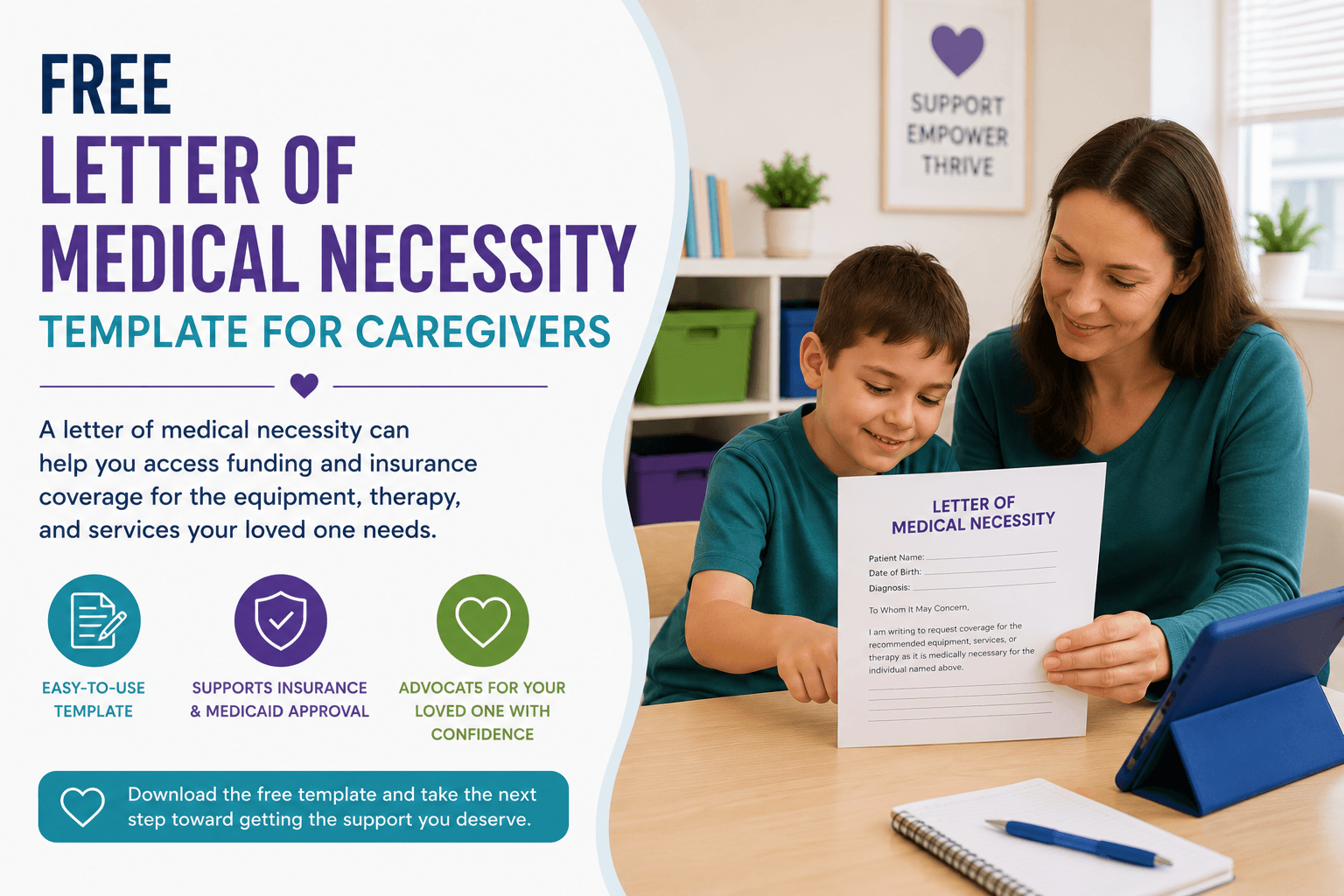
A letter of medical necessity is a written statement from a qualified healthcare professional that explains why a specific product, service, treatment, or piece of equipment is medically or functionally necessary for a particular person.
For adaptive equipment, the letter may explain:
The patient’s diagnosis or functional needs
The daily challenges the patient experiences
The specific product being requested
How the equipment supports safety, mobility, positioning, communication, therapy, or independence
Why a standard or less supportive alternative does not meet the patient’s needs
How long the equipment is expected to be needed
How the provider has assessed the patient’s needs
A letter of medical necessity can support a funding request, but it does not guarantee approval.
When Is a Letter of Medical Necessity Required?
A letter may be requested in many situations, including:
Insurance claims for adaptive equipment
Prior authorization requests
Medicaid funding requests
Medicaid waiver applications
Managed care plan requests
Durable medical equipment requests
Grant applications
School district equipment requests
Therapy equipment requests
Mobility equipment requests
Seating and positioning requests
Communication device requests
Sensory equipment requests
Daily living aid requests
Appeal requests after a funding denial
Some funding sources may require a letter, while others may request a prescription, therapy evaluation, physician order, equipment quote, clinical notes, measurements, or additional documentation instead.
Always ask the payer what documentation is required before submitting a request.
Why This Letter Matters for Caregivers and Families
Adaptive equipment can be expensive, and many families cannot access the equipment they need without funding support. A letter of medical necessity can help explain why an item is more than a convenience or recreational purchase.
The letter may help show how equipment supports:
Safer mobility
Better positioning
Fall prevention
Pressure management
Communication access
Therapy participation
Daily living independence
Caregiver safety
Feeding support
Toileting and bathing access
Sensory regulation
School participation
Community access
Reduced caregiver strain
A detailed letter can help the reviewer understand the patient’s real daily needs rather than seeing only a product name and price.
Accessing Funding for Adaptive Equipment
Funding pathways vary, but a letter of medical necessity may be useful when requesting support from:
Private insurance
Medicaid
Medicaid waivers
Managed care plans
State assistive technology programs
School districts
Early intervention programs
Therapy clinics
Nonprofit grant programs
Community organizations
Flexible spending accounts
Health savings accounts
The requested equipment should be tied to a clear need. A letter may be stronger when it includes a therapy evaluation, product quote, measurements, photographs when appropriate, clinical notes, or documentation showing why standard equipment is not enough.
Common Equipment That May Require a Letter of Medical Necessity
Funding rules vary, but letters of medical necessity are often requested for products such as:
Adaptive wheelchairs
Special needs strollers
Gait trainers
Standers
Patient lifts
Bath chairs
Shower chairs
Commode chairs
Adaptive seating systems
Positioning supports
Car safety equipment
Communication devices
AAC equipment
Adaptive bicycles and tricycles
Safety beds
Sensory room equipment
Weighted products
Therapy equipment
Daily living aids
Feeding supports
Mobility ramps
Transfer aids
Browse eSpecial Needs equipment categories for Mobility Products, Seating Systems, Bathing and Toileting Products, AAC and Communication, Sensory Room Equipment, and Daily Living Aids.
Special Tomato EIO Stroller Push Chair - Adaptive Stroller

$921.50
$2,062.05
The Special Tomato EIO Stroller Push Chair is a lightweight adaptive stroller designed to provide comfortable mobility and positioning support from early intervention through preadolescence. Built for children who need more support than a standard stroller, the EIO combines everyday… read more
Who Can Write a Letter of Medical Necessity?
The correct provider depends on the equipment and the payer’s rules. Some plans require a physician order or physician signature. Others may accept a letter written by a therapist, nurse practitioner, physician assistant, specialist, or other licensed provider. In some cases, a therapist may complete the functional evaluation while a physician signs or co signs the request.
Before asking someone to write a letter, confirm:
Who the payer requires to sign
Whether a prescription is required
Whether a therapy evaluation is required
Whether an NPI number is required
Whether the provider must use letterhead
Whether the letter has a required format
Whether the request needs prior authorization
Whether the provider must be in network
Physicians and Pediatricians
Physicians and pediatricians may provide prescriptions, orders, diagnoses, treatment information, and medical oversight for adaptive equipment requests. Their documentation may be especially important when a payer requires a physician signature or medical order.
A physician may help explain:
Diagnosis
Medical history
Prognosis
Safety concerns
Treatment plan
Need for durable medical equipment
Need for ongoing therapeutic support
Why the requested item is medically appropriate
For more complex equipment, the physician’s documentation may be paired with a therapy evaluation that provides detailed functional information.
Occupational Therapists and Physical Therapists
Occupational therapists and physical therapists are often well positioned to describe functional needs because they assess how a person moves, sits, transfers, uses their hands, completes self care tasks, and participates in daily routines.
An occupational therapist may help document needs related to:
Fine motor skills
Self feeding
Dressing
Bathing
Toileting
Sensory regulation
Seating
Daily living tasks
Communication access
School participation
A physical therapist may help document needs related to:
Mobility
Transfers
Walking
Balance
Strength
Positioning
Standing
Gait training
Wheelchair use
Adaptive cycling
Fall prevention
Some payers may require a physician signature even when the therapist provides the most detailed clinical justification.
Other Qualified Healthcare Providers
Depending on the funding source and requested equipment, other professionals may be involved in writing, reviewing, or co signing a letter of medical necessity.
Potential contributors may include:
Developmental pediatricians
Neurologists
Physiatrists
Rehabilitation specialists
Nurse practitioners
Physician assistants
Speech language pathologists
Behavioral health providers
Seating and mobility specialists
Case managers
Social workers
Assistive technology professionals
Always confirm that the payer accepts the provider’s credentials before submitting the letter.
Letter of Medical Necessity Requirements: What Must Be Included
Every payer has different requirements, but a strong letter often includes the following information:
Patient name
Date of birth
Insurance identification information when required
Diagnosis and relevant medical history
Functional limitations
Requested equipment details
Product model and required accessories
Medical and functional rationale
Why standard alternatives are insufficient
Expected benefits
Duration of need
Provider credentials
Provider signature
Date of signature
Supporting documents
Keep the letter focused on the individual patient. Avoid generic statements that could apply to anyone.
Medical Justification and Supporting Clinical Evidence
Medical justification should connect the diagnosis and functional limitations to the requested equipment.
A strong explanation may include:
Therapy evaluation findings
Functional assessments
Mobility assessments
Seating evaluations
Range of motion findings
Balance findings
Postural observations
Skin integrity concerns
Transfer safety concerns
Caregiver safety concerns
Communication assessments
Previous equipment trials
Documentation showing why standard equipment failed
Avoid overstating results. Use specific and clinically accurate language that reflects the provider’s evaluation.
Free Letter of Medical Necessity Template
Use this general template as a starting point. It must be reviewed, customized, and signed by an appropriately qualified provider. Do not submit it without confirming the requirements of your payer, plan, Medicaid program, waiver, or local funding source.
General Letter of Medical Necessity Template
[Provider Letterhead]
[Date]
To: [Insurance Company, Medicaid Plan, Waiver Program, Grant Organization, or Funding Source]
Re: [Patient Full Name]
Date of Birth: [MM/DD/YYYY]
Member ID: [Insurance or Medicaid ID]
Diagnosis: [Diagnosis and ICD 10 Code if applicable]
Dear Review Team,
I am writing on behalf of my patient, [Patient Full Name], to request coverage or funding for [full product name, model, size, and required accessories].
[Patient Name] has been diagnosed with [diagnosis] and experiences functional limitations related to [mobility, positioning, communication, sensory regulation, bathing, toileting, feeding, hand function, safety, endurance, or other relevant needs].
Due to these limitations, [Patient Name] is unable to safely or effectively [describe the specific daily activities affected]. These challenges affect participation in [home routines, school tasks, therapy, mobility, community access, self care, communication, sleep, or other daily activities].
The requested equipment, [product name], is medically and functionally necessary because it will provide [describe the specific support the product provides]. Required features include [list the medically necessary features, accessories, positioning components, or safety supports].
A standard or lower cost alternative would not meet [Patient Name]’s needs because [explain why standard equipment is unsafe, insufficient, ineffective, unavailable, or unable to provide the required level of support].
Without this equipment, [Patient Name] is at increased risk of [injury, falls, unsafe positioning, caregiver strain, reduced access to therapy, reduced independence, inability to participate in daily routines, or other relevant concerns].
Based on my clinical assessment and professional judgment, [product name] is necessary to support [Patient Name]’s safety, function, independence, mobility, positioning, communication, or therapy goals. This need is expected to continue for [duration of need].
Please contact me at [phone number] or [email address] if additional documentation is needed.
Sincerely,
[Provider Name and Credentials]
[License Number]
[NPI Number if required]
[Practice or Facility Name]
[Address]
[Phone Number]
[Signature]
Customizing the Template for Your Child’s Specific Needs
A letter should never be copied word for word for every child. Strong documentation explains the individual child’s actual abilities, challenges, goals, and equipment needs.
For example, instead of writing:
“Patient needs an adaptive chair for better support.”
Use more specific language such as:
“Patient is unable to maintain safe upright sitting in a standard chair due to reduced trunk control and postural instability. The requested adaptive chair is needed to provide pelvic positioning, trunk support, foot support, and a stable surface for meals, school activities, and fine motor tasks.”
Specific language can help the reviewer understand why the item matters.
Sample Letters of Medical Necessity for Adaptive Equipment
The examples below are fictional samples for educational purposes only. They are not clinical recommendations, prescriptions, legal advice, or guarantees of coverage. A qualified provider must review and customize all documentation before submission.
Sample Letter: Sensory Room Equipment for Autism
[Provider Letterhead]
[Date]
To: [Insurance Company, Medicaid Waiver Program, Grant Organization, or Funding Source]
Re: [Patient Name]
Date of Birth: [MM/DD/YYYY]
Diagnosis: Autism spectrum disorder, [ICD 10 code if applicable]
Dear Review Team,
I am writing to request funding for sensory room equipment for my patient, [Patient Name].
[Patient Name] has autism spectrum disorder and experiences documented sensory regulation challenges that affect participation in daily routines, therapy activities, school tasks, transitions, and family life. The patient demonstrates [sensory seeking behaviors, sensory avoiding behaviors, difficulty with transitions, difficulty maintaining regulation, limited attention, reduced participation, or other relevant findings].
The requested sensory equipment includes [list specific products such as weighted lap pad, sensory seating, tactile tools, visual light equipment, sensory wall panel, therapy ball, or other items]. These items are needed to support a structured sensory plan that addresses the patient’s documented functional and therapy needs.
The requested equipment will provide appropriate sensory input to support regulation, engagement, safe participation, and transition routines. Standard household items do not provide the needed level of durability, safety, structure, or therapeutic function.
Without these supports, [Patient Name] experiences increased difficulty participating in [school routines, therapy, home activities, self care, communication, sleep routines, or community participation].
Based on my assessment, the requested sensory room equipment is medically and functionally necessary to support the patient’s therapy plan and daily participation.
Sincerely,
[Provider Name and Credentials]
[License Number]
[NPI Number if required]
[Signature]
Sample Letter: Caregiver Support and Daily Living Aids
[Provider Letterhead]
[Date]
To: [Insurance Company, Medicaid Plan, Waiver Program, or Funding Source]
Re: [Patient Name]
Date of Birth: [MM/DD/YYYY]
Diagnosis: [Diagnosis and ICD 10 code if applicable]
Dear Review Team,
I am writing to request coverage for [requested daily living aid, bathing product, toileting product, transfer aid, feeding aid, or other adaptive equipment] for my patient, [Patient Name].
[Patient Name] has functional limitations affecting [bathing, toileting, dressing, feeding, transfers, hygiene, mobility, hand use, or other daily activities]. The patient currently requires [describe the level of caregiver assistance needed] and is unable to complete these activities safely with standard household equipment.
The requested item, [product name and model], is medically necessary because it provides [describe safety, positioning, access, stability, caregiver support, or functional benefit]. Required features include [list essential features].
Without this equipment, the patient is at increased risk for [falls, unsafe transfers, poor positioning, skin concerns, caregiver injury, reduced independence, inability to complete hygiene tasks, or other relevant concerns].
The requested equipment will help support safer daily living routines, increased independence when appropriate, and reduced physical strain on caregivers.
Sincerely,
[Provider Name and Credentials]
[License Number]
[NPI Number if required]
[Signature]
What to Expect After Submission
After submission, the payer may approve the request, deny the request, ask for more information, request a different product, or request a new evaluation.
Stay proactive by:
Tracking submission dates
Saving confirmation numbers
Following up before deadlines
Responding quickly to requests for information
Asking for decisions in writing
Requesting a copy of the denial reason if denied
Keeping copies of all paperwork
What to Do If Your Letter Is Denied
A denial does not always mean the request is over. Read the denial notice carefully and identify the specific reason for the decision.
Common reasons may include:
Missing documentation
Incomplete provider information
Missing prescription
Missing prior authorization
Insufficient functional justification
Lack of required evaluation
Request for a different supplier
Product not included in the plan benefit
Item considered non covered or recreational
Insufficient explanation of why standard alternatives do not work
Request submitted after a deadline
Contact the payer and ask what information is needed to reconsider the request.
How to Appeal a Denial
Appeal rules and deadlines vary by payer and location. Follow the denial notice closely and submit the appeal on time.
An appeal may include:
A written appeal form or letter
The denial notice
Updated letter of medical necessity
Additional therapy notes
New clinical evaluations
Product trial information
Photos or measurements when relevant
Provider letters
Caregiver statement
Documentation showing why lower cost alternatives are not appropriate
Evidence of daily functional impact
Ask the payer whether peer to peer review, external review, expedited appeal, or additional clinical review is available.
For legal or plan specific questions, consider speaking with your insurer, case manager, benefits advocate, disability rights organization, or qualified attorney in your area.
Additional Funding Resources for Adaptive Equipment
When insurance or Medicaid coverage is limited, families may explore other funding options.
Possible sources include:
Nonprofit grants
Community foundations
Disability specific organizations
State assistive technology programs
School district funding
Early intervention programs
Therapy clinic support
Civic organizations
Religious or community groups
Local fundraising
Employer benefit accounts
Health savings accounts
Flexible spending accounts
Financing options
Availability varies by location, age, diagnosis, income, equipment type, and funding organization.
Nonprofit Grants and Assistance Programs
Some nonprofit organizations and local charities offer grants or assistance for adaptive equipment. Funding opportunities may change frequently, so confirm eligibility, deadlines, and documentation requirements directly with each organization.
Grant applications may be stronger when they include:
Patient story and functional needs
Provider recommendation
Product quote
Equipment details
Explanation of daily impact
Information about other funding attempts
Family contribution when required
Photos or therapist letters when appropriate
Do not wait until the last minute. Many grant programs have limited funding cycles and application windows.
Flexible Financing Options for Families
Families may consider financing when an item is needed before other funding sources are available or when coverage does not apply. eSpecial Needs offers Affirm Financing options for eligible purchases.
Financing is not a funding guarantee. Review all available terms, payment schedule, eligibility requirements, interest or fee information if applicable, and total cost before making a decision.
Get Help With Equipment Quotes
A detailed equipment quote can be helpful for insurance requests, Medicaid documentation, waiver submissions, school purchases, grant applications, and family planning.
eSpecial Needs can help provide equipment information and quotes for adaptive products, sensory tools, mobility equipment, seating, bathing supports, daily living aids, and therapy products.
Request support through eSpecial Needs Quote Requests.
Important Disclaimer
This article and template are general educational resources only. They are not medical advice, legal advice, insurance advice, or a guarantee of coverage, approval, reimbursement, or funding.
eSpecial Needs is not a medical provider, insurance company, law firm, or government agency. We cannot determine medical necessity, write clinical letters, submit claims, interpret your insurance policy, or guarantee that a payer will approve any request.
Requirements can vary based on your location, state laws, local rules, insurance plan, Medicaid program, waiver, diagnosis, provider credentials, equipment type, and funding source. Always confirm current requirements with your insurer, Medicaid plan, case manager, prescribing provider, therapist, or qualified local professional before submitting documentation.
For product guidance and equipment quotes, visit Letters of Medical Necessity or request help through eSpecial Needs Quote Requests.
FAQs
Is a letter of medical necessity required for adaptive equipment?
Sometimes. Requirements vary based on the insurance plan, Medicaid program, waiver, grant organization, school district, equipment type, and location.
Some funding sources may require a letter of medical necessity, while others may request a prescription, therapy evaluation, product quote, physician order, measurements, prior authorization form, or other supporting documentation.
Always check with the funding source before submitting a request.
Who can write a letter of medical necessity?
The correct provider depends on the equipment and the funding source. Letters may be written or signed by physicians, pediatricians, occupational therapists, physical therapists, nurse practitioners, physician assistants, neurologists, developmental pediatricians, rehabilitation specialists, speech language pathologists, or other qualified professionals.
Some payers require a physician signature even when a therapist completes the functional evaluation and equipment recommendation.
Can an occupational therapist write a letter of medical necessity?
An occupational therapist may be able to write or contribute to a letter of medical necessity, especially for equipment related to sensory needs, fine motor skills, self care, feeding, dressing, bathing, toileting, seating, communication access, and daily living activities.
However, some insurance plans or Medicaid programs may require a physician order, physician signature, or additional documentation. Confirm the specific requirements before submitting the letter.
Can a physical therapist write a letter of medical necessity?
A physical therapist may help write or support a letter of medical necessity for mobility equipment, gait trainers, standers, wheelchairs, adaptive bicycles, seating systems, transfer equipment, positioning supports, and other products connected to movement and physical function.
Some funding sources may still require a physician prescription or co signature.
Can parents or caregivers write a letter of medical necessity?
Parents and caregivers can provide valuable supporting information, but they generally cannot replace a letter from a qualified healthcare provider when the payer requires clinical documentation.
A caregiver statement can explain how the requested equipment affects daily routines, safety, caregiver burden, school participation, transportation, self care, sleep, mobility, and family life.
Can a letter of medical necessity help pay for sensory equipment?
A letter of medical necessity may help support a request for sensory room equipment, weighted products, sensory seating, therapy tools, or other sensory supports when the equipment is connected to documented therapy goals, safety needs, participation challenges, positioning concerns, or functional limitations.
Some plans may consider sensory products recreational or non covered. Others may review them when strong clinical documentation is provided. There is no guarantee of coverage.
Can a letter of medical necessity help pay for a wheelchair?
A letter of medical necessity is often an important part of a wheelchair funding request. The documentation may explain the patient’s mobility needs, posture, balance, safety concerns, endurance, seating requirements, and why a standard wheelchair would not provide appropriate support.
The request may also require a prescription, seating evaluation, measurements, product quote, prior authorization, and other clinical documentation.
Can insurance deny a letter of medical necessity?
Yes. A letter of medical necessity can be denied if the payer determines that the product is not covered, the documentation is incomplete, the functional justification is insufficient, prior authorization was not obtained, a required provider signature is missing, or a lower cost alternative is considered appropriate.
A denial does not always mean the request is permanently closed. Families may be able to submit additional documentation or appeal the decision.
Can I use the free template exactly as written?
No. The template is only a general starting point. It must be customized to the patient’s diagnosis, functional needs, requested equipment, payer requirements, and provider assessment.
A template should never be submitted as a generic form letter without review by a qualified provider.
Can eSpecial Needs write a letter of medical necessity?
No. eSpecial Needs cannot write clinical letters, determine medical necessity, provide medical advice, submit insurance claims, interpret insurance policies, or guarantee funding approval.
A qualified healthcare provider who knows the patient’s needs should complete and sign the letter.
Can eSpecial Needs provide a product quote for a funding request?
Yes. A detailed product quote may be helpful for insurance claims, Medicaid submissions, waiver applications, grant requests, school purchases, and other funding documentation.
Families, schools, clinics, and care teams can request product support through eSpecial Needs Quote Requests.
Can grants help pay for adaptive equipment?
Some nonprofit organizations, local charities, disability specific programs, therapy programs, civic organizations, and community groups offer grants or assistance for adaptive equipment.
Grant requirements vary. Applications may request a product quote, provider letter, therapy evaluation, diagnosis information, personal statement, proof of financial need, or documentation of other funding attempts.