Table of Contents
- Quick Answer: What Is an Adaptive Equipment Store?
- Why New Caregivers Feel Overwhelmed
- The Challenge of Finding Specialized Equipment in One Place
- What Sets a Special Needs Supply Store Apart from General Retailers?
- Adaptive Equipment Categories New Caregivers Should Know
- Mobility Equipment: Adaptive Strollers, Wheelchairs, and Pediatric Mobility Aids
- Adaptive Seating and Positioning Equipment for Children
- Sensory Motor Tools and Sensory Integration Equipment
- Sensory Room Equipment and Sensory Wall Panels
- Deep Pressure Therapy Products and Chill Out Chairs
- Bathing Aids, Toileting Aids, and Daily Living Aids
- Indoor Therapy Gym Equipment and Movement Therapy Tools
- Inclusive Learning Tools, Educational Materials, and Special Needs Toys
- Assistive Technology for Nonverbal and Communication Challenged Children
- Adaptive Clothing and Sensory Friendly Apparel
- How to Assess Your Child’s Adaptive Equipment Needs
- Collaborating with Occupational and Physical Therapists
- Understanding Diagnosis and Functional Goals
- Using an Expert Quote Request Service
- Funding and Paying for Adaptive Equipment
- What Is a Letter of Medical Necessity?
- Medicaid and Private Insurance Coverage for Durable Medical Equipment
- Flexible Financing Options
- Price Match Guarantees
- Grants and Funding Resources for Families
- Buying Adaptive Equipment for Schools, Clinics, and Institutions
- Purchase Orders for Schools and Government Agencies
- Sensory Room Ideas for Classrooms and Therapy Clinics
- B2B Quote Requests and Bulk Purchasing Support
- What to Look for When Choosing an Adaptive Equipment Store Online
- Product Breadth
- Expert Support
- Transparent Pricing and Policies
- School and Clinic Purchasing Support
- FAQs
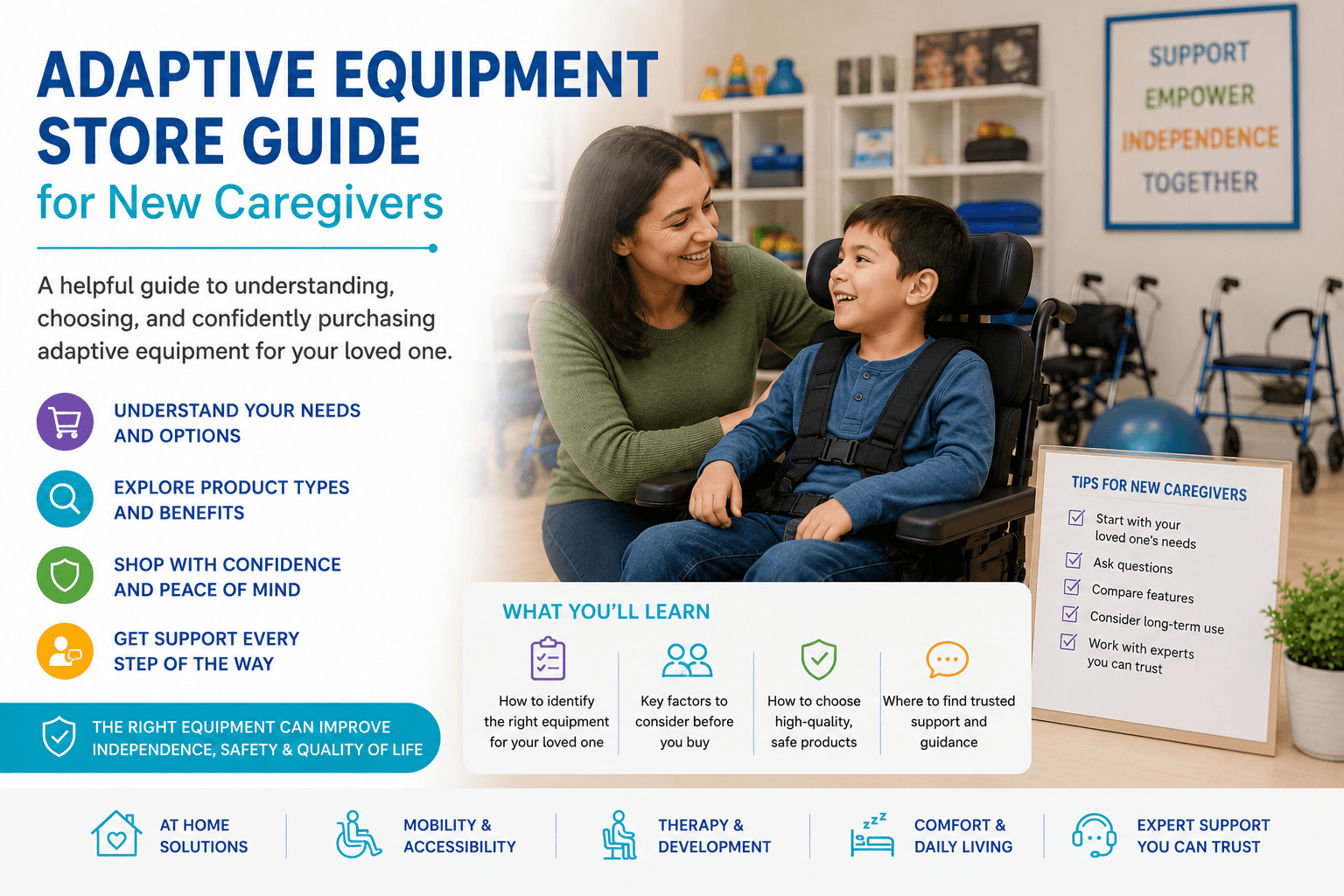
Adaptive Equipment Store Guide for New Caregivers
Becoming a caregiver for a child with special needs can feel overwhelming at first. There are appointments to manage, therapy goals to understand, diagnoses to research, school meetings to attend, insurance questions to answer, and daily routines that may suddenly require new levels of planning. On top of all of that, caregivers are often expected to find the right adaptive equipment, sensory products, mobility aids, therapy tools, and daily living supports without a clear roadmap. An adaptive equipment store can help with this.
For many families, the search begins with one simple question:
Where do I even start?
A dedicated adaptive equipment store can make that process much easier. Unlike general retailers, a special needs supply store is designed around the needs of children, adults, families, therapists, schools, and caregivers who require products beyond standard consumer goods. The right adaptive equipment store can help you compare adaptive strollers, wheelchairs, sensory room equipment, adaptive seating, bathing aids, toileting aids, deep pressure therapy products, therapy swings, special needs toys, assistive technology, and more in one trusted place.
For new caregivers, this matters. Choosing adaptive equipment is not just about convenience. It is about safety, comfort, function, independence, therapy progress, and quality of life.
This guide explains how an adaptive equipment store helps families and professionals find the right products, what categories to understand first, how to assess your child’s needs, and how to navigate funding, insurance, purchase orders, quotes, and budget friendly options.
Quick Answer: What Is an Adaptive Equipment Store?
An adaptive equipment store is a specialized retailer that offers products designed to support people with physical, developmental, sensory, mobility, communication, and daily living needs. These stores typically carry special needs equipment such as adaptive strollers, wheelchairs, sensory products, therapy tools, positioning devices, bath and toileting aids, special needs toys, assistive technology, and school or clinic equipment.
A quality adaptive equipment store helps caregivers do more than shop. It helps them understand product categories, compare options, request quotes, gather documentation, and find equipment that matches a child’s functional needs.
Why New Caregivers Feel Overwhelmed
New caregivers are often asked to make important decisions quickly. A therapist may recommend adaptive seating. A doctor may mention mobility equipment. A teacher may suggest sensory tools for school. Another parent may recommend a weighted blanket or therapy swing. Insurance may ask for documentation. The school may request an IEP meeting. A grant application may require a quote. Suddenly, the caregiver is trying to understand dozens of products, funding rules, clinical terms, and purchasing options at the same time.
Common caregiver questions include:
- What equipment does my child actually need?
- What is the difference between an adaptive stroller and a wheelchair?
- Which sensory products are appropriate for autism or sensory processing disorder?
- Can insurance cover adaptive equipment?
- Do I need a letter of medical necessity?
- How do I know if a product will fit?
- Can my child’s school purchase this equipment?
- What if I buy the wrong product?
A dedicated special needs adaptive equipment store helps reduce that confusion by organizing products into meaningful categories and offering resources that support better decisions.
The Challenge of Finding Specialized Equipment in One Place
Many caregivers start by searching general retail sites. While those platforms may offer thousands of products, they are not always built for special needs families. The problem is not just selection. It is relevance.
A general retailer may show a long list of products without explaining whether they are appropriate for cerebral palsy, autism, sensory processing disorder, low muscle tone, mobility limitations, developmental delays, or daily care needs.
This creates several problems:
- Caregivers spend hours comparing products across multiple websites
- Product details may be incomplete or unclear
- Sizing and support features may be hard to understand
- Medical and therapy use cases may not be explained
- School or clinic purchasing options may be missing
- Quote support may not be available
- Insurance documentation may be harder to gather
- Caregivers may purchase products that do not meet the child’s needs
When products are fragmented across multiple vendors, families lose time and confidence. A specialized adaptive equipment store gives caregivers one place to explore multiple categories, compare options, and request support.
What Sets a Special Needs Supply Store Apart from General Retailers?
A special needs supply store is built around function, diagnosis related needs, therapy goals, and caregiver support. General retailers are built around mass consumer shopping.
That difference matters.
| Store Type | Best For | Limitations |
|---|---|---|
| General retailer | Everyday household products and basic supplies | Limited adaptive product guidance, less clinical context, fewer specialized filters |
| Medical supply store | Basic durable medical equipment | May not carry sensory, educational, pediatric, or therapy based products |
| Adaptive equipment store | Special needs equipment, therapy products, sensory tools, mobility aids, daily living supports | Best when caregivers need specialized products and expert support |
A strong adaptive equipment store offers:
- Curated special needs products
- Multiple adaptive equipment categories
- Product information for caregivers and professionals
- Quote request support
- School and clinic purchasing options
- Purchase order support
- Funding resources
- Products for home, school, therapy, and community use
- Equipment for children and adults with special needs
For caregivers, this means less guessing and more confidence.
Adaptive Equipment Categories New Caregivers Should Know
Adaptive equipment is a broad term. It includes many product types that support movement, positioning, sensory regulation, communication, hygiene, therapy, safety, learning, and independence.
The table below gives a simple overview.
| Category | Common Products | Primary Purpose |
|---|---|---|
| Mobility equipment | Adaptive strollers, wheelchairs, gait trainers, walkers | Safe movement and transportation |
| Adaptive seating | Activity chairs, positioning chairs, floor sitters | Posture, support, comfort, participation |
| Sensory equipment | Sensory toys, compression tools, weighted products | Regulation, calming, focus, body awareness |
| Sensory room equipment | Bubble tubes, wall panels, crash pads, swings | Structured sensory input and therapy support |
| Bathing and toileting aids | Bath chairs, commodes, toilet supports | Hygiene, safety, caregiver assistance |
| Therapy equipment | Swings, balance tools, mats, therapy balls | Gross motor development and movement |
| Assistive technology | AAC devices, switches, communication tools | Communication and access |
| Educational tools | Special needs toys, learning aids, manipulatives | Cognitive, social, and motor development |
| Adaptive clothing | Easy dressing clothing, sensory friendly apparel | Comfort, independence, dressing support |
Understanding these categories helps caregivers prioritize what to look at first.
Mobility Equipment: Adaptive Strollers, Wheelchairs, and Pediatric Mobility Aids
Mobility equipment helps children and adults move safely at home, school, therapy, and in the community.
Common mobility products include:
- Adaptive strollers
- Manual wheelchairs
- Transport chairs
- Gait trainers
- Pediatric walkers
- Standers
- Transfer equipment
- Mobility accessories
Adaptive strollers are often used for children who need more support than a standard stroller can provide. They may offer better positioning, larger weight capacity, trunk support, head support, harness systems, and durable frames for daily use.
Wheelchairs may be appropriate for children or adults who need more independent mobility, custom positioning, or long term mobility support.
Gait trainers and walkers may support children who are working on standing, stepping, balance, coordination, or walking skills.
Mobility equipment may be recommended for conditions such as cerebral palsy, muscular dystrophy, spina bifida, developmental delays, low muscle tone, orthopedic conditions, neurological conditions, and other mobility challenges.
Adaptive Seating and Positioning Equipment for Children
Adaptive seating helps children maintain safer and more supportive positions during daily activities. For children with low muscle tone, poor trunk control, cerebral palsy, developmental delays, or postural instability, standard chairs may not provide enough support.
Height Adjustable Tilting Benches - Medium
$289.95
The Height Adjustable Tilting Benches - Medium provides supportive seating designed to help children maintain better posture, stability, and alignment during seated activities, therapy sessions, and everyday developmental work. Created for users who do not need full back support but… read more

Adaptive seating may help with:
- Upright posture
- Head and trunk alignment
- Feeding support
- Classroom participation
- Fine motor activities
- Play
- Communication
- Respiratory comfort
- Reducing fatigue
Common products include:
- Activity chairs
- Positioning chairs
- Floor sitters
- Corner chairs
- Standers
- Seat inserts
- Lateral supports
- Head supports
- Positioning wedges
Choosing the right seating product often requires input from an occupational therapist, physical therapist, or seating specialist.
Height Adjustable Tilting Benches - Small
$249.95
The Height Adjustable Tilting Benches - Small provides supportive seating designed to help young children maintain better posture, stability, and alignment during seated activities, therapy sessions, and early developmental work. Created for children who do not need full back support… read more

Sensory Motor Tools and Sensory Integration Equipment
Sensory motor tools are commonly used by occupational therapists, schools, and families to support sensory processing, body awareness, movement, and motor development. These products may help children who seek movement, avoid certain sensory input, struggle with focus, or need support regulating their nervous system.
Examples include:
- Therapy balls
- Balance boards
- Fidget tools
- Sensory brushes
- Tactile toys
- Weighted lap pads
- Resistance bands
- Putty
- Scooter boards
- Compression tools
- Crash pads
Sensory motor equipment can be helpful for children with autism, sensory processing disorder, ADHD, developmental delays, coordination challenges, and emotional regulation needs.
Tactile Sensory Kit
$67.95
The Tactile Sensory Kit includes many of our most popular tactile items for sensory motor massage and texture stimulation on-the-go. With nine handheld sensory toys that each feature a different tactile experience, it's a great go-to bag for occupational therapists,… read more

Sensory Room Equipment and Sensory Wall Panels
A sensory room is a dedicated space designed to provide calming, organizing, or stimulating sensory experiences in a controlled environment. Schools, therapy clinics, and families often use sensory rooms to support children with autism, sensory processing disorder, anxiety, ADHD, developmental disabilities, and emotional regulation challenges.
Common sensory room equipment includes:
- Sensory wall panels
- Bubble tubes
- Fiber optic lights
- Crash pads
- Therapy swings
- Tactile panels
- Interactive light products
- Calming seating
- Projectors
- Sensory mats
Sensory wall panels are especially useful because they provide tactile, visual, and interactive sensory input without taking up much floor space. They can help children explore textures, practice fine motor skills, engage visually, and participate in calming sensory play.
Large Razzle-Dazzle Marble LED Sensory Wall Panel - Visual & Tactile Stimulation
$1,500.00
$1,650.00
The Large Razzle-Dazzle Marble LED Sensory Wall Panel is an interactive sensory wall panel designed to support visual, tactile, and auditory stimulation in sensory rooms, therapy spaces, classrooms, and care environments. With more than 2,000 colored marbles, built-in LED lighting,… read more

Deep Pressure Therapy Products and Chill Out Chairs
Deep pressure therapy products provide firm, calming input to the body. Many children and adults with sensory needs find deep pressure soothing because it can support body awareness, emotional regulation, and calming routines.
Common deep pressure products include:
- Weighted blankets
- Weighted lap pads
- Compression vests
- Body socks
- Weighted shoulder wraps
- Crash pads
- Compression sheets
- Chill out chairs
Chill out chairs are often used in sensory rooms, classrooms, bedrooms, therapy clinics, and calming spaces. They provide a supportive place for children to relax, reset, and receive calming sensory input. These products may be helpful for children with autism, sensory processing disorder, ADHD, anxiety, and developmental disabilities.
Double Squeeze Hug Machine - Calming Deep Pressure Aid
$699.00
$799.00
The Double Squeeze Machine is a calming deep pressure sensory tool designed to provide even, consistent proprioceptive input for children who benefit from structured sensory regulation. Often used as a squeeze machine or hug machine, it helps support self-regulation, body… read more

Bathing Aids, Toileting Aids, and Daily Living Aids
Daily care routines can be physically demanding for caregivers and stressful for children when the right supports are not in place. Adaptive bathing and toileting aids help improve safety, comfort, hygiene, and independence.
Common products include:
- Bath chairs
- Shower chairs
- Toilet supports
- Commode chairs
- Transfer benches
- Changing tables
- Adaptive utensils
- Dressing aids
- Hygiene supports
- Safety rails
These products may be needed when a child has balance challenges, limited trunk control, mobility limitations, muscle weakness, transfer difficulties, or safety concerns during bathing and toileting. The right equipment can reduce caregiver strain while helping the child participate more comfortably in daily routines.
Indoor Therapy Gym Equipment and Movement Therapy Tools
Indoor therapy gym equipment gives children safe ways to move, climb, swing, balance, crawl, and build strength. Movement based equipment is often used in occupational therapy, physical therapy, sensory rooms, and home therapy spaces.
Common options include:
- Therapy swings
- Climbing structures
- Crash mats
- Balance beams
- Therapy balls
- Scooter boards
- Trampolines designed for therapy use
- Foam play shapes
- Crawling tunnels
These products can support gross motor development, balance, coordination, motor planning, sensory regulation, and confidence. For home use, caregivers should consider available space, installation requirements, safety, supervision, and therapist recommendations.
11 piece Junior Gym Set
$1,681.75
$1,850.00
Soft set ups with different densities of foam and reversible supports. Use individual pieces or progressively in groups. The wipe-clean vinyl mats are kids stay safe as they play. All heavy duty 14 oz. vinyl coated covers meet CA TB117… read more

Inclusive Learning Tools, Educational Materials, and Special Needs Toys
Play is an important part of learning and development. Special needs toys and inclusive learning tools can support cognitive, social, sensory, motor, and communication goals.
Examples include:
- Cause and effect toys
- Switch adapted toys
- Fine motor manipulatives
- Tactile learning tools
- Visual schedules
- Social emotional learning tools
- Adaptive art supplies
- Sensory bins
- Communication supports
- Educational games
These products can be used at home, in classrooms, during therapy sessions, and in inclusive learning environments.
The best special needs toys are not just entertaining. They help children practice meaningful skills in a way that feels engaging and motivating.
Lang O Learn: 13 Box Set
$169.99
13 Box set of the Lang-O-Learn Flash Cards. Full-color photo flash cards, labled on the reverse in 17 languages. This is a 13-box set of our popular Lang-O-Learn Flash Cards. Each card set features bright, colorful, and current photographic images… read more

Assistive Technology for Nonverbal and Communication Challenged Children
Assistive technology can help children communicate, access learning, and participate more fully in daily life. For children who are nonverbal or have communication challenges, augmentative and alternative communication tools may be recommended.
These may include:
- AAC devices
- Communication boards
- Switches
- Switch adapted toys
- Mounting systems
- Tablet access tools
- Adaptive keyboards
- Environmental control devices
Speech language pathologists often help families choose communication tools that match the child’s abilities and goals. Assistive technology can support requesting, choice making, social interaction, classroom participation, and independence.
QuickTalker FeatherTouch 23
$265.00
This dynamic speech device is easy to use, durable, and and goes everywhere with the user. QuickTalker FT 23 is perfect for use when reading a story, interacting during a lesson in the classroom, or communicating with a family member.… read more

Adaptive Clothing and Sensory Friendly Apparel
Clothing can be a major source of stress for children with sensory sensitivities, mobility needs, or medical devices.
Adaptive and sensory friendly clothing may include:
- Tag free designs
- Soft fabrics
- Easy fasteners
- Side openings
- Back openings
- Magnetic closures
- Clothing that accommodates braces or orthotics
- Wheelchair friendly designs
- Seamless socks
- Compression clothing
These products can help make dressing easier, reduce sensory discomfort, and support independence. For children who resist dressing or experience discomfort from seams, tags, buttons, or tight waistbands, sensory friendly apparel may make daily routines smoother.
How to Assess Your Child’s Adaptive Equipment Needs
Before purchasing adaptive equipment, start with your child’s functional needs. A diagnosis can provide helpful context, but equipment decisions should be based on what your child needs help doing each day.
Ask these questions:
- Does my child need help sitting safely?
- Does my child need support walking or moving through the community?
- Does my child become overwhelmed by sensory input?
- Does my child seek deep pressure, movement, or tactile input?
- Does my child need help bathing or toileting safely?
- Does my child need communication support?
- Does my child need equipment for school participation?
- Does my child need help with fine motor or gross motor development?
- Does my child outgrow standard products too quickly?
- Does caregiving require unsafe lifting, transfers, or positioning?
These questions help narrow the search to the most relevant product categories.
Collaborating with Occupational and Physical Therapists
Occupational therapists and physical therapists can be valuable partners when choosing adaptive equipment.
An occupational therapist may help with:
- Sensory processing
- Fine motor skills
- Feeding support
- Daily living activities
- Adaptive seating
- Bathing and toileting needs
- Sensory diets
- Classroom accommodations
A physical therapist may help with:
- Mobility
- Walking
- Balance
- Strength
- Transfers
- Positioning
- Gross motor development
- Gait trainers
- Standers
- Wheelchairs
Therapist recommendations can help caregivers avoid costly mistakes and choose products that support real therapy goals.
Understanding Diagnosis and Functional Goals
Different diagnoses may point caregivers toward certain equipment categories, but every child is unique.
For example:
| Diagnosis or Need | Product Categories to Consider |
|---|---|
| Autism | Sensory equipment, deep pressure tools, sensory room products, communication supports |
| Cerebral palsy | Adaptive seating, mobility equipment, positioning devices, bathing aids |
| ADHD | Movement tools, sensory seating, fidgets, weighted lap pads |
| Low muscle tone | Supportive seating, standers, therapy equipment, positioning aids |
| Developmental delay | Therapy toys, adaptive seating, mobility aids, sensory motor tools |
| Nonverbal communication | AAC devices, switches, communication supports |
| Sensory processing disorder | Sensory integration tools, compression products, calming equipment |
The key is to connect equipment to a specific goal, such as improving sitting tolerance, safer transfers, better communication, reduced overstimulation, or increased independence.
Using an Expert Quote Request Service
An expert quote request service from an adaptive equipment store can help caregivers identify equipment that fits the child’s needs, budget, and setting.
This is especially helpful when:
- You are not sure which product category to choose
- You need a quote for insurance or funding
- Your school or clinic requires procurement documentation
- You need product details for a letter of medical necessity
- You are comparing multiple options
- You need help finding products within a specific budget
A quote request from an adaptive equipment store can save time and provide clearer documentation for families, schools, clinics, and funding organizations.
Funding and Paying for Adaptive Equipment
Adaptive equipment can be expensive, but families may have several funding options.
Possible payment and funding paths include:
- Private insurance
- Medicaid
- Medicaid waiver programs
- Flexible spending accounts
- Health savings accounts
- Grants
- Nonprofit funding
- School district funding
- Community fundraising
- Buy now pay later financing
- Price match programs
- Purchase orders for institutions
Funding requirements vary depending on the product, payer, and intended use.
What Is a Letter of Medical Necessity?
A letter of medical necessity is a document written by a qualified healthcare professional explaining why a specific product or service is medically necessary.
It may include:
- Diagnosis
- Functional limitations
- Requested equipment
- Clinical justification
- Safety concerns
- Expected outcomes
- Why standard alternatives are not appropriate
A letter of medical necessity may be required for adaptive strollers, wheelchairs, seating systems, therapy equipment, sensory products, bathing aids, toileting aids, and assistive technology. Caregivers can ask a physician, occupational therapist, physical therapist, speech language pathologist, or specialist whether an LMN is appropriate.
Medicaid and Private Insurance Coverage for Durable Medical Equipment
Some adaptive equipment may qualify as durable medical equipment, often called DME. Coverage depends on the insurance plan, state Medicaid rules, medical necessity, diagnosis, documentation, and whether the product meets policy criteria.
Common documentation may include:
- Prescription
- Letter of medical necessity
- Therapy evaluation
- Product quote
- Diagnosis codes
- Prior authorization forms
- Supplier information
Common approval challenges include missing documentation, unclear clinical justification, lack of proof that alternatives are insufficient, or products being categorized as convenience items rather than medically necessary equipment.
Flexible Financing Options
When insurance or grant funding is not available, flexible financing can make adaptive equipment more manageable. Buy now pay later plans such as Affirm may allow families to spread payments over time instead of paying the full amount upfront. This is something an adaptive equipment store usually offers where a general store doesn't.
This can be helpful for higher cost products such as adaptive strollers, sensory room equipment, therapy furniture, positioning systems, and mobility aids. Caregivers should always review payment terms carefully before choosing financing.
Price Match Guarantees
A price match guarantee can help caregivers make the most of their budget.
When shopping for adaptive equipment online, compare:
- Product name
- Manufacturer
- Model number
- Size
- Included accessories
- Shipping costs
- Warranty terms
- Return policy
- Availability
The lowest price is not always the best value if the product lacks support, warranty protection, accurate sizing help, or school purchasing options.
Grants and Funding Resources for Families
Families may be able to access grants or financial assistance from:
- Disability focused nonprofits
- Local community foundations
- Diagnosis specific organizations
- State disability programs
- Religious or civic organizations
- School based funding sources
- Therapy related foundations
- Community fundraising campaigns
Grant applications often require a quote, diagnosis documentation, explanation of need, and sometimes a letter from a healthcare provider.
Buying Adaptive Equipment for Schools, Clinics, and Institutions
Schools, therapy clinics, hospitals, government agencies, and nonprofit organizations often need adaptive equipment for multiple users.
Institutional buyers may look for:
- Purchase order support
- Bulk pricing
- Quote request services
- Product recommendations
- Sensory room planning help
- Durable products
- Tax exempt purchasing support when applicable
- Clear product documentation
- Reliable shipping
- Multi category ordering
A specialized adaptive equipment store can help streamline the process for professional buyers.
Purchase Orders for Schools and Government Agencies
Many schools and government organizations purchase equipment through purchase orders.
Purchase order support is important for:
- Special education departments
- Occupational therapy teams
- Physical therapy departments
- School districts
- Public agencies
- Therapy clinics
- Hospitals
- Nonprofit programs
Using a purchase order can simplify internal approvals and allow institutions to purchase needed equipment through established procurement systems.
Sensory Room Ideas for Classrooms and Therapy Clinics
Sensory rooms and sensory corners can be customized based on the space, budget, and users.
A classroom sensory corner may include:
- Weighted lap pads
- Fidgets
- Flexible seating
- Noise reduction headphones
- Visual timers
- Calming lights
- Tactile tools
A therapy clinic sensory room may include:
- Therapy swings
- Crash pads
- Sensory wall panels
- Bubble tubes
- Balance equipment
- Climbing tools
- Deep pressure products
A school sensory room may include:
- Calming zone
- Movement zone
- Fine motor station
- Adaptive seating
- Sensory wall panels
- Visual regulation tools
Structured sensory environments help children access the type of input they need in a safe, purposeful way.
B2B Quote Requests and Bulk Purchasing Support
For schools, clinics, and organizations, a B2B quote request can simplify larger purchases.
Bulk purchasing support may help with:
- Multi item quotes
- Sensory room packages
- Classroom equipment lists
- Therapy gym equipment
- Adaptive seating orders
- Product substitutions
- Budget planning
- Procurement documentation
This is especially useful for districts building sensory rooms, clinics expanding therapy spaces, or organizations purchasing equipment for multiple locations.
What to Look for When Choosing an Adaptive Equipment Store Online
Not all adaptive equipment retailers offer the same level of support. Before choosing where to buy, consider the following criteria.
Product Breadth
A strong adaptive equipment store should carry multiple categories in one place.
Look for products across:
- Mobility
- Seating
- Positioning
- Sensory
- Therapy
- Daily living
- Bathing
- Toileting
- Communication
- Education
- Toys
- Institutional equipment
A broad catalog helps caregivers avoid searching across too many vendors.
Expert Support
Caregivers should look for a store that offers product guidance, quote support, and knowledgeable service.
Expert support is especially important when buying:
- Adaptive strollers
- Wheelchairs
- Seating systems
- Sensory room equipment
- Therapy swings
- Bathing aids
- Toileting systems
- Communication devices
- Large institutional orders
Transparent Pricing and Policies
Before purchasing, review:
- Product price
- Shipping cost
- Delivery timeline
- Return policy
- Warranty
- Product availability
- Assembly requirements
- Size charts
- Financing options
- Price match policies
Clear policies help families avoid unexpected costs or delays.
School and Clinic Purchasing Support
Schools and clinics should look for:
- Purchase order acceptance
- Quote request options
- Bulk order support
- Product documentation
- Responsive customer service
- Multiple category ordering
- Sensory room planning support
This makes procurement much easier for professional buyers.
FAQs
What is adaptive equipment?
Adaptive equipment refers to products designed to help people with physical, developmental, sensory, communication, or daily living challenges participate more safely and independently. Examples include adaptive strollers, wheelchairs, sensory tools, seating systems, bath chairs, therapy equipment, communication devices, and daily living aids.
What is the best adaptive equipment store for special needs products?
The best adaptive equipment store is one that offers a wide range of special needs products, expert guidance, clear product details, quote support, purchase order options, funding resources, and reliable customer service. Caregivers should look for a store that carries mobility, sensory, therapy, seating, daily living, and educational products in one place.
How do I know what adaptive equipment my child needs?
Start by identifying your child’s functional challenges. Consider mobility, sitting, sensory regulation, communication, bathing, toileting, learning, and safety needs. Work with your child’s occupational therapist, physical therapist, physician, or speech language pathologist to choose equipment that supports specific goals.
Can insurance pay for adaptive equipment?
Insurance may cover some adaptive equipment when it is considered medically necessary. Coverage depends on the plan, diagnosis, product type, documentation, and prior authorization requirements. Families may need a prescription, letter of medical necessity, therapy evaluation, and product quote.
What adaptive equipment is useful for autism?
Children with autism may benefit from sensory products, weighted items, compression tools, sensory seating, communication supports, visual schedules, calming equipment, sensory room products, and special needs toys. The best choice depends on the child’s sensory profile and daily needs.
Do schools buy adaptive equipment?
Yes. Schools may purchase adaptive equipment for classrooms, therapy rooms, sensory rooms, special education programs, and student support services. Many schools use purchase orders and request quotes before placing orders.
What is a quote request for adaptive equipment?
A quote request gives caregivers, schools, clinics, or funding sources detailed pricing and product information. Quotes are often used for insurance submissions, grants, school procurement, Medicaid requests, and institutional purchasing.
What is the difference between a general retailer and a special needs equipment store?
A general retailer sells broad consumer products. A special needs equipment store focuses on adaptive products designed for children and adults with disabilities, sensory needs, mobility challenges, developmental delays, and therapy goals. Specialized stores usually provide more relevant categories and better product guidance.