Table of Contents
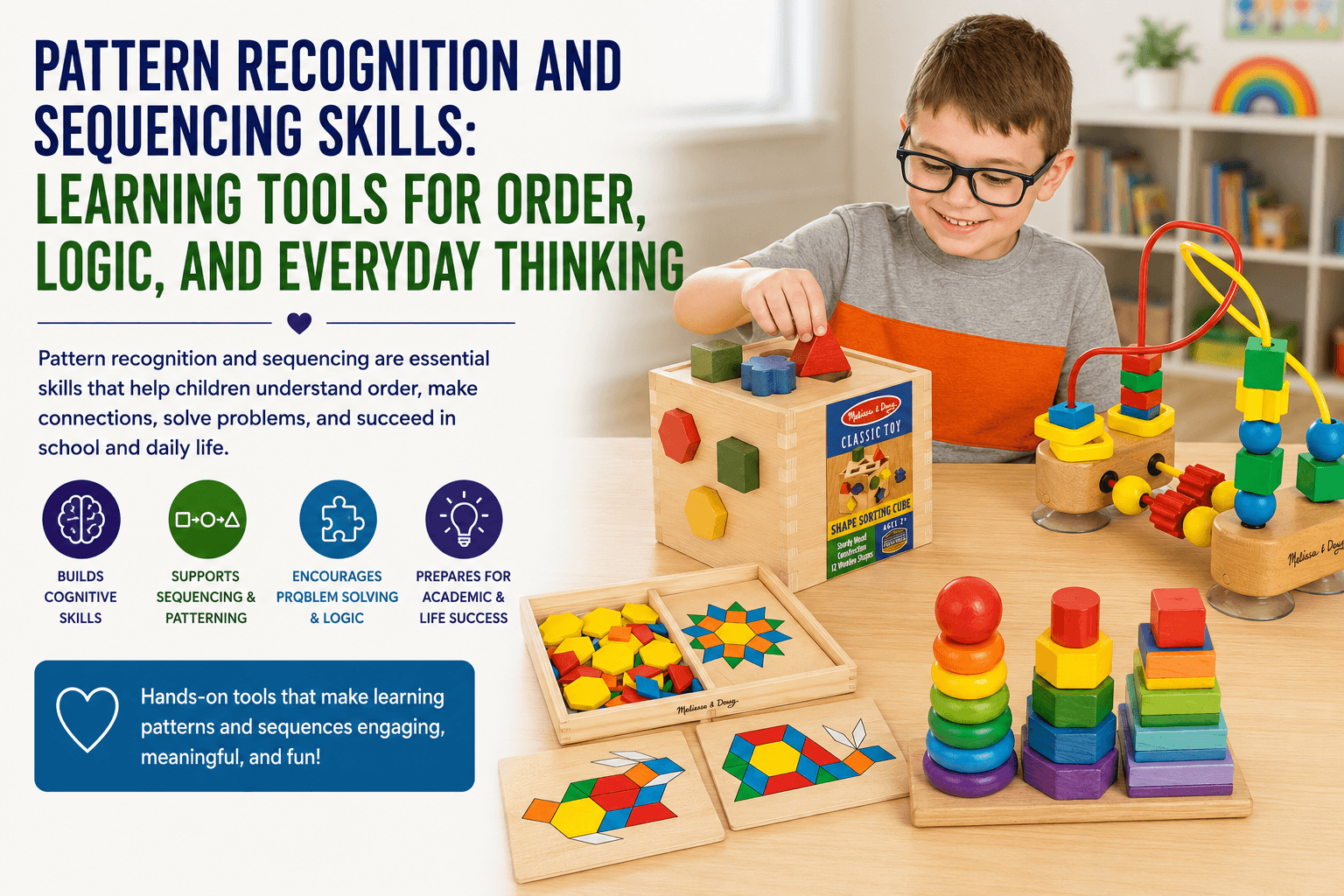
Pattern recognition and sequencing skills help children and adults understand order, predict what comes next, solve problems, and follow steps. These skills are used in reading, math, communication, routines, self care, classroom learning, therapy activities, and everyday life.
For children with autism, ADHD, developmental delays, sensory processing needs, cognitive challenges, or fine motor delays, learning patterns and sequences through hands on activities can make abstract thinking more concrete. Instead of only hearing directions or looking at worksheets, learners can touch, move, match, sort, arrange, and practice skills in a structured way.
What Are Pattern Recognition and Sequencing Skills?
Pattern recognition is the ability to notice similarities, differences, repeated designs, relationships, and predictable rules. A child may recognize that red, blue, red, blue comes next with red. Another learner may notice that socks go on before shoes, or that a story has a beginning, middle, and end.
Sequencing is the ability to understand order. It helps a person know what comes first, what comes next, and what happens last. Sequencing is important for following directions, completing tasks, telling stories, solving problems, and building independence.
Together, pattern recognition and sequencing skills help learners answer common questions like:
- What comes next?
- What is the same?
- What is different?
- What happens first?
- What step comes after this?
- How do these pieces fit together?
- What order should I follow?
These are small questions, but they support big learning goals.
Melissa & Doug Pattern Blocks and Boards
$28.95
$30.99
Keeps children engaged for hours in rewarding play! Features 10 simply designed colorful patterns, and over 100 pattern blocks in 6 different shapes and colors to replicate the pattern shown. Contents store neatly in durable wooden case. Develops shape recognition… read more

Why Are Pattern Recognition and Sequencing Skills Important?
Pattern recognition and sequencing are foundation skills for academic learning and daily routines. A learner uses these skills when counting, sorting, reading, matching letters, recognizing shapes, completing puzzles, following classroom routines, using a visual schedule, getting dressed, brushing teeth, preparing a snack, or retelling an event.
These skills may support:
- Early math readiness
- Reading comprehension
- Visual discrimination
- Problem solving
- Memory
- Executive functioning
- Direction following
- Fine motor planning
- Daily living routines
- Communication
- Independent work
- Classroom participation
- Confidence
When learners understand order and patterns, the world can feel more predictable. That predictability may be especially helpful for students who benefit from structure, repetition, and visual support.
Who Benefits From Pattern and Sequencing Activities?
Pattern recognition and sequencing activities can benefit many learners, including young children, students in special education classrooms, therapy clients, adults with cognitive needs, and individuals working on independence skills.
These tools may be useful for:
- Autism support
- ADHD support
- Developmental delays
- Speech and language therapy
- Occupational therapy
- Early childhood education
- Special education classrooms
- Cognitive skill building
- Fine motor practice
- Life skills instruction
- Memory care activities
- Home learning routines
The best activity depends on the learner’s age, ability level, attention span, motor skills, and interests. Some learners may start with simple matching. Others may work on picture sequencing, bead patterns, pattern blocks, sorting tasks, or multi step routines.
What Types of Tools Help Build These Skills?
The Pattern Recognition and Sequencing Skills collection includes hands on learning tools that encourage structure, repetition, and active thinking. These may include sorting activities, matching games, visual sequencing tools, manipulatives, puzzles, and interactive learning aids.
Helpful activity types include:
- Matching sets
- Sorting activities
- Sequence cards
- Pattern blocks
- Bead sequencing activities
- Picture sequencing games
- Visual discrimination activities
- Fine motor manipulatives
- Step by step learning tools
- Cause and effect activities
For example, a picture sequencing activity can help a learner understand what happens first, next, and last. A bead sequencing set can support matching, color recognition, fine motor coordination, and logical order. Pattern blocks can help with shape recognition, symmetry, spatial reasoning, and early STEM concepts.
FAQs
What is an example of pattern recognition for children?
A simple example of pattern recognition is noticing that a sequence repeats, such as red, blue, red, blue. Children may also recognize patterns in shapes, sounds, movements, pictures, routines, numbers, or daily activities.
What is an example of sequencing in daily life?
A common sequencing example is brushing teeth: pick up the toothbrush, add toothpaste, brush, rinse, and put the toothbrush away. Sequencing helps learners understand steps in the correct order.
Are pattern recognition and sequencing the same thing?
No. Pattern recognition means noticing relationships, repeats, similarities, or rules. Sequencing means understanding order, such as first, next, then, and last. The skills often work together during learning and daily routines.
Why do children need sequencing skills?
Children use sequencing skills to follow directions, tell stories, complete classroom tasks, get dressed, wash hands, clean up, and understand routines. Sequencing can also support reading comprehension, math readiness, planning, and independence.
How can I tell if a child struggles with sequencing?
A child may have trouble putting story events in order, following multi step directions, completing routines, remembering what comes next, organizing tasks, or explaining something that happened. Visual supports and hands on practice may help.
What age should children start working on patterns?
Many children begin noticing simple patterns in early childhood through songs, blocks, colors, shapes, movement games, and sorting activities. The activity should match the child’s developmental level rather than age alone.