Table of Contents
The Obi 3 Robotic Feeding Device is an advanced adaptive dining solution designed to help individuals with upper body limitations enjoy more independence, dignity, and choice during meals. For people who have difficulty lifting utensils, scooping food, controlling hand movement, or bringing food to the mouth, mealtime often requires continuous caregiver assistance. Obi helps change that experience by giving users more control over each bite.
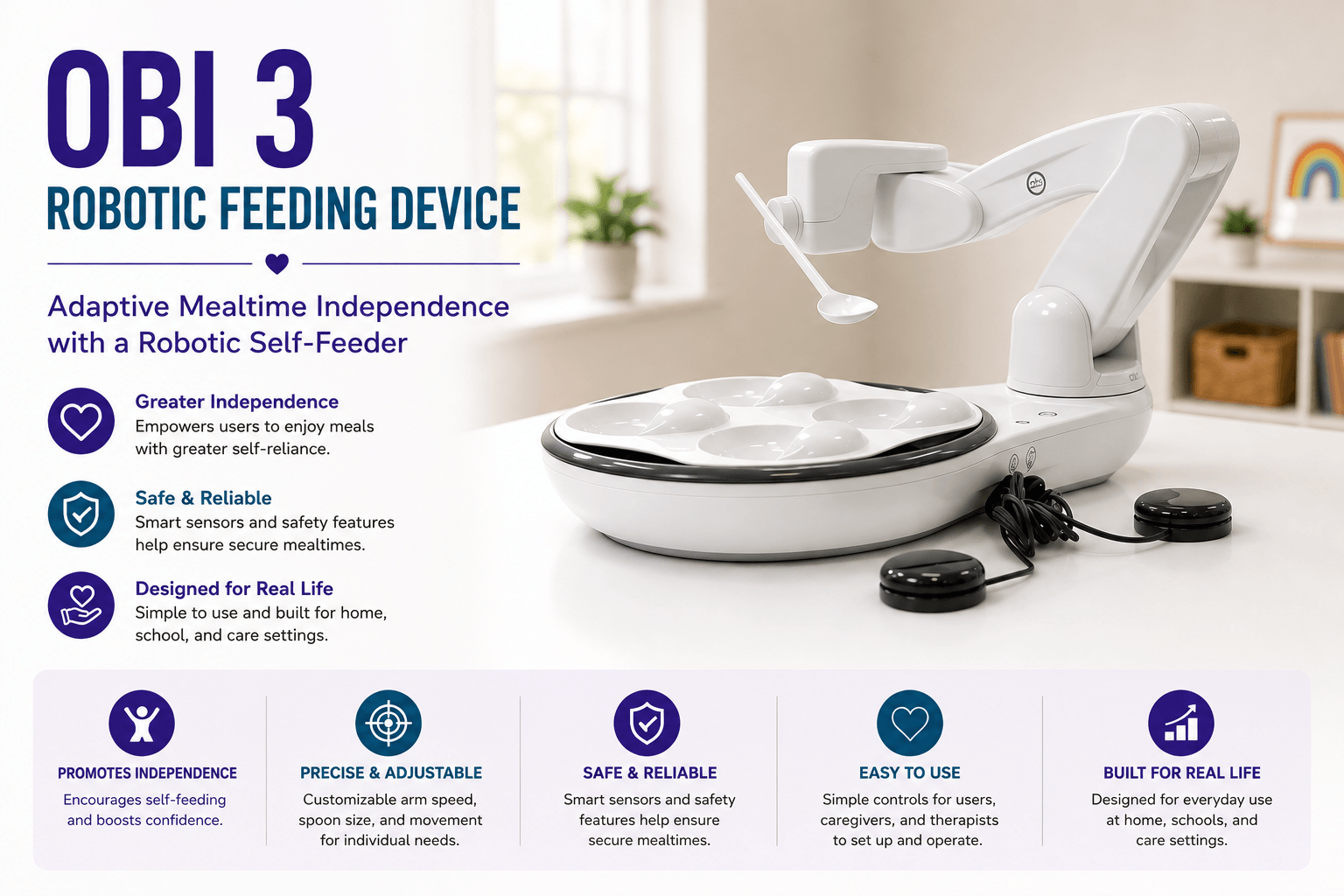
This robotic self feeder uses simple switch activated controls and a precision engineered robotic arm to scoop food and deliver it to the user’s mouth. Instead of relying entirely on a caregiver to choose the next bite, the user can help direct the meal, select from different food compartments, and participate more actively in the dining experience.
Designed for More Independent Eating
Obi is built around one important goal: helping users take a more active role in mealtime. The device includes four separate food compartments, allowing different foods to be placed in one accessible tray. With switch controls, the user can choose which compartment the robotic arm scoops from, making mealtime more interactive and personalized.
This can be especially meaningful for individuals who want greater independence but need physical support because of limited upper body mobility, neuromuscular conditions, developmental disabilities, or reduced motor control.
Obi may be a helpful option for users with needs related to:
Cerebral palsy
Muscular dystrophy
Multiple sclerosis
Parkinson’s disease
Spinal cord injury
ALS
Amputation
Essential tremor
Motor neuron disease
Other upper extremity motor challenges
Every user’s needs are different, so families and care teams should review product details and consult appropriate professionals when choosing adaptive feeding equipment.
Simple Switch Activated Control
The Obi 3 Robotic Feeding Device works with most adaptive switches, making it flexible for users with different physical abilities. The product includes two black Buddy Button switches, helping users begin with a simple control setup.
Switch access may allow a user to activate the device with the hand, arm, head, foot, or another reliable movement pattern depending on positioning and switch placement. This makes Obi a strong option for users who may not have the fine motor control needed for traditional utensils but can activate a switch.
Four Food Compartments for Choice and Variety
One of Obi’s most important features is its four compartment plate. This design gives users access to different foods during a meal. A caregiver can load the compartments, and the user can help decide what bite comes next.
This supports more than nutrition. It supports choice, participation, and personal preference. Being able to choose between foods can make mealtime feel more natural and respectful, especially for users who are used to having meals directed entirely by someone else.
Portable, Rechargeable, and Easy to Clean
Obi is designed for real life use in homes, schools, therapy centers, long term care settings, and community environments. It weighs 7.7 pounds and includes a rechargeable lithium ion battery that provides up to four hours of eating time when fully charged.
The device is also designed with cleaning in mind. Components are dishwasher, microwave, and freezer safe, and the product is made from BPA free plastic. The package includes one plate, one placemat, two spoons, one charger, one lithium ion battery, and two black Buddy Button switches.
For users who travel between home, school, appointments, or care settings, the Obi Carrying Case can help protect the device and organize accessories.
A Helpful Tool for Families and Care Teams
Obi does not replace the importance of caregiver support, safe mealtime supervision, or feeding guidance when needed. However, it can help reduce the amount of hands on assistance required during some meals and give caregivers more opportunity to engage socially instead of focusing only on feeding each bite.
For families, schools, clinics, and care teams, Obi may support:
More user directed meals
Greater dining participation
Improved mealtime dignity
Reduced caregiver feeding demands
Adaptive switch access
Choice between foods
Consistent setup for supported eating
Home, school, and facility use
Shop Obi at eSpecial Needs
The Obi 3 Robotic Feeding Device is a powerful adaptive dining tool for individuals who need support with self feeding but want more control over mealtime. With robotic feeding technology, switch activated access, four food compartments, portable design, easy cleaning, and included switches, Obi can help make meals more engaging, respectful, and independent.
You can also explore related eSpecial Needs categories, including Dining Aids, Eating Utensils, Daily Living Aids, Assistive Technology, Switches, and Living Aids.
FAQs
What makes the Obi 3 different from regular adaptive utensils?
Regular adaptive utensils still require the user to lift, guide, and bring food to the mouth. The Obi 3 Robotic Feeding Device uses a robotic arm and switch activated controls to help scoop and deliver food, which may support users who cannot reliably use standard utensils on their own.
Does Obi feed the user automatically?
Obi is not fully automatic in the sense of choosing bites without input. It is designed to be user directed through switch activation. The user can help control when the robotic arm moves and which food compartment is selected, depending on setup and ability.
Can Obi be used by someone with limited hand movement?
Yes. Obi may be helpful for users with limited hand or arm movement because it works with adaptive switches. A switch can often be positioned where the user has the most reliable movement, such as near the hand, arm, head, foot, or another accessible body area.
What types of food work best with Obi?
Obi works best with foods that can be scooped and held on a spoon. Soft foods, small bite sized foods, and foods with a texture that stays on the spoon are often easier to use. Very thin liquids, large pieces, or foods that roll easily may be harder to manage.
Can Obi be used for every meal?
That depends on the user’s needs, endurance, food textures, supervision requirements, and setup. Some users may use Obi for daily meals, while others may use it for selected meals, snacks, therapy practice, or independence building.