Table of Contents
- What Is a Letter of Medical Necessity?
- Why Families Need an LMN for Adaptive Equipment
- How an LMN Differs from a Prescription or Doctor’s Note
- Who Can Write a Letter of Medical Necessity?
- Physicians and Pediatric Specialists
- Occupational Therapists and Physical Therapists
- Other Qualified Healthcare Professionals
- What Adaptive Equipment Typically Requires an LMN?
- Mobility Equipment
- Adaptive Seating and Positioning Devices
- Sensory Room Equipment and Deep Pressure Products
- Bathing, Toileting, and Daily Living Aids
- Assistive Technology Devices
- What to Include in a Letter of Medical Necessity for Adaptive Equipment
- Patient Information and Diagnosis
- Functional Limitations
- Description of the Requested Equipment
- Clinical Justification
- Why Lower Cost Alternatives Are Not Enough
- Prognosis and Expected Outcomes
- Letter of Medical Necessity Requirements by Funding Source
- Medicaid and EPSDT Requirements
- Private Insurance Requirements
- Kaiser and Other Major Health Plans
- School District and IDEA Funding
- How to Get a Letter of Medical Necessity
- Step 1: Identify the Equipment You Need
- Step 2: Speak with the Healthcare or Therapy Team
- Step 3: Provide Equipment Details and Documentation
- Step 4: Review the LMN Before Submission
- Step 5: Submit the LMN to the Funding Source
- Free Letter of Medical Necessity Template
- Sample Letter of Medical Necessity for Adaptive Equipment
- Tips for Customizing an LMN Template
- What to Do If Your LMN Is Denied
- Common Reasons for LMN Denial
- How to Appeal an Insurance Denial
- How eSpecial Needs Helps Families Navigate Adaptive Equipment Funding
- Expert Quote Request Service
- Funding Resources and LMN Support
- Shop Adaptive Equipment for Medical Necessity Requests
- Why Letters of Medical Necessity Are Important
- FAQs
What Is a Letter of Medical Necessity for Adaptive Equipment?
For many families, adaptive equipment is not optional. It can help a child move safely, sit with proper support, communicate more effectively, participate in school, complete daily care routines, and experience a better quality of life. The challenge is that adaptive equipment can be expensive. Wheelchairs, special needs strollers, adaptive seating systems, sensory supports, bathing aids, toileting equipment, and assistive technology often require significant investment. In many cases, insurance companies, Medicaid programs, schools, or other funding sources will not approve payment without documentation that proves the equipment is medically necessary. That is where a letter of medical necessity for adaptive equipment comes in.
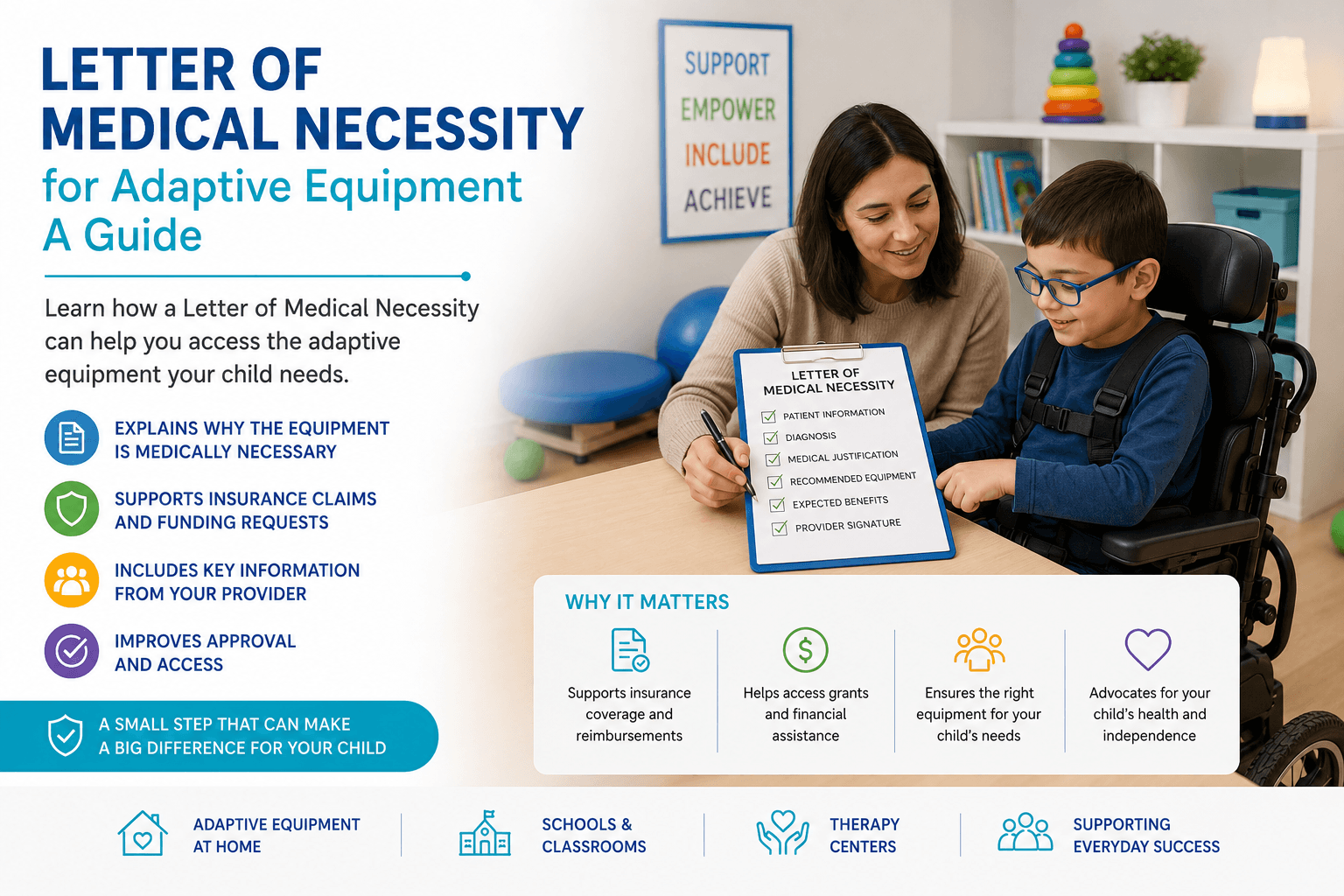
A letter of medical necessity, often called an LMN, is one of the most important documents families and caregivers can use when requesting funding for adaptive equipment. It explains why a specific product is needed, how it supports the individual’s medical or functional needs, and why less expensive or standard alternatives are not appropriate. A strong LMN can make the difference between an approval and a denial.
This guide explains what a letter of medical necessity is, who can write one, what should be included, which types of adaptive equipment often require one, and how families can improve their chances of securing funding.
What Is a Letter of Medical Necessity?
A letter of medical necessity is a formal document written by a qualified healthcare professional to explain why a patient needs a specific medical product, therapy, service, or piece of adaptive equipment. For adaptive equipment, the LMN connects the requested item to the individual’s diagnosis, functional limitations, daily care needs, safety concerns, and expected outcomes.
In simple terms, the letter answers one key question. Why is this equipment medically necessary for this person?
Insurance companies and funding programs use the LMN to decide whether the requested equipment meets their coverage criteria. The letter must do more than state that the equipment would be helpful. It must clearly explain why the equipment is necessary, appropriate, and directly related to the individual’s medical condition or disability.
Why Families Need an LMN for Adaptive Equipment
Families of children and adults with special needs often face major financial barriers when purchasing adaptive equipment.
Many products are essential for safety, independence, positioning, mobility, therapy, or daily living, but they may not be automatically covered by insurance. Even when coverage is possible, the funding source usually requires detailed documentation.
An LMN helps families by:
- Explaining the medical need for the requested equipment
- Supporting insurance prior authorization requests
- Helping Medicaid or waiver programs review the request
- Providing documentation for school districts or funding organizations
- Strengthening appeals after a denial
- Giving clinicians a structured way to justify the equipment
Without a strong LMN, funders may deny the request because they do not have enough information to understand why the equipment is needed.
How an LMN Differs from a Prescription or Doctor’s Note
A letter of medical necessity for adaptive equipment is more detailed than a standard prescription or doctor’s note. A prescription usually identifies what is being ordered. For example, it may say that a child needs a wheelchair, adaptive stroller, or communication device. A doctor’s note may confirm a diagnosis, limitation, or recommendation. An LMN goes further. It explains the clinical reasoning behind the request.
| Document Type | Main Purpose | Level of Detail |
|---|---|---|
| Prescription | Orders a product, service, or therapy | Basic |
| Doctor’s note | Confirms a condition, limitation, or recommendation | Moderate |
| Letter of medical necessity | Explains why the requested equipment is medically necessary | Detailed |
A strong LMN typically includes the diagnosis, functional limitations, equipment details, clinical justification, alternatives considered, and expected outcomes.
Who Can Write a Letter of Medical Necessity?
A letter of medical necessity for adaptive equipment should be written or signed by a licensed professional who is qualified to evaluate the individual’s condition and equipment needs. The best author depends on the type of equipment being requested and the requirements of the funding source.
Physicians and Pediatric Specialists
Physicians are often required to write or sign letters of medical necessity, especially for insurance or Medicaid requests.
This may include:
- Pediatricians
- Primary care physicians
- Physiatrists
- Neurologists
- Orthopedic specialists
- Developmental pediatricians
- Rehabilitation physicians
A physician’s signature may be especially important for mobility equipment, complex seating systems, assistive technology, and equipment tied to a specific medical diagnosis.
Occupational Therapists and Physical Therapists
Occupational therapists and physical therapists often play a major role in adaptive equipment requests.
They can provide detailed information about:
- Positioning needs
- Mobility limitations
- Fine motor challenges
- Gross motor function
- Transfer safety
- Muscle tone
- Postural control
- Daily living needs
- Therapy goals
- Equipment trials
For seating, positioning, mobility, bathing, toileting, and sensory equipment, therapists often provide the most detailed functional justification. In some cases, an OT or PT may write the LMN. In other cases, they may provide supporting documentation that a physician reviews and signs.
Other Qualified Healthcare Professionals
Depending on the equipment, other professionals may contribute to or write an LMN.
These may include:
- Speech language pathologists for communication devices
- Neurologists for neurological conditions
- Behavioral health providers for certain therapeutic supports
- Rehabilitation specialists for complex equipment needs
- Nurse practitioners or physician assistants when accepted by the payer
The most important factor is that the writer has the credentials and clinical knowledge required by the funding source.
What Adaptive Equipment Typically Requires an LMN?
Many types of adaptive equipment may require a letter of medical necessity, especially when insurance, Medicaid, waiver funding, or a school district is being asked to pay.
Mobility Equipment
Mobility equipment commonly requires an LMN because it directly affects safety, access, and independence.
Examples include:
- Manual wheelchairs
- Power wheelchairs
- Special needs strollers
- Gait trainers
- Walkers
- Standers
- Transfer equipment
For wheelchairs and special needs strollers, the LMN should explain why standard mobility options are not sufficient. It should describe the individual’s mobility limitations, endurance, postural needs, safety risks, and ability to participate in home, school, or community activities.
Adaptive Seating and Positioning Devices
Adaptive seating and positioning equipment often requires detailed medical justification.
Examples include:
- Positioning chairs
- Activity chairs
- Floor sitters
- Standers
- Supportive seating systems
- Positioning wedges
- Lateral supports
- Head supports
The LMN should explain how the equipment supports posture, alignment, respiratory function, feeding, communication, participation, or safety. For children with cerebral palsy, low muscle tone, poor trunk control, or orthopedic concerns, proper positioning can be essential for daily function.
Sensory Room Equipment and Deep Pressure Products
Some sensory products may require an LMN when families seek coverage through insurance, Medicaid, waivers, grants, or other funding programs.
Examples include:
- Weighted blankets
- Compression products
- Sensory seating
- Therapy swings
- Crash pads
- Calming sensory equipment
- Sensory room tools
The LMN should connect the equipment to documented sensory needs, safety concerns, emotional regulation challenges, therapy goals, or functional participation. For children with autism or sensory processing challenges, the letter should clearly explain how the equipment supports regulation, reduces harmful behaviors, or improves participation in daily routines.
Bathing, Toileting, and Daily Living Aids
Adaptive equipment for daily care may require an LMN because it supports hygiene, safety, transfers, and caregiver assistance.
Examples include:
- Bath chairs
- Shower chairs
- Toileting systems
- Commode chairs
- Transfer benches
- Adaptive utensils
- Dressing aids
- Supportive changing systems
The LMN should describe the individual’s limitations with bathing, toileting, transfers, balance, strength, safety, and caregiver burden.
Height Adjustable Tilting Benches - Medium
$289.95
The Height Adjustable Tilting Benches - Medium provides supportive seating designed to help children maintain better posture, stability, and alignment during seated activities, therapy sessions, and everyday developmental work. Created for users who do not need full back support but… read more

Assistive Technology Devices
Assistive technology often requires extensive documentation because these devices can be costly.
Examples include:
- AAC devices
- Communication switches
- Adaptive computer access tools
- Environmental control systems
- Mounting systems
- Specialized learning technology
For communication devices, a speech language pathologist may need to provide detailed assessment findings, communication goals, device trials, and evidence that the requested device is appropriate.
What to Include in a Letter of Medical Necessity for Adaptive Equipment
A strong letter of medical necessity for adaptive equipment should be specific, complete, and tailored to the funding source.
Generic letters are more likely to be denied.
Patient Information and Diagnosis
The letter of medical necessity for adaptive equipment should include basic identifying and medical information.
This may include:
- Patient name
- Date of birth
- Diagnosis
- Relevant medical history
- ICD codes when available
- Current treatment or therapy services
- Name and credentials of the clinician writing the letter
The diagnosis alone is usually not enough. The letter must explain how the diagnosis affects daily function.
Functional Limitations
The letter of medical necessity for adaptive equipment should clearly describe what the individual cannot do safely or independently without the requested equipment.
Examples may include difficulty with:
- Sitting upright
- Walking safely
- Maintaining balance
- Completing transfers
- Communicating needs
- Participating in school
- Bathing or toileting
- Regulating sensory input
- Avoiding injury
- Participating in community activities
Functional details are often more persuasive than diagnosis labels alone.
Description of the Requested Equipment
The letter of medical necessity for adaptive equipment should identify the specific equipment being requested.
Include details such as:
- Product name
- Manufacturer
- Model
- Size
- Features
- Accessories
- Supplier
- Quote or price estimate if available
Being specific helps the reviewer understand exactly what is being requested and why each feature matters.
Clinical Justification
This is the most important part of the LMN. The clinician should explain why the equipment is medically necessary and how it addresses the individual’s needs.
A strong justification may include:
- Assessment findings
- Therapy observations
- Safety concerns
- Equipment trials
- Functional goals
- Caregiver needs
- Medical risks if the equipment is not provided
- Expected benefits of using the equipment
The letter of medical necessity for adaptive equipment should make a clear connection between the equipment and the individual’s daily functioning.
Why Lower Cost Alternatives Are Not Enough
Many funding sources want to know whether a less expensive option could meet the same need. The LMN should explain why standard or lower cost alternatives are not appropriate.
For example:
- A standard stroller may not provide necessary postural support
- A standard chair may not prevent unsafe positioning
- A basic walker may not provide adequate stability
- A non adaptive bath seat may not support safe transfers
- A general calming item may not meet documented sensory needs
This section helps show that the requested item is not simply preferred, but necessary.
Prognosis and Expected Outcomes
The letter of medical necessity for adaptive equipment should explain what improvements or protections are expected if the equipment is approved.
Possible outcomes may include:
- Improved safety
- Better posture
- Increased independence
- Reduced caregiver strain
- Improved participation in school or therapy
- Better communication access
- Reduced risk of injury
- Improved ability to complete daily care routines
Clear expected outcomes help funders understand the value of the equipment.
Letter of Medical Necessity Requirements by Funding Source
Different funding sources may have different requirements. Families should always review the specific rules for their insurance plan, Medicaid program, school district, waiver program, or grant provider.
Medicaid and EPSDT Requirements
Medicaid programs often require documentation that the requested equipment is medically necessary. For children under 21, EPSDT may provide additional pathways for medically necessary services and equipment. Requirements vary by state, but documentation often needs to show that the item corrects, improves, or helps manage a medical or developmental condition. Families should check their state Medicaid requirements and ask whether prior authorization is needed.
Private Insurance Requirements
Private insurance companies often require prior authorization before approving adaptive equipment.
Common requirements may include:
- Prescription
- Letter of medical necessity
- Diagnosis codes
- Therapy evaluation
- Equipment quote
- Supplier information
- Documentation of alternatives tried
- Policy specific forms
The language in the LMN should align with the insurance plan’s coverage criteria whenever possible.
Kaiser and Other Major Health Plans
Large health plans may have their own internal review processes, forms, preferred suppliers, and authorization requirements.
Families should contact the plan directly to ask:
- Who must write or sign the LMN
- Whether prior authorization is required
- Which supplier must be used
- What forms are needed
- Whether therapy evaluations are required
- How appeals are handled
Requirements can vary significantly by plan and region.
School District and IDEA Funding
When adaptive equipment is needed for school access, participation, or IEP implementation, funding may involve the school district rather than health insurance.
In school settings, documentation may need to show how the equipment supports:
- Access to education
- IEP goals
- Classroom participation
- Therapy services
- Safety during the school day
- Communication
- Mobility within the school environment
School based equipment requests often involve the IEP team, therapists, special education staff, and district administrators.
How to Get a Letter of Medical Necessity
Getting a letter of medical necessity for adaptive equipment is easier when families prepare before speaking with the clinician.
Step 1: Identify the Equipment You Need
Start by determining what equipment is needed and why.
Consider:
- What daily challenge needs to be solved?
- Where will the equipment be used?
- Who will use it?
- What features are required?
- Has a therapist recommended a specific product?
- Are there safety concerns?
- Will the item support therapy, school, home, or community participation?
Families can also request product guidance from adaptive equipment specialists to identify appropriate options and gather quotes.
Step 2: Speak with the Healthcare or Therapy Team
Once you have identified the equipment, contact the child’s physician, therapist, or specialist. Bring clear information about the need.
Helpful details include:
- Diagnosis
- Current challenges
- Therapy goals
- Safety concerns
- Equipment currently being used
- Why current equipment is not enough
- Product information for the requested item
The more specific the request, the easier it is for the clinician to write a complete letter.
Step 3: Provide Equipment Details and Documentation
Clinicians may not know the exact product specifications.
Families can help by providing:
- Product name
- Product description
- Manufacturer information
- Quote
- Supplier contact information
- Photos or product pages
- Therapy notes
- IEP documentation if school related
- Insurance requirements if available
This helps prevent missing details that could delay approval.
Step 4: Review the LMN Before Submission
Before sending the letter to the funding source, review it carefully.
Check that it includes:
- Correct patient information
- Accurate diagnosis
- Specific equipment name
- Functional limitations
- Clear medical justification
- Explanation of why alternatives are not enough
- Clinician signature and credentials
- Date
- Any required payer language or forms
Small errors can slow down approval.
Step 5: Submit the LMN to the Funding Source
Submit the letter of medical necessity for adaptive equipment with all required supporting documents.
A complete package may include:
- Letter of medical necessity
- Prescription
- Product quote
- Therapy evaluation
- Insurance forms
- Prior authorization request
- Medical records
- Supplier documentation
After submission, keep copies of everything and track the request regularly.
Free Letter of Medical Necessity Template
A letter of medical necessity template can help families and clinicians save time.
A good LMN template should include:
- Patient information
- Diagnosis
- Requested equipment
- Functional limitations
- Clinical justification
- Alternatives considered
- Expected outcomes
- Clinician signature section
Templates should always be customized. A generic letter is less effective than one that clearly explains the individual’s specific needs.
Sample Letter of Medical Necessity for Adaptive Equipment
Below is a sample structure that shows how an LMN may be organized.
Date:
Patient Name:
Date of Birth:
Diagnosis:
Requested Equipment:
Clinician Name and Credentials:
To Whom It May Concern,
I am writing to document the medical necessity of the requested adaptive equipment for the patient named above.
The patient has a diagnosis of [diagnosis], which affects [mobility, posture, communication, sensory regulation, daily living, or other functional area]. As a result, the patient experiences significant difficulty with [specific functional limitations].
The requested equipment, [product name], is medically necessary because it will support [specific need]. Without this equipment, the patient is at increased risk for [safety concern, reduced participation, injury, caregiver strain, poor positioning, or other relevant concern].
Standard alternatives have been considered and are not appropriate because [explain why lower cost or non adaptive options do not meet the clinical need].
The expected benefits of this equipment include [improved safety, better positioning, improved communication, increased independence, improved participation, reduced caregiver burden, or other outcomes].
Based on my clinical evaluation, I recommend approval of this equipment as medically necessary.
Sincerely,
[Clinician Name]
[Credentials]
[License Number]
[Contact Information]
Tips for Customizing an LMN Template
To improve the strength of the letter:
- Use the patient’s specific diagnosis and functional limitations
- Avoid vague statements like “this would be helpful”
- Explain why the equipment is medically necessary
- Include details about safety and daily function
- List the exact equipment being requested
- Address lower cost alternatives
- Match the funding source’s requirements
- Include supporting documentation
- Ask the clinician to use clear clinical language
The strongest letter of medical necessity for adaptive equipment are personalized, detailed, and directly connected to real life function.
What to Do If Your LMN Is Denied
A denial can be frustrating, but it does not always mean the request is over. Denials are common, and many families succeed after submitting additional documentation or filing an appeal.
Common Reasons for LMN Denial
Funding requests may be denied because:
- The letter was too vague
- The diagnosis was listed but functional needs were not explained
- The equipment was not described clearly
- Lower cost alternatives were not addressed
- Required forms were missing
- The clinician’s credentials were not accepted
- The request did not match the policy criteria
- The payer considered the item convenience based rather than medically necessary
- There was not enough evidence of safety or functional need
Understanding the reason for denial helps families strengthen the next submission.
How to Appeal an Insurance Denial
If the request is denied, review the denial letter carefully.
Then take these steps:
- Identify the specific reason for denial
- Ask the insurer what documentation is missing
- Request the plan’s medical policy for the item
- Ask the clinician to revise or expand the LMN
- Add therapy notes, evaluations, photos, or progress reports
- Include a stronger explanation of why alternatives are not appropriate
- Submit the appeal before the deadline
- Keep copies of every document
A revised LMN with stronger clinical details can improve the chances of approval.
How eSpecial Needs Helps Families Navigate Adaptive Equipment Funding
Finding the right adaptive equipment can be overwhelming, especially when funding approval depends on documentation. eSpecial Needs helps families, caregivers, schools, and clinicians identify equipment that supports mobility, positioning, sensory needs, therapy goals, daily living, and independence.
Families can use eSpecial Needs as a resource when gathering product information for an LMN, requesting quotes, and comparing adaptive equipment options.
Expert Quote Request Service
A detailed quote can be helpful when preparing a letter of medical necessity for adaptive equipment. eSpecial Needs can help families identify appropriate equipment options and provide product details that clinicians may need when writing an LMN. This can support a stronger funding request by giving the clinician clear information about the requested item.
Funding Resources and LMN Support
Families often need more than product options. They need guidance on the funding process. eSpecial Needs provides helpful resources for families exploring insurance, Medicaid, school based funding, grants, and other financial assistance options. Having the right product information, quote details, and documentation can make the LMN process easier to manage.
Shop Adaptive Equipment for Medical Necessity Requests
eSpecial Needs offers a wide selection of adaptive equipment that may support medical necessity documentation, including:
- Mobility equipment
- Special needs strollers
- Adaptive seating
- Positioning products
- Sensory equipment
- Therapy tools
- Daily living aids
- Bathing and toileting supports
- Communication and assistive technology products
Whether your family is preparing an insurance request, Medicaid submission, school equipment request, or grant application, starting with the right equipment information can help support the process.
Why Letters of Medical Necessity Are Important
A letter of medical necessity is one of the most important tools families can use when seeking funding for adaptive equipment. A strong LMN clearly explains the diagnosis, functional limitations, requested equipment, clinical justification, alternatives considered, and expected outcomes. The more specific and personalized the letter is, the stronger the request becomes.
Families should work closely with physicians, therapists, equipment specialists, and funding sources to make sure the letter of medical necessity for adaptive equipment includes all required information. With the right documentation and the right support, families can improve their chances of securing adaptive equipment that helps their child or loved one move, communicate, participate, and live more safely.
FAQs
What is a letter of medical necessity?
A letter of medical necessity, often called an LMN, is a formal document written by a qualified healthcare professional that explains why a patient needs a specific product, service, therapy, or piece of adaptive equipment. For adaptive equipment, the letter connects the requested item to the person’s diagnosis, functional limitations, safety needs, and expected outcomes.
Why do I need a letter of medical necessity for adaptive equipment?
Many insurance companies, Medicaid programs, school districts, and funding organizations require proof that adaptive equipment is medically necessary before they will approve payment. An LMN explains why the equipment is needed, how it supports daily function, and why standard or lower cost alternatives are not appropriate.
Who can write a letter of medical necessity?
A letter of medical necessity is usually written by a licensed healthcare professional, such as a physician, pediatric specialist, occupational therapist, physical therapist, speech language pathologist, neurologist, nurse practitioner, or rehabilitation specialist. The right professional depends on the requested equipment and the funding source’s requirements.
Does a doctor have to write the LMN?
Not always. Some funding sources require a physician to write or sign the letter, while others may accept documentation from an occupational therapist, physical therapist, speech language pathologist, nurse practitioner, or other qualified clinician. Families should check with the insurance plan, Medicaid program, school district, or funding organization before submitting the request.
Is a letter of medical necessity the same as a prescription?
No. A prescription usually identifies what product or service is being ordered. A letter of medical necessity explains why the product or service is medically necessary. An LMN is more detailed and typically includes diagnosis, functional limitations, clinical justification, alternatives considered, and expected outcomes.
What should be included in a letter of medical necessity?
A strong LMN should include the patient’s name, diagnosis, relevant medical history, functional limitations, requested equipment, product details, clinical justification, why alternatives are not sufficient, expected outcomes, and the clinician’s signature and credentials. Some funding sources may also require diagnosis codes, therapy evaluations, quotes, or prior authorization forms.
What types of adaptive equipment may require an LMN?
Adaptive equipment that commonly requires an LMN includes wheelchairs, special needs strollers, adaptive seating, positioning systems, standers, gait trainers, sensory equipment, bath chairs, toileting systems, communication devices, assistive technology, and daily living aids. Requirements vary by payer and product category.
Do sensory products need a letter of medical necessity?
Sometimes. Sensory equipment such as weighted blankets, compression products, sensory seating, therapy swings, crash pads, and calming tools may require an LMN if a family is seeking insurance, Medicaid, waiver, grant, or school funding. The letter should explain how the sensory product supports regulation, safety, therapy goals, or daily participation.
Can an LMN help pay for a special needs stroller?
Yes. A special needs stroller often requires an LMN because it supports mobility, positioning, safety, and community access. The letter should explain why a standard stroller is not appropriate, describe the child’s mobility or postural needs, and identify the specific features required.
Can an LMN help pay for a wheelchair?
Yes. Wheelchairs commonly require a letter of medical necessity. The LMN should explain the individual’s mobility limitations, ability to self propel if applicable, postural support needs, safety risks, endurance, home and community access needs, and why the requested wheelchair is medically necessary.
Can an LMN help pay for adaptive seating?
Yes. Adaptive seating and positioning devices often require an LMN. The letter should explain how the equipment supports posture, alignment, feeding, communication, respiratory function, classroom participation, therapy goals, or safe daily positioning.
Can an LMN help pay for bathing or toileting equipment?
Yes. Bath chairs, shower chairs, commode chairs, toileting systems, and transfer aids may require an LMN when funding is requested. The letter should document balance, strength, mobility, transfer, hygiene, and caregiver safety needs.
Can an LMN support assistive technology funding?
Yes. Assistive technology, including AAC devices and adaptive access tools, often requires detailed medical or therapeutic justification. The LMN may need to include communication needs, assessment findings, device trials, therapy goals, and evidence that the requested device is appropriate.
What is the most important part of an LMN?
The most important part of an LMN is the clinical justification. This section explains why the requested equipment is medically necessary for the individual’s specific condition and functional needs. It should clearly connect the diagnosis, limitations, safety concerns, and expected outcomes to the requested product.
How specific should the requested equipment description be?
The equipment description should be as specific as possible. Include the product name, manufacturer, model, size, features, accessories, supplier, and quote when available. Specific details help reviewers understand exactly what is being requested and why each feature is needed.
Why should the LMN explain lower cost alternatives?
Funding sources often want to know whether a less expensive or standard option could meet the same need. The LMN should explain why those alternatives are not safe, effective, or appropriate. This helps show that the requested equipment is necessary rather than simply preferred.
What are common reasons an LMN is denied?
Common reasons for denial include vague medical justification, missing functional details, incomplete product information, lack of diagnosis codes, missing signatures, failure to address lower cost alternatives, missing prior authorization forms, or the payer deciding the item is not covered under the policy.
What should I do if my LMN is denied?
If an LMN is denied, review the denial letter carefully and identify the specific reason. Ask the funding source what documentation is missing, request the relevant policy criteria, and work with the clinician to revise the LMN. Adding therapy notes, evaluations, product quotes, photos, and stronger clinical justification may improve an appeal.
Can I appeal an insurance denial for adaptive equipment?
Yes. Many families appeal denials for adaptive equipment. The appeal should directly respond to the reason for denial and include stronger documentation. A revised LMN, therapy evaluation, physician notes, equipment trial results, and explanation of why alternatives are not appropriate can help support the appeal.
How long does it take to get approval after submitting an LMN?
Approval timelines vary by funding source. Private insurance, Medicaid, school districts, and grant programs may each have different review processes. Families should ask about expected timelines, prior authorization steps, appeal deadlines, and how to track the request after submission.
Does Medicaid require a letter of medical necessity?
Medicaid often requires documentation showing that requested adaptive equipment is medically necessary. Requirements vary by state and equipment type. For children under 21, EPSDT may provide additional pathways for medically necessary services or equipment, but families should confirm state specific rules.
Does private insurance require an LMN?
Many private insurance plans require an LMN for adaptive equipment, especially if prior authorization is needed. Plans may also require a prescription, therapy evaluation, diagnosis codes, supplier quote, medical records, or plan specific forms.
Can a school district request a letter of medical necessity?
Yes. If adaptive equipment is needed for school access, classroom participation, therapy services, mobility, communication, or safety, the school district may request documentation. School based requests may involve the IEP team, therapists, special education staff, and district administrators.
Is an LMN required for IDEA or IEP related equipment?
Not always, but documentation is usually required. If equipment is needed for a student to access education or meet IEP goals, the IEP team may need written justification from school therapists, physicians, or other professionals. The documentation should connect the equipment to educational access and functional participation.
Can parents write a letter of medical necessity?
Parents can provide helpful supporting information, but the LMN itself should usually be written or signed by a qualified healthcare professional. Parents can help by sharing daily challenges, safety concerns, equipment information, and examples of how the equipment would improve function.
Can a caregiver write supporting documentation?
Yes. A caregiver statement can strengthen a request by describing daily care challenges, transfer risks, mobility limitations, safety concerns, and the impact on family routines. However, it usually does not replace a clinician written LMN.
What information should I give my clinician before they write an LMN?
Provide the clinician with the product name, model, supplier, quote, photos or product page, diagnosis information, functional challenges, therapy goals, insurance requirements, and examples of why current equipment or standard alternatives do not meet the need.
Should I review the LMN before submitting it?
Yes. Families should review the LMN for accuracy and completeness before submission. Check the patient information, diagnosis, equipment name, clinical justification, alternatives considered, expected outcomes, clinician credentials, date, and any required payer forms.
Can I use a letter of medical necessity template?
Yes. A template can help organize the letter and ensure important details are included. However, every LMN should be customized to the individual, diagnosis, equipment, functional limitations, and funding source. Generic letters are more likely to be denied.