Table of Contents
- Why Climbing Is One of the Most Powerful Therapeutic Activities for Special Needs Kids
- The 8 Best Climbing Products for Children With Special Needs
- 1. Spark Indoor Therapy Gym — Best All-in-One Movement System
- 2. Adjustable Indoor Climbing Wall — Best for Home Sensory Rooms
- 3. Adaptive Climbing Wall — Best for Schools and Adapted PE
- 4. Everlast Climbing Tyke Tower — Best Freestanding Climbing Wall for Preschoolers
- 5. Soft Tunnel Climber — Best for Toddlers and Early Movers
- 6. Soft Play Mini Climber Ball Pit — Best Combo for Sensory-Seeking Toddlers
- 7. Interactive Climbing Accessories — Best for Adding Cognitive Challenge
- 8. Pattern Gross Motor Foam Climbing Blocks — Best for Configurable Play
- How to Choose the Right Climbing Setup
- Frequently Asked Questions About Climbing for Special Needs Kids
- Is climbing safe for children with autism or sensory processing differences?
- What age can my child start climbing?
- Why does my autistic child climb on everything?
- How much space do I need for a home climbing setup?
- How long should a climbing session last to get therapeutic benefit?
- Can climbing replace occupational therapy?
- Are climbing walls covered by insurance or Medicaid waivers?
- What’s the difference between a climbing wall and a soft climber?
- Does eSpecial Needs offer quotes for schools and clinics?
- Ready to Get Them Climbing?
Reading time: 9 minutes | Last updated: 2026
If you’ve ever watched a child with sensory needs scale the back of the couch for the fifth time today and thought, “there has to be a reason they keep doing this” — there is. The body is asking for input it can’t get any other way.
Climbing is one of the most therapeutically complete activities a child can do. It engages strength, balance, vestibular processing, proprioception, and motor planning all at once — which is exactly why occupational therapists, physical therapists, adapted PE teachers, and sensory gym designers consistently include climbing equipment in their setups.
In this guide, we break down why climbing matters for kids with special needs, then walk through the 8 best climbing products for homes, classrooms, and clinics — with picks for every age, ability, and space.
💚 Limited-time offer: Save 10% on select climbing products with code CLIMBING10 at checkout. Shop the full Climbing collection →
Why Climbing Is One of the Most Powerful Therapeutic Activities for Special Needs Kids
Climbing looks like play. It functions like therapy. Here’s what’s happening inside a child’s body and brain every time they climb:
1. Builds Strength and Muscle Tone
Climbing engages nearly every major muscle group — arms, shoulders, core, glutes, legs — in a single sustained activity. For children with low muscle tone (hypotonia), Down syndrome, cerebral palsy, or general motor delays, climbing provides full-body resistance work that builds grip strength, postural endurance, and the trunk stability needed for everything from sitting at a desk to handwriting.
2. Develops Gross Motor Skills and Motor Planning
Every climb is a sequence of decisions: where does the right hand go, then the left foot, then the left hand? This is motor planning (praxis) in action — and it’s exactly the skill many children with autism, dyspraxia, and developmental coordination disorder struggle with. Climbing makes motor planning something the body wants to practice.
3. Trains Balance and Postural Control
Climbing demands constant micro-adjustments to stay upright on an unstable, vertical surface. This trains postural muscles, the inner-ear vestibular system, and the brain’s ability to coordinate the two — building the foundation for walking on uneven ground, riding a bike, and navigating crowded spaces.
4. Delivers Vestibular Input
The vestibular system — the inner-ear sensors that tell the body where it is in space — is activated every time a child changes head position. Climbing puts the head in dozens of positions per session: looking up, down, sideways, twisting. For sensory-seeking kids who climb couches, spin in circles, or hang upside down, climbing provides a safe, intentional outlet for the input they’re craving.
5. Provides Proprioceptive Input ("Heavy Work")
Proprioception is the body’s sense of itself in space — where my arms are, how hard I’m gripping, how much force I’m using. Climbing delivers strong proprioceptive input through the joints and muscles, which is calming and organizing for the nervous system. This is why therapists classify climbing as a “heavy work” activity, and why so many kids are noticeably calmer and more focused after a climbing session.
6. Supports Focus, Self-Regulation, and Emotional Control
The combination of proprioceptive and vestibular input from climbing has a documented organizing effect on the nervous system. Many caregivers and therapists report that 10–15 minutes of climbing before a focused task — therapy, homework, or transitions — meaningfully improves attention, sitting tolerance, and mood.
7. Builds Confidence and Independence
For a child who’s spent years hearing “be careful” and “slow down,” reaching the top of a climbing wall they couldn’t summit last month is powerful. Climbing for kids with special needs teaches calculated risk-taking, persistence through difficulty, and the deep confidence that comes from doing something hard. These skills transfer to every other domain — academic, social, emotional.
Browse therapist-trusted climbing gear →
The 8 Best Climbing Products for Children With Special Needs
We chose these eight products based on what we hear daily from occupational therapists, adapted PE teachers, and parents — and on which items consistently get reordered by schools and clinics. Each pick includes who it’s best for, key features, and why it earns its place.
1. Spark Indoor Therapy Gym — Best All-in-One Movement System
Best for: Schools, therapy clinics, and families ready for a complete sensory-motor setup.
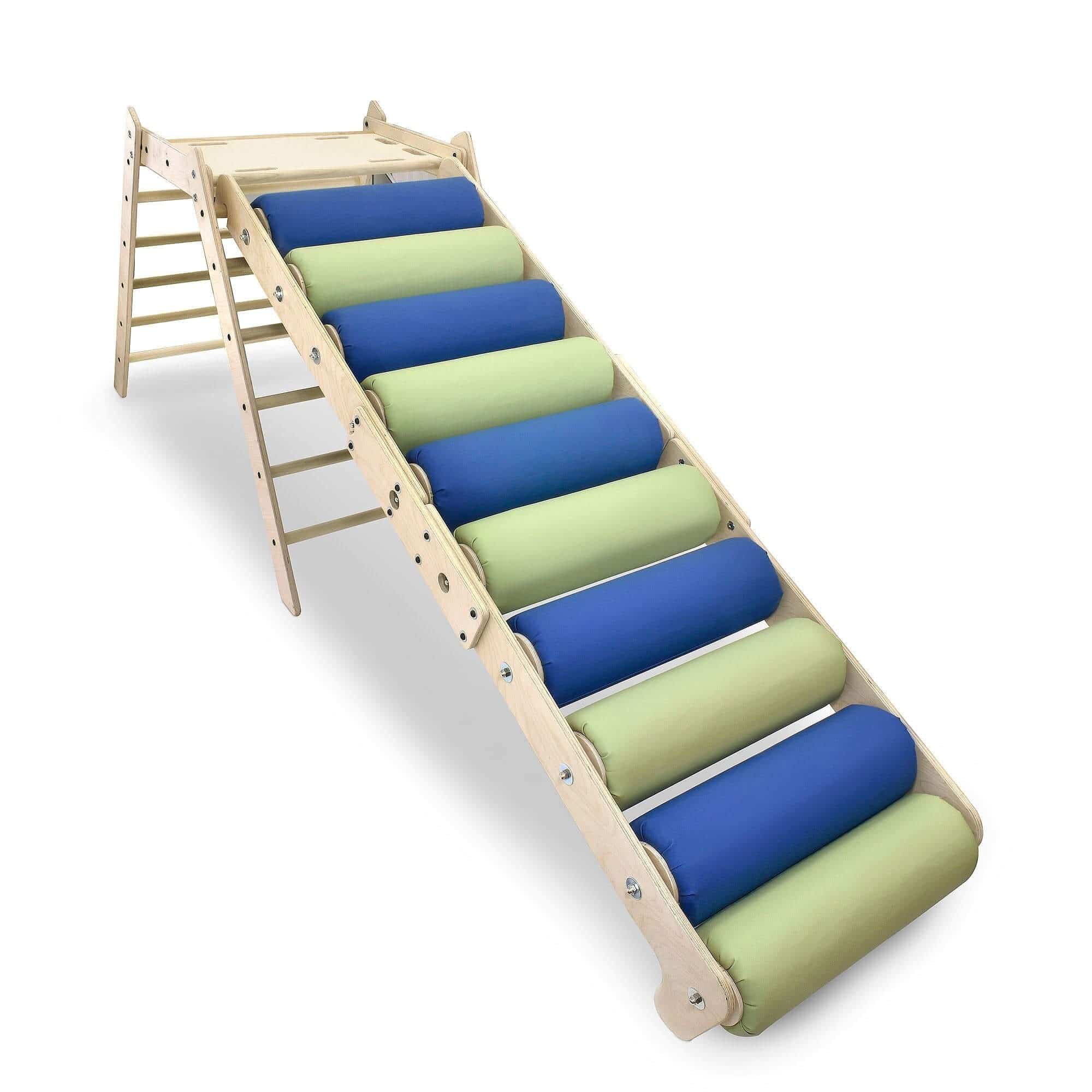
What if the most therapeutic thing in the room looked exactly like a jungle gym? The Spark Indoor Therapy Gym is a freestanding Douglas fir monkey-bar system with ladders on both sides and a swing-attachment glider — bringing climbing for kids with special needs, hanging, gliding, and spinning into a single piece of equipment.
This is the workhorse of pediatric therapy gyms. It supports vestibular work (swinging), proprioceptive input (hanging, climbing), and motor planning (navigating the bars) — and grows with the child from toddlerhood through the early teen years.
- Solid Douglas fir construction
- Built-in ladders for climbing on both sides
- Compatible with swing and glider attachments
- Heavy-duty design for clinical/educational use
Use code CLIMBING10 for 10% off. Shop the Indoor Therapy Gym →
2. Adjustable Indoor Climbing Wall — Best for Home Sensory Rooms
Best for: Families building a home sensory space; smaller therapy clinics.
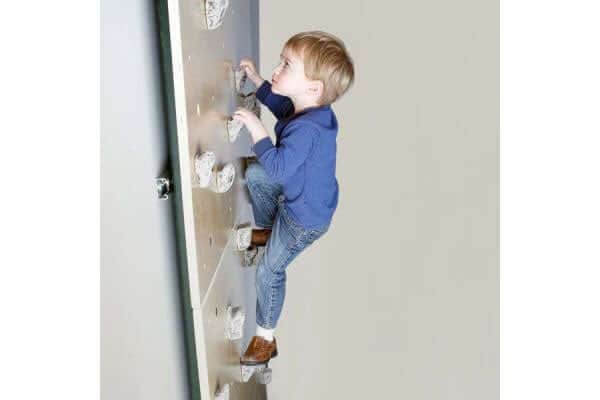
Three panels. Thirty holds. One adjustable tilt that makes climbing accessible for every body. The Adjustable Indoor Climbing Wall installs on any wall and tilts forward 15° with the removal of just two bolts — letting beginners climb at an easier angle, then ramping up the challenge as skills grow.
This is the most flexible at-home climbing investment we recommend. The adjustable angle means one wall serves a child from age 4 to 14, and the color-coded holds support route-setting games that build sequencing and visual planning.
- Adjustable 0°–15° tilt for graded challenge
- 30 color-coded Groperz™ hand holds
- Mounts to standard wall framing
- Compact footprint — fits in playrooms and bedrooms
Use code CLIMBING10 for 10% off. Shop the Adjustable Climbing Wall →
3. Adaptive Climbing Wall — Best for Schools and Adapted PE
Best for: Adapted PE programs, special education classrooms, and pediatric OT clinics.
The first climbing wall built specifically for the kids who get left out of climbing. The Adaptive Climbing Wall pairs color-coded Groperz™ hand holds with grab-bar and ledge-style adaptive holds — giving climbers with limited grip strength, motor planning challenges, or balance differences a way to participate alongside peers.
The dry-erase magnetic surface lets teachers and therapists integrate academics directly into climbing: spelling words, math problems, color-matching games. It’s the gold standard for inclusive classrooms and adapted PE programs.
- Mix of standard and adaptive hand holds
- Dry-erase magnetic surface for learning integration
- Color-coded routes for graded challenge
- Designed for inclusive, multi-ability classrooms
See the Adaptive Climbing Wall →
4. Everlast Climbing Tyke Tower — Best Freestanding Climbing Wall for Preschoolers
Best for: Preschools, daycares, pediatric clinics, and homes without dedicated wall space.
A five-foot climbing wall that also teaches the alphabet — built for the hands that haven’t quite figured out either yet. The Everlast Climbing Tyke Tower is a freestanding 5-foot, four-sided preschool climbing wall with a magnet-accepting Magna® surface, color-coded tendon-friendly Groperz™ hand holds, and educational letter and number magnets.
This is the rare product that integrates gross motor climbing, fine motor manipulation, and early literacy into one experience. Kids climb around all four sides while arranging magnets — building strength, dexterity, and pre-reading skills simultaneously. It disassembles in about 15 minutes, so it’s ideal for shared therapy spaces and facilities without dedicated wall mounting.
- 5-foot freestanding wall, climbable on all four sides
- Magna® surface with letter and number magnets
- Tendon-friendly Groperz™ hand holds, color-coded by difficulty
- Includes Discovery Plate and activity guide
- Disassembles for transport and storage
Use code CLIMBING10 for 10% off. Shop the Tyke Tower →
5. Soft Tunnel Climber — Best for Toddlers and Early Movers
Best for: Toddlers, early intervention, and children just beginning to climb.
Climbing for the climbers who aren’t ready to climb yet. The Soft Tunnel Climber is an 18″ high, 6-foot square soft-foam play system that gives toddlers and early movers a safe place to crawl, climb, tumble, and build the foundational strength and confidence that real climbing requires.
Soft climbers are often the missing piece in early intervention. They let kids practice the body mechanics of climbing — pushing with the legs, gripping with the hands, navigating uneven surfaces — without the height risk. The foam absorbs every stumble, so confidence builds faster than caution.
- Soft, durable foam construction
- Low 18″ profile for safe early climbing
- 6-foot square footprint
- Ideal for children ages 18 months to 4 years
6. Soft Play Mini Climber Ball Pit — Best Combo for Sensory-Seeking Toddlers
Best for: Sensory-seeking toddlers, daycares, waiting rooms, and home sensory corners.
Climb up. Tumble in. Disappear into 130 colorful balls. Repeat for the next hour. The Soft Play Mini Climber Ball Pit pairs a vinyl-coated foam corner climber with a 130-ball ball pit in one Velcro-connected activity center — delivering safe climbing, soft tumbling, and deep-pressure proprioceptive input in one footprint.
The ball pit is the secret weapon. The pressure of 130 balls against the body is highly regulating for sensory-seeking kids — it’s essentially built-in deep-pressure input, the same principle behind weighted blankets and compression vests. Pair it with the climbing approach and you get a complete sensory experience in one corner.
- Combines corner climber + 130-ball ball pit
- Vinyl-coated nylon over polyurethane foam
- Velcro-connected modular pieces
- Wipe-clean for high-traffic environments
- Must be placed in a corner against walls for safe play
Use code CLIMBING10 for 10% off. Shop the Mini Climber Ball Pit →
7. Interactive Climbing Accessories — Best for Adding Cognitive Challenge
Best for: Any existing climbing wall; therapists and teachers working on visual attention and sequencing.
Eight colors. Sixteen modes. One controller that turns climbing into a problem-solving game. Interactive climbing accessories — color-targeted hold systems, adaptive grab bars, and route-setting tools — turn any climbing wall into a multi-sensory cognitive workout.
These accessories transform the wall from a one-dimensional motor activity into something far more cognitively rich. “Can you get to the top using only green holds?” builds visual scanning, planning, and sequencing skills that transfer directly to academic learning.
- Color-targeted hold systems
- Adaptive grab bars and ledges
- Compatible with most existing climbing walls
- Supports visual scanning, sequencing, and motor planning goals
8. Pattern Gross Motor Foam Climbing Blocks — Best for Configurable Play
Best for: Preschools, early intervention programs, and families wanting a setup that grows with the child.
Modular foam blocks that grow with the kid — and rearrange themselves every time the room feels stale. Pattern Gross Motor Foam Climbing Blocks are configurable soft-play sets that let you create endless climbing courses for toddlers and preschoolers, with the safety and softness needed for the youngest, smallest climbers.
The reconfigurability is the magic. The same set of blocks becomes a tunnel one week, a staircase the next, an obstacle course the week after. That novelty keeps engagement high, which means kids actually use the gear — and parents and therapists get their money’s worth.
- Modular foam blocks that reconfigure into endless layouts
- Soft, durable, wipe-clean covers
- Ideal for children ages 18 months to 5 years
- Supports gross motor, motor planning, and creativity
How to Choose the Right Climbing Setup
Not sure where to start? Use this quick decision framework based on age, environment, and goals:
By age and developmental stage
- Ages 18 months – 3 years: Start with the Mini Climber Ball Pit or Soft Tunnel Climber for safe early climbing.
- Ages 3 – 5 years: The Tyke Tower or Foam Climbing Blocks bridge the gap to real climbing.
- Ages 5 – 12 years: The Adjustable Indoor Climbing Wall grows with the child for years.
- Ages 5 and up — institutional: The Spark Indoor Therapy Gym or Adaptive Wall serve a whole program.
By environment
- Home sensory rooms: Adjustable Climbing Wall + Foam Climbers
- Preschools and daycares: Tyke Tower + Mini Climber Ball Pit
- Therapy clinics: Indoor Therapy Gym + Interactive Accessories
- Schools and adapted PE: Adaptive Climbing Wall + Tyke Tower
By therapeutic goal
- Sensory regulation: Ball Pit Climber, Indoor Therapy Gym
- Motor planning and sequencing: Adjustable Wall, Interactive Accessories
- Early gross motor development: Soft Tunnel Climber, Foam Blocks
- Academic integration: Tyke Tower, Adaptive Wall
Frequently Asked Questions About Climbing for Special Needs Kids
Is climbing safe for children with autism or sensory processing differences?
Yes — climbing is widely used by occupational therapists as a therapeutic activity for children with autism, ADHD, and sensory processing differences. The proprioceptive and vestibular input from climbing is calming and organizing for most sensory-seeking children. As with any physical activity, climbing should be supervised, equipment should be age-appropriate, and safety mats should be used for any climbing wall over a few feet high.
What age can my child start climbing?
Children can begin climbing as soon as they’re mobile — typically around 18 months — using soft foam climbers and ball-pit climbers. Around age 3, most children are ready for low freestanding walls like the Tyke Tower. Real wall climbing on hold-based systems generally starts around age 4 or 5, depending on grip strength and motor coordination.
Why does my autistic child climb on everything?
Climbing on furniture, doorframes, and household objects is usually a sign that a child’s nervous system is seeking vestibular and proprioceptive input — sensory information about movement and body position. Providing a dedicated, safe climbing outlet (like a climbing wall or soft climber) typically reduces unsafe climbing behavior at home because the child can finally get the sensory input they need in a safe, predictable way.
How much space do I need for a home climbing setup?
It depends on the equipment. A soft foam climber or ball-pit climber needs about a 6′ × 6′ corner. An adjustable wall-mounted climbing wall needs about 4′ × 6′ of wall space plus a landing zone of crash mats below. The freestanding Tyke Tower needs roughly an 18′ × 18′ use zone for safe play. The Spark Indoor Therapy Gym needs a dedicated room with at least 10-foot ceilings.
How long should a climbing session last to get therapeutic benefit?
Most occupational therapists recommend 10–15 minutes of climbing to deliver a meaningful dose of vestibular and proprioceptive input. Many caregivers report noticeable improvements in focus, mood, and regulation for 1–2 hours after a session. Climbing is often used as a “sensory snack” before tasks that require focus — therapy, homework, or transitions.
Can climbing replace occupational therapy?
No — climbing is a complement to occupational therapy, not a replacement. A licensed OT can identify your child’s specific sensory profile and design an individualized regulation plan. However, climbing is one of the most commonly recommended at-home activities OTs prescribe, because it delivers so many therapeutic inputs in one activity.
Are climbing walls covered by insurance or Medicaid waivers?
Sometimes. Some state Medicaid waivers (often called HCBS, Katie Beckett, or family support waivers) will cover sensory equipment including climbing walls when prescribed by a licensed therapist as part of a care plan. Coverage varies significantly by state and program. Many eSpecial Needs customers successfully use waiver funds, FSAs, or HSAs to purchase climbing equipment — contact our team for documentation support.
What’s the difference between a climbing wall and a soft climber?
A climbing wall uses fixed or removable hand holds on a vertical surface and is designed to build grip strength, motor planning, and vertical climbing skills — typically for ages 4 and up. A soft climber is a low-profile foam structure designed for crawling, climbing, and tumbling — ideal for toddlers and early movers (ages 18 months – 4 years) or children with significant motor delays.
Does eSpecial Needs offer quotes for schools and clinics?
Yes. We work with hundreds of schools, therapy clinics, hospitals, and sensory gyms nationwide. We offer volume pricing, W-9s, net-30 terms, and consultation on which equipment fits your program. Request an institutional quote →
Ready to Get Them Climbing?
Climbing isn’t just play — it’s some of the most effective therapy work a child can do, in a package they’ll actually look forward to. Whether you’re building a sensory corner at home, designing a therapy clinic, or trying to channel that climb-the-couch energy into something purposeful, the right setup makes all the difference.
This week, save 10% on select climbing products with code CLIMBING10 at checkout.
👉 Shop the full Climbing collection →
Questions about which setup fits your child, classroom, or clinic? Call our movement specialists at 1-877-664-4565 or contact us online. We’ve been helping families and care teams build movement programs that work since 1996.
Adjustable Climbing Wall - Wood Stud Installation
$1,199.95
Pulling, stretching, and climbing can assist strength-building and coordination in a youngster as well as help burn off some extra energy and wiggles. With the Adjustable Climbing Wall, you can provide an area perfect for climbing activities in the home… read more