Meet Jed Surdyke
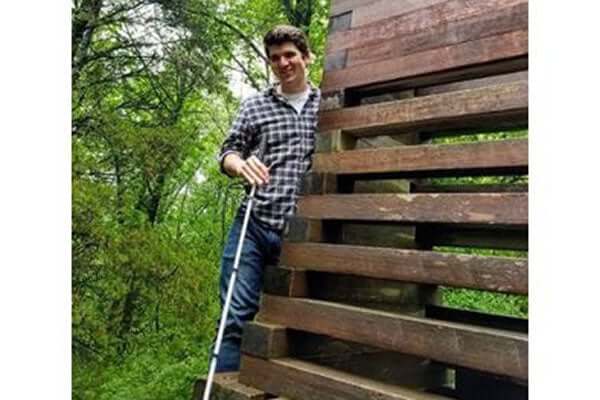
Jed Surdyke is a postulant Catholic Brother in the order of Little Brothers of the Lamb, a monastery in Kansas City, Kansas. Surdyke has no central vision and is legally blind.
Jed Surdyke's story began in a small town outside of St. Louis, Missouri. was blessed to grow up in a loving, Catholic home in Festus, Missouri, with my parents Matt and Jennifer, and the five of us kids, plus some cousins. In my first year of school I wrote that when I grew up, I wanted to be either a priest, a professional motocross rider, or a trashman- maybe I was ambitious, or maybe just indecisive.
The early years
Surdyke wasn't always blind. By the time he was in kindergarten, his vision began decreasing. ""¦I started losing vision when I was about six years old, and after about a years' worth of doctors' visits, we discovered that I had a rare genetic disorder called Cone Rod Dystrophy. This meant that my vision would continue to deteriorate throughout my life- the doctors not knowing how much or how fast- without any way of slowing it down or reversing it.
"Being so young, I couldn't really wrap my head around news like that. So, it really didn't bother me all that much until it started having concrete implications in my life. I had to stop taking piano lessons because I couldn't see the sheet music anymore. It was no longer safe for me to race dirt bikes. For some reason, I was super into sled dogs for a while, and apparently, I came into my parent's room crying one night because I couldn't see this book well enough to review the mushing commands. They were little things, but this is the kind of stuff that started making my vision loss real.
Young adulthood
"As a teenager, my frustration over my vision loss compounded with the typical angst of those years, and I became really angry and rebellious and plunged into a lot of darkness. In the midst of that darkness though, I had a profound experience of God's mercy and love for me, and I began to fall in love with Christ and His Church.
found my joy again through living out my faith; spending time in prayer, getting to know Christ and the members of His Church in youth group or other ministries, serving others at the homeless shelter, or the nursing home, or whenever I saw someone on the street. And so, when I went to college, I knew that somehow, I wanted to give myself in service to the Church. Still indecisive, I decided to triple major in Philosophy, Theology, and English Writing, thinking that maybe I would go on to be a theology professor. But God had different plans.
Surdyke went to school at Rockhurst University in Kansas City, MO. He lived in the residence halls or university-sanctioned housing so that he could have access to a meal plan so that he didn't have to cook and live close to campus to help with communizing. The ins and outs of university life came easily to him, for the most part. His summers were spent in Festus where his family could also help care for him.
However, Surdyke realized that he needed to step out into the world a bit more on his own.
think that the first summer I really lived away from my family was a pretty empowering experience for me. I had a summer internship at a nonprofit organization in Kansas City, where I was working with visually impaired youth. I would ride the city bus to and from work every day. I was totally responsible for paying my bills, making sure that I ate, cleaning the house. You know, all of the normal things that adults do, but really this was the first time I was doing these things by myself. And I certainly wasn't alone. I would call my parents every now and again to ask how to cook something, or video chat my mom to make sure that the clothes I was wearing matched. But nonetheless, I really felt a lot of responsibility, and it was good to know that I really had acquired the basic skills that I needed, despite my disability, to live in this way. Those skills had been fostered in me by my parents and various teachers over the years. And while I wasn't always grateful while learning those skills, I certainly was afterward when I knew how to read braille, and do laundry, and navigate a city independently, and those sorts of things. I really am blessed that I have had so many people and resources available to me so that I could acquire the tools and skills necessary to live independently as I desired.
Well, this is awkward
The toughest part of his disability, says Surdyke, has been the social aspect of it. Blindness can be a bit awkward.
"As a visually impaired person, some of my biggest challenges have been social, which can be a real bummer because I love to be with people. Having no central vision, I cannot make eye contact when meeting a person, nor can I see if they are holding a hand out to me, or looking at me when they are speaking, and these little things can be really tough and kind of awkward at times to navigate. Really, I used to struggle a lot with engaging new people because of this, and sometimes I still do.
After numerous awkward and even frustrating experiences, I have learned a couple of things that have really helped me to overcome this first hurdle in building a relationship.
"The first thing that I've learned is that it is incredibly helpful if I make the first move to engage a person, and I do so in a way that is very clear and upfront regarding my vision. If I wait until someone greets me, I am much more likely to miss a handshake, or to think that they are speaking to me when they are actually introducing themselves to the person next to me. But if I engage the person by putting my hand out and introducing myself, it tends to go much smoother. And if in that process of introducing myself there is an opportunity to mention that I can't see, I try to mention it right away.
"When people see that you have a white cane, they usually realize you have some vision problem, but not always! And I think it makes them more comfortable than I am willing to speak about it, because whether I mention it or not, I'm sure they are already wondering about it, but they might be afraid to ask. So, it's better to get it out of the way as soon as possible, that way everything that follows can go more smoothly.
"The other thing that helps a lot is learning how to laugh at awkwardness rather than becoming discouraged by it. There really is no way around all of the awkward situations that my vision can cause, and sometimes that can be frustrating. But whenever I'm at my best, I have learned not to take myself so seriously, and that makes a huge difference.
 A familiar tug at the heartstrings
Individuals with disabilities wanting to pursue a religious vocation, like a priest, nun, or in this case, brother, is not often talked about, so we were curious. We asked Surdyke: What inspired and prepared you for religious life?
"My Junior year [of college], I realized that this desire of priesthood that I had as a little kid hadn't entirely gone away, and I wouldn't be able to put it to rest unless I looked at it seriously. So, with many nudges from our Heavenly Father, I have spent the past three years very seriously discerning and seeking out what it is that God desires for my life.
"That has brought me to where I am now, a couple of weeks into my postulancy with the Little Brothers of the Lamb in Kansas City, Kansas. This little community is a bit of a Dominican, Franciscan blend that strives to follow Jesus, who himself became poor, in a life of prayer, fraternity, and mission among the poor. It is a very simple and beautiful life, and I am very happy to be sharing in it.
For the parents
For parents of children with disabilities or special needs, Surdyke encourages them to help their children give back. Service and serving the community is imperative, Surdyke stresses.
"I think one thing that helped me a lot in dealing with my disability was to realize that there are concrete ways that I can still give myself in service to others. Since we who have special needs are often in need of assistance, we can easily forget that we have been given gifts that we can share as well. There can be a temptation to feel like I, as a person with a disability, am almost helpless, but that just isn't true.
"As a kid, I went to this summer camp for kids with disabilities called Camp Barnabas. While there, I realized that my vision loss, which felt like a huge loss when I was around my sighted friends, was actually a really small problem in comparison to the struggles of some of the friends I met at this camp.
 realized that I was able to do things like pushing a friend in a wheelchair- he was, of course, giving me directions so that we wouldn't crash. And that same friend could tell me what food was on my plate at lunch. And another friend who was non-verbal would share the gift of his smile and his laughter with the rest of us and make our day. I would really challenge people with special needs to seek out how God might be calling you to serve those around you, and then to really do it. And sometimes, I have learned, the greatest gift that we can give to another is to graciously accept the service that they are offering us.
"As I spend a lot of time with people who are experiencing poverty, I see a lot of times that these people are in a similar situation to me. They are constantly needing to ask others for help. But when they see me and my cane, often these people are the first to rush to my side and offer a hand. And when I accept this gift, we both experience joy. I experience the joy of gratitude, and they experience the joy and dignity of serving their poor brother rather than needing to be served. It really can be a gift. So, that is my advice. Discover how you are being called to give yourself, and this will give you joy.
Although Surdyke isn't a parent, he still has some insights as to what parents can do for their kiddos. know that it can be hard to watch your child struggle with his or her special needs"¦know that you are not alone. There is a large community of people struggling with similar things, and I hope that you will reach out to them and learn from one another. But as someone whose parents went through what you may be going through, I just want to say thank you. Your love and support mean so, so much, even if your child doesn't realize it now, one day they will and I hope that they will thank you."
Share your story!
In the coming weeks on our blog, we will be sharing the stories of the special needs community. If you have a story to tell, please email us.