Table of Contents
- Key Takeaways: How Special Needs Strollers Help With Airport Travel
- What Makes Special Needs Strollers Different From Regular Strollers?
- How Do Special Needs Strollers Simplify Airport Navigation?
- What Is Gate-Checking and Why Does It Matter for Adaptive Strollers?
- How Can You Protect Your Stroller During Transportation Transfers?
- What Rights Protect Travelers Using Special Needs Strollers?
- How Should School Staff Prepare Students for Airport Travel?
- Making Airport Travel Easier With the Right Stroller
- FAQs
Traveling through airports with a child who has mobility needs can feel overwhelming, especially when you're managing an adaptive stroller, medical supplies, and tight connections. Special needs strollers are designed to simplify these challenges, offering features that standard strollers simply don't have. eSpecial Needs offers families and school staff access to special needs strollers built for everyday outings and travel alike.
This article walks you through how adaptive strollers make airport navigation easier, what to know about gate checking, and how to manage transportation transfers. You'll also find answers to common questions from educators and caregivers who travel with students with disabilities.
Key Takeaways: How Special Needs Strollers Help With Airport Travel
- Special needs strollers offer postural support, secure positioning, and durability that standard strollers lack during travel.
- Gate checking your adaptive stroller as an assistive device keeps it with you until boarding and returns it at the jet bridge.
- eSpecial Needs stocks travel-ready strollers with compact fold designs and crash tested frames for safe transportation.
- TSA Cares and the Air Carrier Access Act protect your right to travel with mobility equipment at no extra charge.
- Proper preparation, including labeling, photos, and airline coordination helps prevent damage and delays during your trip.
What Makes Special Needs Strollers Different From Regular Strollers?
Special needs strollers are mobility devices built to support children and adults who need more than basic seating. They include adjustable head, trunk, and pelvic supports that help maintain proper posture during long travel days.
Regular strollers typically lack these positioning features. A standard umbrella stroller won't offer the five-point harness, tilt-in-space function, or durable frame that many travelers with disabilities require. This difference matters when you're navigating crowded terminals and long layovers.
Adaptive strollers also fold more compactly than many wheelchairs, making them easier to gate check. According to KidsHealth, adaptive strollers serve as a lightweight alternative to bulky wheelchairs for quick outings and airport travel counts as exactly that.
How Do Special Needs Strollers Simplify Airport Navigation?
Airports present unique mobility challenges: long concourses, security checkpoints, escalator-free zones, and boarding queues. A well designed special needs stroller helps you move through each stage with your child safely positioned and comfortable.
Most adaptive strollers feature larger rear wheels with toggle locks, curb assist foot pedals, and shock absorption systems. These make it easier to roll over threshold gaps, navigate uneven flooring near construction zones, and handle the bumps common to jet bridges.
For K-12 special education staff traveling with students, this portability matters during school field trips. You can push the stroller through the terminal, gate-check at boarding, and retrieve it immediately upon landing, minimizing the time your student spends out of their mobility device.
What Is Gate-Checking and Why Does It Matter for Adaptive Strollers?
Gate-checking lets you keep your stroller with you through security and up to the aircraft door. Airline staff then store it in the cargo hold during the flight and return it at the jet bridge when you land.
This process matters because it reduces handling time and keeps your child mobile throughout the terminal. Unlike curbside check where you might wait at baggage claim, gate checking typically returns your stroller right where you need it.
Most airlines allow free gate checking for strollers classified as assistive devices. When you check in, tell the agent your stroller is a medical or mobility device. This designation triggers protections under the Air Carrier Access Act (ACAA), which requires airlines to handle mobility equipment with care.
Tips for a Smooth Gate-Check Experience
Remove trays, cushions, and positioning aids before handing over your stroller. Pack them in your carry on to prevent loss or damage. Add a clear label reading "Assistive Device / Fragile" along with your contact information.
Take time-stamped photos of all sides of your stroller at the gate. If anything is damaged on arrival, you'll have documentation for your claim. Report issues immediately before leaving the airport to preserve your rights under federal regulations.
How Can You Protect Your Stroller During Transportation Transfers?
Transportation transfers between flights, from airports to buses, or into accessible vans put extra stress on mobility equipment. Protecting your stroller starts with choosing a model built for travel.
Look for strollers with WC19 certification. This label indicates the frame has been crash-tested for vehicle transport. eSpecial Needs carries options like the Trotter Mobility Chair, which is crash tested and features a compact folding design ideal for transit situations.
When securing your stroller in an accessible vehicle, use the four-point tie-down system at the labeled anchor points. The stroller's five point harness supports your child's posture, but it is not a crash-rated restraint. Always use a vehicle-anchored lap or lap shoulder belt for your child during ground transportation.
What Rights Protect Travelers Using Special Needs Strollers?
Federal law protects your right to travel with mobility equipment. The Air Carrier Access Act (ACAA) prohibits airlines from discriminating against passengers with disabilities and requires them to accommodate assistive devices.
Under the ACAA, airlines must accept your stroller for gate-check or cargo at no additional charge. They must return it in the condition they received it. If your stroller is damaged, you can file a claim and airlines are responsible for repair or replacement costs.
The TSA Cares program also helps travelers with disabilities prepare for security screening. Call 72 hours before your flight to request assistance at the checkpoint. Officers can perform a manual inspection of your stroller if rolling it through a scanner isn't practical.
How Should School Staff Prepare Students for Airport Travel?
K-12 special education staff and school based therapists often coordinate travel for field trips, conferences, or sports events. Preparing students with disabilities for airport travel starts with equipment planning.
Confirm your stroller's folded dimensions and weight meet your airline's gate-check limits. Contact the airline ahead of time to note the assistive device in your reservation. This ensures ground staff know what to expect at boarding.
Practice the airport routine with your student when possible. A visual story showing the sequence, check-in, security, boarding can reduce anxiety. Schedule positioning breaks every 30-60 minutes during layovers to maintain comfort and reduce pressure points.
Special Tomato EIO Stroller Push Chair - Adaptive Stroller
$921.50
$2,062.05
The Special Tomato EIO Stroller Push Chair is a lightweight adaptive stroller designed to provide comfortable mobility and positioning support from early intervention through preadolescence. Built for children who need more support than a standard stroller, the EIO combines everyday… read more

Making Airport Travel Easier With the Right Stroller
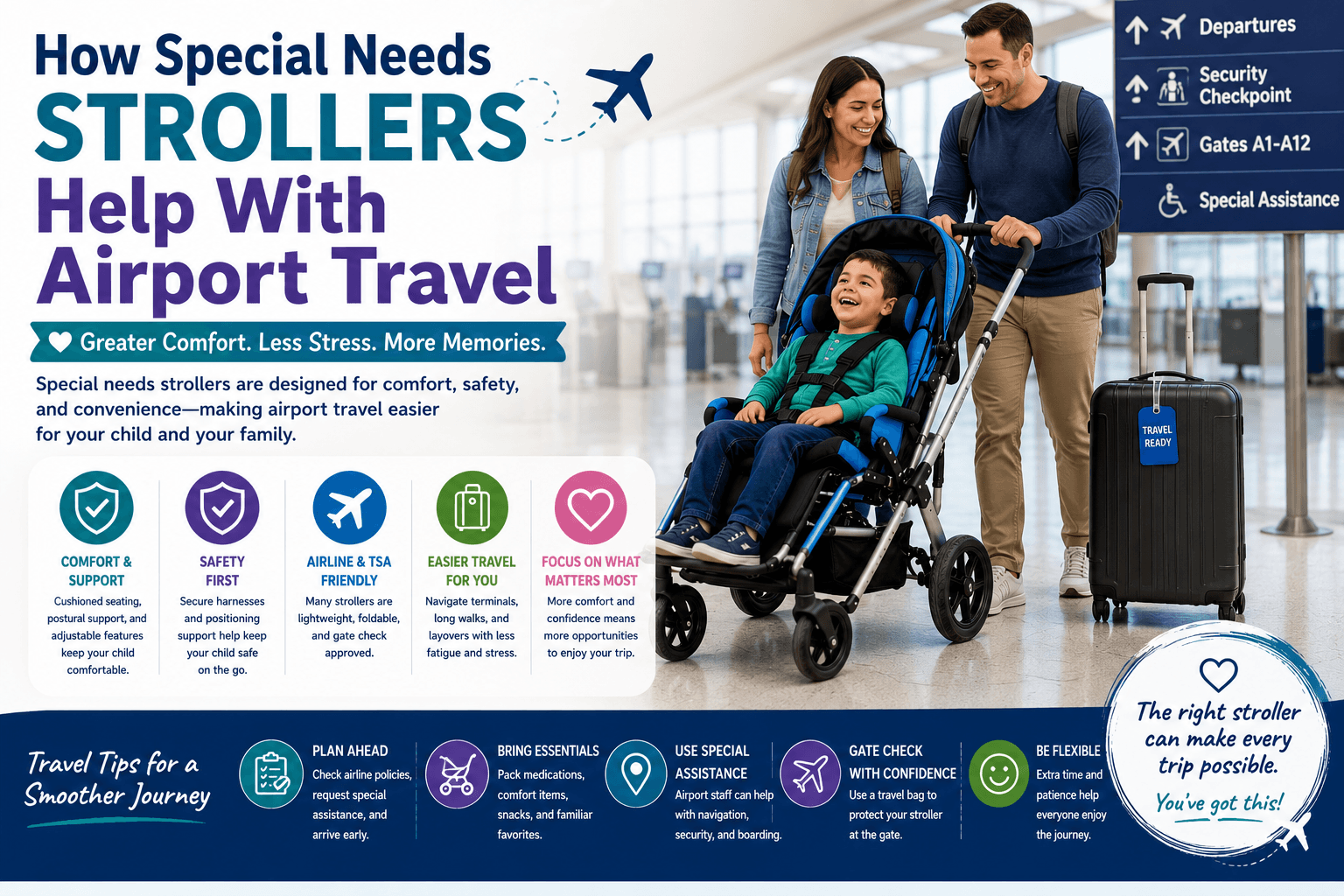
Airport travel with a child who has mobility needs doesn't have to be stressful. The right special needs stroller gives you postural support, compact folding, and the durability needed for gate-checking and transfers. Federal protections ensure airlines accommodate your equipment, and TSA Cares can help smooth security screening.
Whether you're a parent planning a family vacation or a school therapist coordinating a field trip, preparation makes the difference. Choose a travel-ready stroller, document its condition, and communicate with airline staff early. eSpecial Needs gives families and educators access to adaptive strollers designed to handle these exact situations helping you focus on the journey, not the logistics.
FAQs
Can I bring a special needs stroller to the boarding gate?
Yes, you can bring your special needs stroller all the way to the aircraft door. Airlines must allow gate-checking for strollers classified as assistive devices under the Air Carrier Access Act.
Tell staff at check-in that your stroller is a mobility aid. They'll attach a gate-check tag so you can use it through security and down the jet bridge.
Do airlines charge extra for gate-checking adaptive strollers?
No, airlines cannot charge you for checking an assistive device. The Air Carrier Access Act requires airlines to transport mobility equipment at no additional cost. eSpecial Needs recommends confirming this with your carrier when booking.
What if my stroller is damaged during the flight?
Report the damage before leaving the airport. File a written claim at the gate or baggage office and take photos as evidence. Airlines are responsible for repairing or replacing damaged mobility devices under federal regulations.
eSpecial Needs suggests taking time-stamped photos before you hand over your stroller to document its original condition.
How do I prepare my child with autism for airport security?
Contact TSA Cares 72 hours before your trip to request assistance. You can ask for a private screening area or manual inspection if your child has sensory sensitivities.
Practice the airport sequence at home with a visual story. Bring noise-reducing headphones and familiar comfort items to help manage crowded spaces.
Are special needs strollers safe for use on buses and accessible vans?
Strollers with WC19 certification have been crash-tested for vehicle transport. Look for WC19 labels on your stroller's frame before using it as a vehicle seat. eSpecial Needs carries crash-tested models like the Trotter Mobility Chair that are designed for transit situations.
If your stroller isn't WC19 certified, transfer your child to an appropriate car seat during ground transportation.