Table of Contents
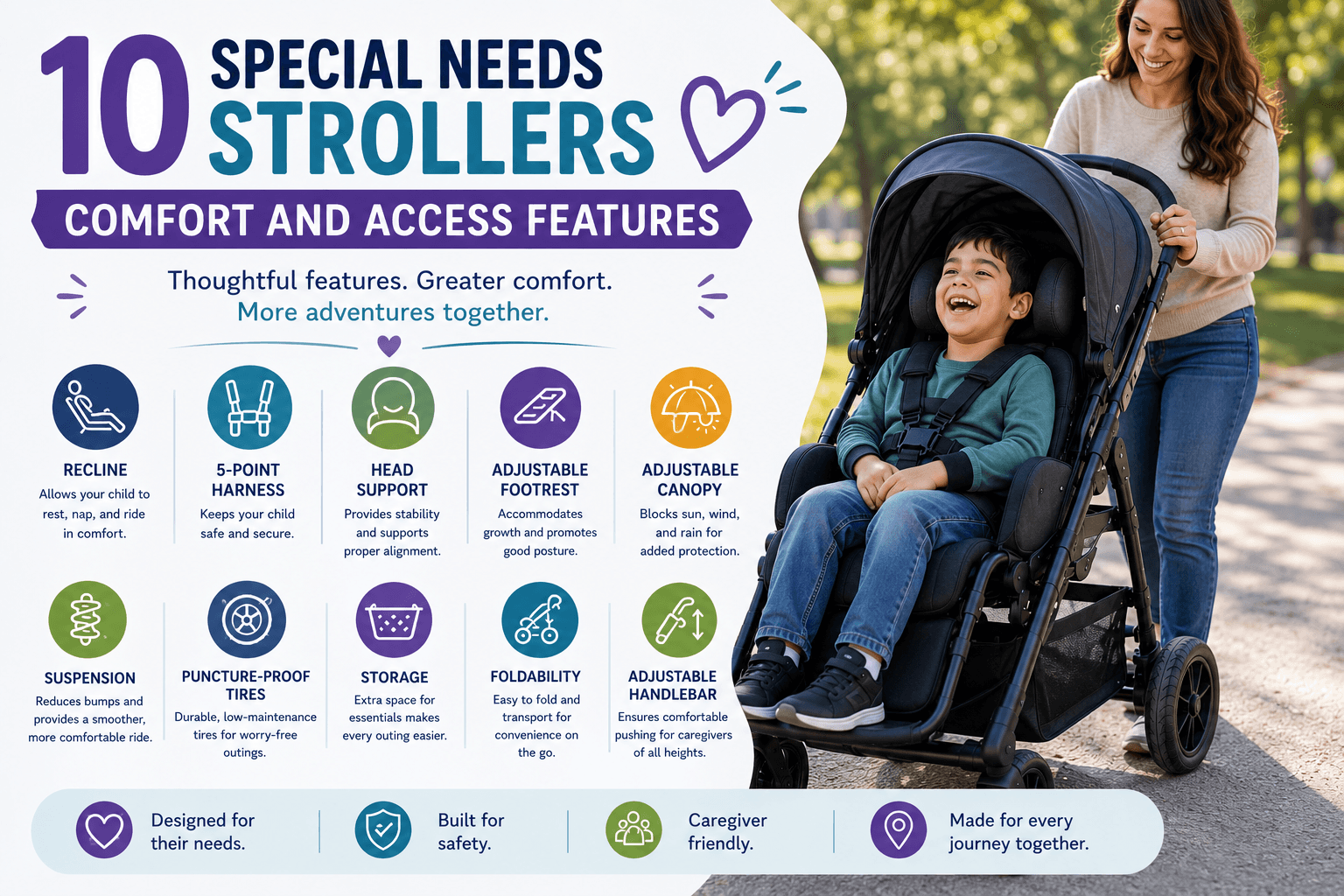
- Quick guide: 10 Special Needs Strollers Comfort and Access Features
- How we chose the best comfort and access features for special needs strollers
- The 10 best comfort and access features in special needs strollers
- 1. Tilt-in-space positioning: Best overall feature for postural support
- 2. Five-point harness systems: Secure restraint for daily mobility
- 3. Adjustable head and trunk supports: Customizable positioning
- 4. All-terrain wheels: Outdoor accessibility
- 5. Suspension systems: Smoother rides
- 6. Compact folding frames: Easy transport
- 7. WC19 transit safety compliance: School bus ready
- 8. Adjustable canopy protection: Sun and sensory shielding
- 9. Padded and breathable seating: All-day comfort
- 10. Storage capacity for medical equipment: Room for essentials
- Comparison table: The best comfort and access features in special needs strollers
- How do special needs strollers differ from regular strollers?
- What age and weight do special needs strollers accommodate?
- Why eSpecial Needs is the best source for special needs strollers
- FAQs
Choosing a special needs stroller for a child requires careful attention to comfort and accessibility features. eSpecial Needs offers adaptive strollers designed to support children and adults with mobility challenges in school, therapy, and community settings. This guide covers the ten most important features that set special needs strollers apart from standard options.
If you work in K-12 special education or serve as a school therapist, you know that mobility equipment can shape a student's ability to participate in daily routines. The right special needs strollers helps with travel, field trips, and transitions between activities. Below, you'll find the key features to look for—and why they matter for families, educators, and caregivers alike.
Quick guide: 10 Special Needs Strollers Comfort and Access Features
- Tilt-in-space positioning: The best feature for pressure relief and postural support during long outings
- Five-point harness systems: A secure option for children needing trunk and hip stability
- Adjustable head and trunk supports: Helpful for users requiring customized postural alignment
- All-terrain wheels: A practical feature for outdoor use and uneven surfaces
- Suspension systems: Reduces vibration and bumps for smoother rides
- Compact folding frames: Convenient for transport and storage in vehicles
- WC19 transit safety compliance: Designed for safe travel on school buses and accessible vans
- Adjustable canopy protection: Shields from sun, wind, and sensory overload
- Padded and breathable seating: Supports comfort during extended use
- Storage capacity for medical equipment: Accommodates oxygen, feeding pumps, and therapy supplies
How we chose the best comfort and access features for special needs strollers
We reviewed research from rehabilitation specialists, pediatric therapists, and caregiver feedback to identify the features that make the biggest difference in daily use. Our focus was on practical benefits for families and school-based professionals who rely on adaptive strollers for student mobility.
- Postural support quality: Does the feature help maintain safe, comfortable positioning throughout the day?
- Safety standards: Is the feature tested for vehicle transport or daily use in various environments?
- Ease of use for caregivers: Can school staff and parents adjust settings quickly without special tools?
- Durability for frequent use: Will the feature hold up in busy school hallways, therapy centers, and outdoor trips?
- Growth adaptability: Does the feature allow adjustments as the child grows and their needs change?
- Comfort for extended sitting: Will the child remain comfortable during long school days or community outings?
Special Tomato EIO Stroller Push Chair - Adaptive Stroller
$921.50
$2,062.05
The Special Tomato EIO Stroller Push Chair is a lightweight adaptive stroller designed to provide comfortable mobility and positioning support from early intervention through preadolescence. Built for children who need more support than a standard stroller, the EIO combines everyday… read more

The 10 best comfort and access features in special needs strollers
1. Tilt-in-space positioning: Best overall feature for postural support
Tilt-in-space strollers allow the entire seat to recline while maintaining the hip angle. This keeps your child's body properly aligned during rest breaks or when fatigue sets in. For children who need pressure relief or have difficulty holding their head upright, this feature makes a significant difference.
eSpecial Needs carries strollers with tilt-in-space options ranging from 10 to 45 degrees. This flexibility lets caregivers adjust positioning throughout the day based on the child's comfort and activity level. School therapists often recommend tilt-in-space for students who spend extended periods in their mobility equipment. The feature also helps with digestion and breathing by allowing gravity to assist with positioning. According to pediatric rehabilitation research, proper positioning can reduce the risk of skin breakdown and improve overall comfort during transport.
Tilt-in-space positioning benefits
- Pressure redistribution: Shifting weight away from the seat base helps prevent skin issues during long school days
- Respiratory support: Angled positioning can help open airways and support easier breathing
- Rest positioning: Your child can take comfortable breaks without transferring to another surface
- Feeding assistance: Proper angles can support safer swallowing for children with feeding challenges
- Caregiver control: Easy-to-reach levers let you adjust tilt without disrupting your child
Tilt-in-space positioning pros and cons
Pros:
- Maintains hip angle while reclining, which supports proper skeletal alignment
- Allows micro-adjustments throughout the day for changing comfort needs
- Reduces caregiver strain by eliminating the need for manual repositioning
Cons:
- Adds slightly more weight to the stroller frame, though modern designs minimize this
- Requires brief training to learn optimal angle settings for your child
- May increase the overall footprint when fully tilted, though most models remain maneuverable
2. Five-point harness systems: Secure restraint for daily mobility
A five-point harness secures your child at the shoulders, hips, and between the legs. This distributes force across the body during movement and sudden stops. For children with limited trunk control, this restraint system keeps them safely positioned.
Five-point harness features
- Adjustable shoulder straps: Accommodate different torso lengths as your child grows
- Padded harness covers: Soft materials reduce irritation during extended wear
- Quick-release buckles: Allow fast access for transfers and emergencies
Five-point harness pros and cons
Pros:
- Distributes restraint force evenly across the strongest parts of the body
- Works for children with varying levels of trunk control
- Adjustable fit accommodates growth and different clothing layers
Cons:
- Some children may need time to acclimate to the snug fit
- Requires regular adjustment to maintain proper positioning
- Buckles need periodic inspection to confirm they engage correctly
3. Adjustable head and trunk supports: Customizable positioning
Head and trunk supports help children who cannot independently hold their body upright. These accessories attach to the stroller frame and can be positioned to match your child's specific needs. Lateral supports prevent side-to-side leaning.
Head and trunk support features
- Height-adjustable headrests: Position correctly as your child grows
- Removable lateral supports: Add or remove based on daily needs
- Contoured padding: Cradles the body for improved alignment
Head and trunk support pros and cons
Pros:
- Allows customization based on professional therapy recommendations
- Supports children with varying levels of head control
- Can be repositioned as positioning needs evolve
Cons:
- May require professional fitting for optimal positioning
- Additional accessories add to overall weight
- Some models require tool-based adjustment rather than quick-release
4. All-terrain wheels: Outdoor accessibility
Standard stroller wheels struggle on grass, gravel, and uneven pavement. All-terrain wheels feature larger diameters and rubber or air-filled tires that absorb bumps. This lets your child participate in outdoor activities and navigate varied surfaces.
All-terrain wheel features
- Larger wheel diameter: Rolls over obstacles more easily
- Pneumatic or solid rubber tires: Absorb shock from uneven ground
- Locking swivel mechanism: Stabilizes travel on unpaved paths
All-terrain wheel pros and cons
Pros:
- Opens access to parks, playgrounds, and nature trails
- Reduces vibration transmitted to your child
- Handles transitions between indoor and outdoor surfaces
Cons:
- Larger wheels add width to the overall frame
- Air-filled tires may require occasional inflation checks
- Some all-terrain models have a larger turning radius in tight spaces
5. Suspension systems: Smoother rides
Suspension absorbs shock from bumps and uneven surfaces before it reaches your child. This is especially important for children who are sensitive to jarring movements or have conditions that make vibration uncomfortable.
Suspension system features
- Shock-absorbing springs: Cushion impact from curbs and rough ground
- Adjustable firmness: Tune ride quality for different environments
- Integrated frame design: Maintains compact folding while adding suspension benefits
Suspension system pros and cons
Pros:
- Reduces discomfort for children sensitive to movement
- Decreases fatigue during longer outings
- Works with all-terrain wheels for maximum outdoor comfort
Cons:
- Adds complexity to the frame design
- Some models require periodic maintenance checks
- May slightly increase the stroller's folded size
6. Compact folding frames: Easy transport
A stroller that folds quickly and compactly fits into car trunks, storage closets, and tight spaces. Umbrella-style folds are popular for their slim profile. Quick-fold mechanisms let one caregiver collapse the stroller without assistance.
Compact folding features
- One-hand fold mechanisms: Collapse the stroller while managing other tasks
- Umbrella-style fold: Creates a narrow profile for tight storage
- Lightweight frames: Easier to lift into vehicles and transport
Compact folding pros and cons
Pros:
- Fits in standard vehicle trunks without removing seats
- Reduces setup time at destinations
- Makes air travel and public transit more manageable
Cons:
- Ultra-compact models may have fewer positioning accessories
- Some folding mechanisms require practice to master
- Lightest models may have lower weight capacities
7. WC19 transit safety compliance: School bus ready
WC19 is a voluntary crash-test standard for wheelchair and stroller frames used as vehicle seats. Strollers meeting this standard have designated anchor points for tie-down systems on school buses and accessible vans. For K-12 special education teams, WC19 compliance means your student can remain safely positioned in their mobility equipment during transport.
WC19 compliance features
- Crash-tested anchor points: Marked locations for vehicle tie-downs
- Frame integrity testing: Confirms the stroller can withstand impact forces
- Compatible restraint systems: Works with WC18-rated vehicle securement systems
WC19 compliance pros and cons
Pros:
- Eliminates the need to transfer your child to a car seat for bus transport
- Reduces handling time during school pickup and drop-off routines
- Meets safety requirements for many school district transportation policies
Cons:
- Not all stroller models offer this certification
- Proper securement requires trained staff and compatible vehicle hardware
- Annual inspection may be required by some school districts
8. Adjustable canopy protection: Sun and sensory shielding
A good canopy blocks sun, wind, and visual distractions. For children with sensory sensitivities, a canopy can create a calmer environment by reducing overwhelming stimuli. Extended canopies cover more of the seating area.
Canopy features
- UPF sun protection: Blocks harmful UV rays during outdoor activities
- Extended coverage: Shields more of the body from sun and visual clutter
- Ventilation panels: Maintains airflow while blocking direct light
Canopy pros and cons
Pros:
- Reduces sensory overload in busy or bright environments
- Protects skin from sun exposure during extended outdoor time
- Creates a more private, calming space for rest
Cons:
- Large canopies may block caregiver visibility in some positions
- Fabric requires periodic cleaning to maintain UV protection
- Some canopy frames add height to the folded stroller profile
9. Padded and breathable seating: All-day comfort
Children who spend hours in their stroller need seating that prevents pressure buildup and regulates temperature. Padded seats distribute weight more evenly. Breathable mesh fabric allows airflow to reduce sweating.
Padded seating features
- Memory foam or high-density padding: Contours to your child's body for support
- Breathable mesh panels: Allow air circulation to prevent overheating
- Removable seat covers: Enable regular washing for hygiene
Padded seating pros and cons
Pros:
- Supports comfort during school days that involve extended sitting
- Reduces the risk of pressure-related skin issues
- Temperature-regulating materials work in various climates
Cons:
- Thicker padding may reduce seat depth in some models
- Mesh materials may show wear over time in high-use situations
- Some specialized padding options may be purchased separately
10. Storage capacity for medical equipment: Room for essentials
Many children with special needs travel with medical supplies, therapy tools, or feeding equipment. A stroller with adequate storage keeps these items organized and accessible. Under-seat baskets, back pouches, and side pockets all contribute to carrying capacity.
Storage features
- Under-seat baskets: Hold larger items like therapy equipment bags
- Back storage pouches: Keep frequently needed items within reach
- Side pockets: Organize smaller supplies for quick access
Storage pros and cons
Pros:
- Eliminates the need for separate bags when traveling with medical equipment
- Keeps essentials organized and accessible during outings
- Frees up caregiver hands for pushing and supervising
Cons:
- Heavy items in storage may affect stroller balance if not loaded carefully
- Maximum storage capacity varies significantly between models
- Some storage compartments may be less accessible when the seat is reclined
Comparison table: The best comfort and access features in special needs strollers
| Feature | Tilt Range | Transit Certified | Folding Style |
|---|---|---|---|
| Special Needs Adaptive Strollers | Up to 45° | ✓ | Multiple options |
| Standard Pediatric Strollers | 10-15° | ✗ | Basic fold |
| Basic Adaptive Models | Up to 30° | Varies | Umbrella fold |
How do special needs strollers differ from regular strollers?
Regular strollers are designed for typically developing children up to a certain age and weight. Special needs strollers offer additional postural support, higher weight capacities, and features like tilt-in-space that regular strollers lack. The frame construction on adaptive strollers is built to handle heavier loads and more frequent use. Materials are chosen for durability in therapy settings and school environments where equipment sees daily wear.
Positioning accessories like head supports, lateral trunk supports, and footrest adjustments are either included or available as add-ons. These allow customization based on occupational therapy and physical therapy assessments.
What age and weight do special needs strollers accommodate?
Special needs strollers are available for users from toddlers through adults. Many models support weights up to 150 pounds or more, with some designed specifically for larger children and adolescents who have outgrown standard equipment.Seat dimensions vary to accommodate different body sizes. Growth-adjustable frames allow seat depth, width, and back height modifications as your child develops. This means one stroller can serve your family for several years.
eSpecial Needs carries options ranging from pediatric sizes to adult-capacity models. Consulting with a therapist can help match seat dimensions to your child's current measurements while planning for future growth.
Why eSpecial Needs is the best source for special needs strollers
Finding the right mobility equipment takes time and expertise. eSpecial Needs simplifies your search by offering a curated selection of adaptive strollers from trusted manufacturers. You get access to detailed product information and support from a team that understands the needs of families and schools.
When you're ready to explore your options, browse the stroller collection at eSpecial Needs to find mobility solutions designed for comfort, accessibility, and everyday participation.
FAQs
What is tilt-in-space and why does it matter?
Tilt-in-space reclines the entire seat while maintaining the angle between the seat and back. This redistributes pressure away from the seat base, which helps prevent skin breakdown during long periods of sitting. eSpecial Needs offers strollers with adjustable tilt settings for customized comfort.
Can special needs strollers be used on school buses?
Yes, if the stroller meets WC19 crash-test standards. WC19-compliant strollers have anchor points designed to work with vehicle tie-down systems. eSpecial Needs can help you identify transit-ready models that meet school transportation requirements.
How do I know what size stroller my child needs?
Seat width, depth, and back height should match your child's body measurements. A physical or occupational therapist can assess your child and recommend appropriate dimensions. eSpecial Needs stocks strollers in multiple sizes to accommodate different body types and ages.
Are all-terrain wheels necessary for school use?
All-terrain wheels are most beneficial for outdoor activities and uneven surfaces. For primarily indoor school use, standard wheels with good maneuverability may be sufficient. However, all-terrain options offer flexibility if your school includes outdoor learning spaces or playground time.
How often should stroller positioning be adjusted?
Positioning should be checked regularly as your child grows. Most therapists recommend reassessment every six months or whenever you notice changes in comfort or posture. eSpecial Needs carries strollers with easy-adjust features that accommodate growth without replacing the entire unit.
What is a special needs stroller?
A special needs stroller is an adaptive mobility stroller designed for children, teens, or adults who need more support than a standard stroller provides. These strollers often include larger weight capacities, stronger frames, postural supports, harness systems, adjustable seating, recline or tilt options, and accessories that support comfort, safety, and accessibility.
How is a special needs stroller different from a regular stroller?
A regular stroller is designed for infants and toddlers who typically outgrow it quickly. A special needs stroller is built for larger children and users who need extra positioning, mobility support, safety features, or long term use. Adaptive strollers may include reinforced frames, adjustable footrests, lateral supports, headrests, harnesses, transit options, and larger seating dimensions.
Who needs a special needs stroller?
A special needs stroller may be helpful for children or adults with cerebral palsy, autism, developmental delays, low muscle tone, muscular dystrophy, spina bifida, seizure disorders, mobility limitations, fatigue, poor safety awareness, elopement risk, or physical disabilities that make walking long distances difficult.
What comfort features should I look for in a special needs stroller?
Important comfort features may include padded seating, adjustable recline, tilt in space, head support, lateral trunk supports, adjustable footrests, breathable fabric, sun canopy, suspension, and proper seat depth and width. The best comfort features depend on the user’s posture, tone, size, endurance, and daily routine.
What access features matter most in an adaptive stroller?
Helpful access features include easy caregiver brakes, swing away footrests, adjustable harnesses, removable supports, easy folding, transport tie down options, storage, tray compatibility, and stroller designs that make transfers easier. These features can help caregivers manage daily outings with less strain.
Why is proper stroller fit so important?
Proper fit helps support comfort, posture, safety, and long term use. A stroller that is too small may cause discomfort or poor alignment, while one that is too large may not provide enough support. Seat width, seat depth, back height, lower leg length, and weight capacity should all be considered.
What measurements are needed for a special needs stroller?
Common measurements include hip width, seat depth, back height, lower leg length, shoulder height, overall height, and weight. These measurements help determine which stroller size and support accessories will best fit the user.
What is recline on a special needs stroller?
Recline changes the angle of the backrest. It may help users rest, relax, or tolerate longer periods in the stroller. Recline can be helpful for children who fatigue easily, need rest breaks, or require a more relaxed position during travel.
Why are adjustable footrests important?
Adjustable footrests help support the legs and feet in a comfortable position. Proper foot support can improve posture, reduce sliding, support alignment, and make the stroller more comfortable during longer use.
Why are headrests important in adaptive strollers?
Headrests provide support for users who have limited head control, fatigue, low muscle tone, or postural needs. A properly positioned headrest can improve comfort, alignment, and safety during daily travel.
What are lateral supports?
Lateral supports are side supports that help keep the trunk aligned. They are useful for users who lean to one side, have low muscle tone, poor trunk control, or need additional postural support while seated.
What is a stroller harness used for?
A harness helps keep the user safely positioned in the stroller. It may reduce sliding, leaning, or unsafe movement. Harnesses are especially important for children with poor trunk control, low tone, limited safety awareness, or sensory seeking movement.
What type of harness is best for a special needs stroller?
The best harness depends on the user’s size, posture, tone, and safety needs. Options may include pelvic belts, five point harnesses, chest straps, or positioning vests. A therapist or adaptive equipment specialist can help identify the most appropriate option.
Why does stroller suspension matter?
Suspension helps absorb bumps and uneven surfaces, making rides smoother and more comfortable. Good suspension is especially helpful for outdoor use, sidewalks, parks, school campuses, theme parks, and users who are sensitive to jarring movement.
Are larger wheels better for special needs strollers?
Larger wheels may improve performance on uneven surfaces, grass, gravel, sidewalks, and outdoor terrain. Smaller wheels may be easier for indoor maneuvering and compact folding. The right wheel type depends on where the stroller will be used most often.
What is an all terrain special needs stroller?
An all terrain special needs stroller is designed for outdoor surfaces such as grass, trails, gravel, parks, and uneven sidewalks. These strollers often include larger wheels, stronger frames, durable tires, and suspension for smoother movement.
What stroller features help caregivers?
Caregiver friendly features may include lightweight folding, adjustable push handles, easy brakes, storage baskets, compact transport size, removable accessories, smooth maneuverability, and easy to clean fabrics. These features can reduce strain during everyday use.
Are special needs strollers easy to fold?
Some adaptive strollers fold compactly, while others are larger and more supportive but less compact. Families should compare folded dimensions, stroller weight, and vehicle storage needs before choosing a model.
What comfort features help children with sensory sensitivities?
Children with sensory sensitivities may benefit from soft padding, breathable fabrics, adjustable recline, sun canopies, smooth suspension, quiet wheels, supportive harnesses, and accessories that create a more predictable and calming seating experience.
Can a special needs stroller help with sensory overload?
A special needs stroller may help some children manage sensory overload by giving them a secure, familiar, and supported place to rest during outings. Canopies, supportive seating, and positioning features can create a more controlled space in busy environments.
Can adaptive strollers help children who elope or wander?
Yes. Adaptive strollers may help children who elope, wander, or have poor safety awareness by providing a safer seated option during public outings. However, they should always be used with active caregiver supervision and a broader safety plan.
Are adaptive strollers helpful for theme parks?
Yes. Many families use adaptive strollers at theme parks because they provide mobility support, positioning, rest, shade, and safety in crowded environments. Families should check park stroller size rules and stroller as wheelchair policies before visiting.
Can a special needs stroller be used for travel?
Yes. Many adaptive strollers are used for travel, medical appointments, airports, vacations, and community outings. Families should consider stroller weight, folding size, transport needs, durability, and whether the stroller can be gate checked or transported safely.
What special needs stroller is best for older kids?
The best stroller for older kids depends on the child’s height, weight, posture, mobility, endurance, and daily use needs. Older children may need higher weight capacity, wider seating, taller back support, stronger frames, and age appropriate styling.
How much weight can a special needs stroller hold?
Weight capacity varies by model. Some adaptive strollers support smaller children, while others are designed for older kids, teens, or adults. Families should check both weight capacity and seating dimensions before purchasing.
Why should I consider growth room?
Growth room helps extend the useful life of the stroller. However, too much extra room may reduce support. The goal is to choose a stroller that fits now while allowing safe and reasonable growth.
Can special needs strollers support children with low muscle tone?
Yes. Children with low muscle tone may need adaptive seating features such as trunk supports, headrests, harnesses, footrests, and proper seat positioning to help maintain comfort and alignment.
What accessories are available for special needs strollers?
Common accessories include canopies, rain covers, trays, storage baskets, headrests, lateral supports, harnesses, footrests, abductor supports, transit tie downs, oxygen tank holders, cup holders, and seat cushions. Accessory availability depends on the stroller model.
Are special needs strollers covered by insurance?
Some special needs strollers may be covered by insurance, Medicaid, waiver programs, or other funding sources when they are medically necessary. Coverage depends on the plan, diagnosis, documentation, and prior authorization requirements.
What documentation is needed for insurance coverage?
Families may need a prescription, letter of medical necessity, product quote, therapy evaluation, diagnosis information, measurements, and documentation explaining why a standard stroller is not sufficient.
What is a letter of medical necessity for a special needs stroller?
A letter of medical necessity is a document from a qualified healthcare provider explaining why the user needs an adaptive stroller. It should include diagnosis, functional limitations, mobility needs, safety concerns, postural support needs, and why lower cost or standard options are not appropriate.
Can Medicaid pay for a special needs stroller?
Medicaid or Medicaid waiver programs may help pay for a special needs stroller when it is considered medically necessary and properly documented. Requirements vary by state and program.
Can grants help pay for a special needs stroller?
Yes. Some disability grants, nonprofit organizations, community programs, and diagnosis specific foundations may help families pay for adaptive strollers. Many grant applications require a quote and documentation of need.
How do I choose between a special needs stroller and a wheelchair?
A special needs stroller is typically caregiver pushed and often easier to fold or transport. A wheelchair may provide more custom seating or allow self propulsion. The best choice depends on mobility, posture, independence, transportation, and therapist recommendations.