Table of Contents
- What Is a Chill Out Chair?
- Defining Adaptive Sensory Seating
- The Role of Deep Pressure and Movement in Sensory Regulation
- Why a Chill Out Chair Stands Apart from Standard Adaptive Seating
- Freedom Concepts Chill Out Chair: A Closer Look
- Brand Background: Why Freedom Concepts?
- Chill Out Chair Models Explained
- Chill Out Chair Roll’er: Features and Best Use Cases
- Chill Out Chair Rock’er: Features and Best Use Cases
- Comparing the Roll’er and Rock’er
- Who Benefits Most from a Chill Out Chair?
- Children with Sensory Processing Disorder
- Kids on the Autism Spectrum
- Children with Cerebral Palsy and Motor Disabilities
- Children with Anxiety, ADHD, or Emotional Dysregulation
- Use in Schools and Therapy Clinics
- Chill Out Chair Colors and Customization
- Sizing and Weight Capacity Considerations
- Chill Out Chair Accessories and Add Ons
- Chill Out Chair Tray
- Other Functional Accessories
- Pairing a Chill Out Chair with Other Sensory Tools
- Chill Out Chair Price: What to Expect
- Factors That Affect Price
- Financing Options and Budget Assistance
- How to Use a Letter of Medical Necessity
- How to Request Funding Support Through eSpecial Needs
- Insurance, Medicaid, and Grants
- How to Complete the Chill Out Chair Order Form
- Step by Step Order Form Guide
- Requesting a Quote from an Adaptive Equipment Specialist
- Purchase Orders for Schools and Therapy Clinics
- Why Buy Your Chill Out Chair from eSpecial Needs?
- Expert Guidance and Quote Request Service
- Price Match Guarantee and Competitive Pricing
- Why Chill Out Chairs Are Important
- FAQs
Chill Out Chair: What It Is and Who Benefits Most
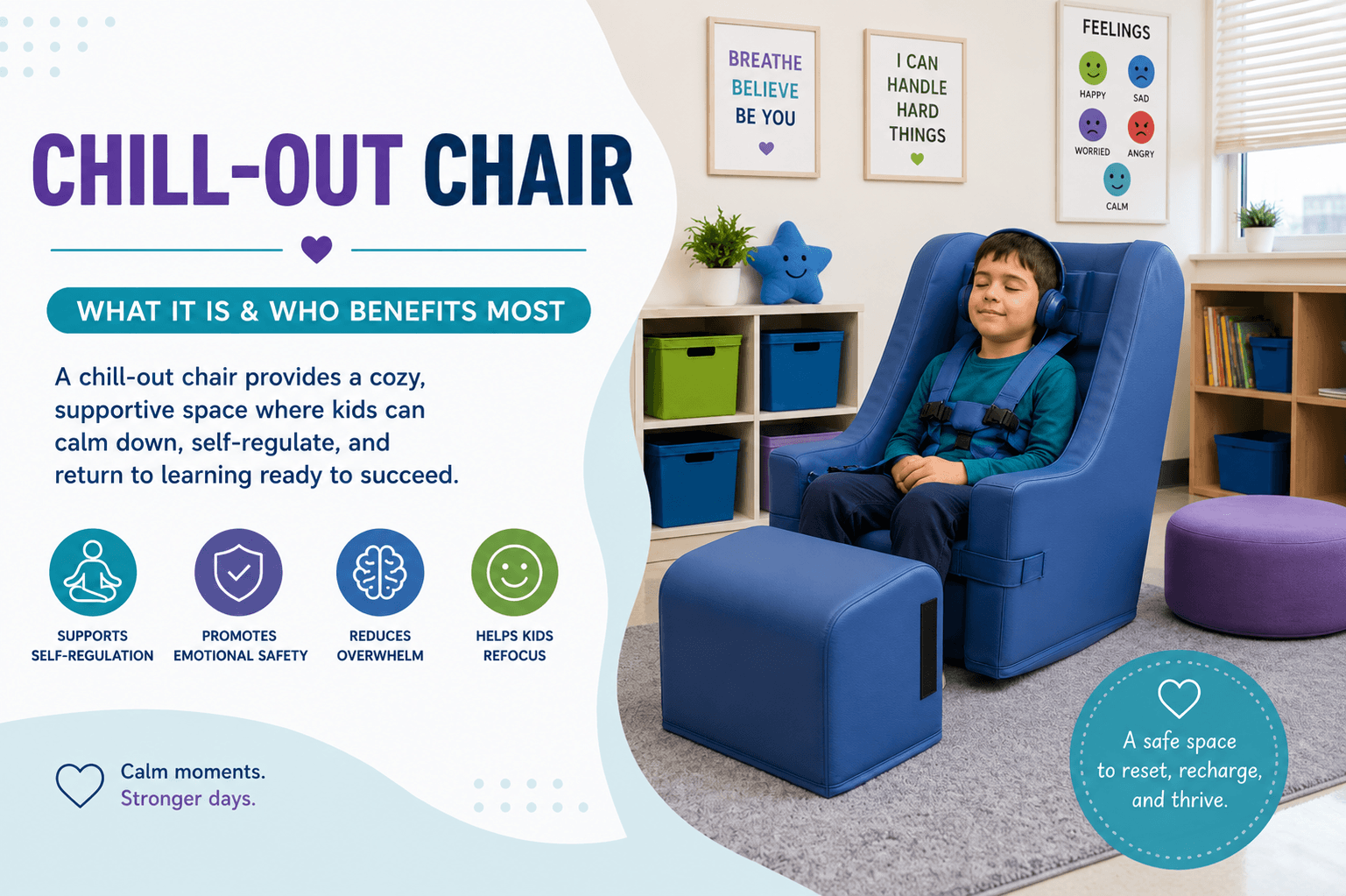
A chill out chair is a specialized adaptive seating solution designed to provide comfort, support, calming sensory input, and a safe place to relax for children and adults with special needs. Unlike standard classroom chairs, bean bags, or lounge seating, a chill out chair is built to support posture, sensory regulation, body awareness, and everyday participation at home, school, therapy clinics, and care environments. For many families, teachers, therapists, and caregivers, seating is not just about having a place to sit. The right seating can help a child calm down, stay supported, engage in activities, recover from sensory overload, or participate more comfortably in daily routines.
A chill out chair is especially helpful for individuals who benefit from adaptive sensory seating, deep pressure input, gentle movement, enclosed support, or a predictable calming space. It can be used during sensory breaks, quiet time, reading, therapy activities, independent play, classroom regulation, or home relaxation routines. This guide explains what a chill out chair is, how it works, who benefits most, how the Freedom Concepts Chill Out Chair models compare, what accessories are available, how funding may work, and how families and schools can choose the right option.
What Is a Chill Out Chair?
A chill out chair is adaptive seating designed to provide a calming, supportive, and comfortable place for children or adults with sensory, motor, developmental, or positioning needs.
Depending on the model, it may offer:
- Supportive foam positioning
- Deep body cradling
- Gentle rocking or rolling movement
- A semi enclosed seating experience
- Comfortable postural support
- A calming place for sensory breaks
- Optional activity or feeding tray support
- Use at home, school, or in therapy
The goal is to create a seating experience that feels secure and supportive while helping the user relax and participate more comfortably. Unlike a standard chair, a chill out chair is designed specifically for users who may need extra sensory, emotional, or physical support.
Adult Therapy Rocker Chair
$1,099.95
The Adult Therapy Rocker Chair is a supportive sensory rocker chair designed to provide calming vestibular input for teens and adults who benefit from gentle rocking and secure body support. Its cradling shape helps users relax after sensory overload while… read more

Defining Adaptive Sensory Seating
Adaptive sensory seating refers to seating designed for individuals who need more than basic support. It may help with posture, sensory regulation, comfort, positioning, attention, or emotional calming. Standard seating usually focuses on one goal: giving someone a place to sit.
Adaptive sensory seating may support multiple goals at once, including:
- Calm and regulation
- Body awareness
- Postural alignment
- Seated comfort
- Sensory input
- Emotional recovery
- Participation in activities
- Reduced caregiver strain
For children with special needs, seating can affect nearly every part of the day. If a child is uncomfortable, unsupported, or overwhelmed, it can be harder to focus, communicate, eat, play, or learn. A chill out chair can help by creating a comfortable and supportive place that matches the user’s sensory and positioning needs.
The Role of Deep Pressure and Movement in Sensory Regulation
Many children and adults with sensory challenges benefit from firm pressure, gentle movement, or enclosed support. These types of sensory input can help the nervous system feel more organized. Deep pressure input may feel calming and grounding. It can come from weighted products, compression tools, supportive seating, or foam designs that cradle the body.
Gentle movement may also help some users regulate. Rocking and rolling motions can support vestibular input, which relates to balance and movement processing. A chill out chair may combine supportive positioning with calming sensory input, making it useful for individuals who need help settling their bodies during daily routines.
Why a Chill Out Chair Stands Apart from Standard Adaptive Seating
Some adaptive chairs are designed mainly for posture. Others are designed for mobility, feeding, classroom seating, or medical positioning. A chill out chair stands apart because it focuses on comfort, regulation, and supported relaxation.
It may be useful when a child needs:
- A quiet reset space
- A supportive sensory seat
- A place to calm after overstimulation
- Gentle movement
- Deep body support
- A safe place for independent activity
- A seating option for home, therapy, or classroom calming areas
It is not simply a chair. It can become part of a sensory routine, calm down corner, therapy space, or classroom regulation plan.
Vibro Acoustic CalmContour Relaxer - Sensory Relaxing Positioning Chair
$1,199.95
Get the same serene relaxation as with our CalmContour Relaxer positioning chair with the added benefit of calming vibro acoustic relaxation. This innovative product transforms your quest for the perfect relaxation posture into reality. Engineered to alleviate stress on contact,… read more

Freedom Concepts Chill Out Chair: A Closer Look
Freedom Concepts designs adaptive products for individuals with special needs, including supportive seating and mobility solutions. The Freedom Concepts Chill Out Chair line is designed to combine comfort, positioning, sensory support, and everyday usability. On eSpecial Needs, the Chill Out Rock’er Chair is described as an adaptive seating solution that combines comfort, support, and therapeutic benefits. It features soothing rocking motion, adjustable tilt, and a deep V foam design that cradles the body for secure, comfortable seating.
The Freedom Concepts Roll’er is described as a pediatric prone and supine mobility device that supports independent movement, exploration, therapeutic positioning, strength, coordination, and engagement. These models are often considered by families, therapists, schools, and care teams looking for supportive sensory seating that can be used in different settings.
Brand Background: Why Freedom Concepts?
Freedom Concepts is known for adaptive products designed to support individuals with special needs. Their products are often used by families, therapists, schools, and care providers who need equipment that is more specialized than standard furniture or consumer seating. When choosing adaptive seating, brand experience matters. Families and institutions are not just buying furniture. They are choosing equipment that may be used every day by a child or adult with sensory, motor, or postural needs. A chill out chair from a specialized adaptive equipment manufacturer is designed with those needs in mind.
Chill Out Chair Models Explained
The Freedom Concepts line includes two commonly discussed models: the Roll’er and the Rock’er. Both are designed to support comfort, positioning, and sensory needs, but they serve different purposes.
Chill Out Chair Roll’er: Features and Best Use Cases
The Roll’er model is designed around mobility, positioning, and engagement. It can support prone and supine positioning, which means a child may be positioned on the stomach or back depending on therapeutic needs and product configuration.
The Roll’er may be useful for:
- Pediatric therapy sessions
- Floor level engagement
- Gross motor development
- Mobility exploration
- Strength building
- Coordination activities
- Classroom or therapy participation
- Children who benefit from movement and supported positioning
The Roll’er is commonly used in therapy and educational environments where movement, exploration, and therapeutic positioning are important.
Chill Out Chair Rock’er: Features and Best Use Cases
The Rock’er model provides a soothing rocking motion and adjustable tilt. According to the eSpecial Needs product listing, the Rock’er includes a deep V foam design that cradles the body and helps promote relaxation and alignment.
The Rock’er may be useful for:
- Sensory breaks
- Calm down corners
- Home relaxation
- Classroom regulation
- Therapy clinics
- Users who enjoy rocking input
- Individuals who benefit from supportive seated comfort
- Emotional regulation routines
The Rock’er is often a strong choice when the main goal is calming sensory seating rather than prone or supine mobility.
Comparing the Roll’er and Rock’er
| Feature | Chill Out Roll’er | Chill Out Rock’er |
|---|---|---|
| Primary focus | Mobility, exploration, therapeutic positioning | Rocking, calming, relaxation, seated support |
| Movement type | Rolling and positioning support | Rocking motion and adjustable tilt |
| Best for | Therapy activities, movement participation, prone or supine support | Sensory breaks, calming spaces, relaxation, seated regulation |
| Common settings | Therapy clinics, schools, home therapy spaces | Classrooms, sensory rooms, bedrooms, therapy spaces |
| User need | Movement, positioning, engagement | Calming, comfort, gentle vestibular input |
The right chill out chair depends on the child’s needs. If the goal is active positioning and movement exploration, the Roll’er may be a better fit. If the goal is calming, relaxation, and sensory regulation, the Rock’er may be the stronger option.
Who Benefits Most from a Chill Out Chair?
A chill out chair may support children and adults with a range of sensory, developmental, motor, and emotional needs.
Children with Sensory Processing Disorder
Children with sensory processing disorder may become overwhelmed by everyday input or seek strong sensory experiences to feel regulated.
A chill out chair may help by providing:
- A predictable sensory space
- Body support
- Calming input
- A place for sensory breaks
- Reduced environmental demands
- Gentle movement when appropriate
For children who struggle with transitions, busy classrooms, or overstimulating environments, having a designated sensory seat can be helpful.
Kids on the Autism Spectrum
Autistic children may benefit from sensory seating that feels safe, predictable, and supportive.
A chill out chair can help some autistic children:
- Calm after sensory overload
- Take a break from noise or activity
- Regulate before returning to learning
- Receive gentle movement input
- Feel supported during quiet activities
- Participate in a calm down corner
- Build predictable sensory routines
Every autistic child has different sensory preferences, so the chair should be introduced gradually and used based on the child’s response.
Children with Cerebral Palsy and Motor Disabilities
Children with cerebral palsy or motor disabilities may need extra support for positioning and comfort. While a chill out chair may not replace medical positioning equipment, it can be part of a supportive seating plan when appropriate.
Potential benefits may include:
- More comfortable resting posture
- Supportive seating during quiet activities
- Reduced need for transfers in certain settings
- Better access to sensory breaks
- A more comfortable alternative to standard seating
Families should work with a physical therapist, occupational therapist, or seating specialist when selecting adaptive seating for children with motor disabilities.
Children with Anxiety, ADHD, or Emotional Dysregulation
Some children need a predictable place to calm down when the day feels overwhelming.
A chill out chair can support:
- Quiet time
- Emotional regulation
- Focus after movement breaks
- Recovery after transitions
- Reduced restlessness
- Structured sensory routines
- A safe classroom or home calming space
For children with ADHD, anxiety, or emotional dysregulation, the chair can become part of a broader sensory diet or self regulation plan.
Use in Schools and Therapy Clinics
Schools and therapy clinics often use adaptive seating to help students and clients regulate, participate, and stay comfortable.
A chill out chair may be used in:
- Special education classrooms
- Occupational therapy rooms
- Sensory rooms
- Calm down corners
- Pediatric therapy clinics
- Early intervention spaces
- Resource rooms
- Home therapy programs
The eSpecial Needs chill out chair collection notes that these chairs are used in classrooms, therapy settings, homes, and care environments to support comfort, calm, and participation.
Chill Out Chair Colors and Customization
Customization can matter because many children respond strongly to color, texture, and visual environment. Some users prefer calming neutral colors, while others enjoy brighter colors that feel engaging and fun.
When choosing colors, consider:
- The user’s sensory preferences
- The room environment
- Whether the chair is for home, school, or clinic
- Whether a calming or playful look is preferred
- Cleaning and durability needs
- Whether the chair should blend in or stand out
If a color chart or order form is required, families and schools should review the current options before placing an order.
Sizing and Weight Capacity Considerations
Choosing the right size is essential. A chair that is too small may feel restrictive, while one that is too large may not provide the intended support.
Before ordering, consider:
- User height
- User weight
- Age
- Growth needs
- Postural support needs
- Transfer needs
- Setting
- Whether multiple users will share the chair
- Manufacturer sizing guidance
For schools and clinics, sizing may need to support a broader range of students. For home use, the chair should match the individual child as closely as possible while considering growth.
Chill Out Chair Accessories and Add Ons
Accessories can make a chill out chair more functional for therapy, classroom, feeding, and activity use.
Chill Out Chair Tray
A tray can support independent activity by creating a stable surface for play, learning, eating, communication devices, fine motor tasks, or tabletop activities.
A tray may be useful for:
- Reading
- Drawing
- Feeding when appropriate
- Using communication tools
- Fine motor activities
- Puzzles
- Switch adapted toys
- Classroom work
- Therapy tasks
Freedom Concepts notes that its Adaptive Activity Tray can be used with wheelchairs, powerchairs, Chill Out Chairs, and many other seating devices.
Other Functional Accessories
Depending on the model and configuration, families may consider accessories that support comfort, positioning, stability, or activity participation.
Potential accessory considerations include:
- Tray options
- Support kits
- Positioning supports
- Base options
- Replacement covers or parts if available
- Mobility or tilt related components
- Classroom or therapy activity add ons
Current accessory availability should always be verified before purchase.
Pairing a Chill Out Chair with Other Sensory Tools
A chill out chair can work well as part of a sensory room, calm down corner, or home sensory routine.
Pair it with:
- Weighted lap pads
- Fidgets
- Noise reduction headphones
- Visual timers
- Soft lighting
- Sensory wall panels
- Bubble tubes
- Tactile toys
- Compression tools
- Calm down cards
- Breathing visuals
The chair can serve as the anchor of a calming space, while smaller sensory tools provide additional support.
Chill Out Chair Price: What to Expect
Chill out chair pricing can vary based on model, size, configuration, accessories, shipping, and supplier. Product listings may change over time, so families and schools should check current pricing before ordering. On eSpecial Needs, the Chill Out Chairs collection lists the Freedom Concepts Chill Out Roll’er Chair as starting at $1,856.00, while related listings may vary by model or configuration. Because adaptive equipment can be a larger purchase, it is helpful to request a quote before making a final decision.
Factors That Affect Price
The final cost may depend on:
- Model choice
- Size
- Color
- Accessories
- Tray options
- Base options
- Shipping
- Special order requirements
- Institutional purchasing needs
- Current promotions or price match eligibility
Schools, clinics, and families should compare the complete configuration, not just the base product price.
Financing Options and Budget Assistance
Families purchasing adaptive seating out of pocket may benefit from financing options, price match programs, grants, or phased purchasing plans.
Budget support may include:
- Flexible financing when available
- Price match guarantee
- Medicaid funding when eligible
- Private insurance when covered
- Grants
- Nonprofit assistance
- School funding
- Purchase orders for institutions
Funding availability varies by product, diagnosis, documentation, and payer.
How to Use a Letter of Medical Necessity
A letter of medical necessity, often called an LMN, may help support insurance, Medicaid, grant, or funding requests for adaptive equipment.
For a chill out chair, the letter may explain:
- Diagnosis
- Functional limitations
- Sensory regulation needs
- Positioning needs
- Why standard seating is not sufficient
- How the chair supports daily routines or therapy goals
- Expected benefits
- Provider recommendation
An LMN should be written or signed by a qualified professional, such as a physician, occupational therapist, physical therapist, or specialist depending on payer requirements.
How to Request Funding Support Through eSpecial Needs
eSpecial Needs can help families gather product details and quotes that may be useful for funding documentation. Families can share product information with clinicians, insurance providers, Medicaid programs, school teams, or grant organizations.
A quote can support:
- Insurance submissions
- Medicaid requests
- Grant applications
- School procurement
- Letters of medical necessity
- Family budgeting
The more specific the documentation, the easier it may be for reviewers to understand what is being requested.
Insurance, Medicaid, and Grants
A chill out chair may be considered for funding when it supports documented medical, sensory, developmental, positioning, or functional needs. Coverage is not guaranteed and depends on the funding source.
Families may explore:
- Private insurance
- Medicaid
- Medicaid waiver programs
- Disability grants
- Local nonprofits
- School based funding
- Community fundraising
- Flexible spending accounts
- Health savings accounts
Always check payer requirements before purchasing if reimbursement is expected.
How to Complete the Chill Out Chair Order Form
Specialized adaptive equipment may require more details than a standard online order. This helps ensure the correct model, size, color, accessories, and configuration are selected.
Step by Step Order Form Guide
When completing an order form, be prepared to provide:
- User name or reference information if required
- User age, height, and weight
- Desired model
- Size selection
- Color choice
- Accessory selections
- Tray or support options if needed
- Shipping information
- Funding or purchase order details if applicable
- Contact information for questions
If you are unsure about any section, request help before submitting the order.
Requesting a Quote from an Adaptive Equipment Specialist
A quote request can help families, schools, and clinics compare options and avoid ordering mistakes.
When requesting a quote, include:
- User age
- Height and weight
- Diagnosis or support needs
- Primary goal for the chair
- Setting
- Desired model
- Any therapist recommendations
- Budget range
- Accessories needed
- Funding source if applicable
An adaptive equipment specialist can help match the right chill out chair configuration to the user’s needs.
Purchase Orders for Schools and Therapy Clinics
Schools and therapy clinics often use purchase orders for adaptive equipment. This process helps institutions manage budgets, approvals, and documentation.
Purchase orders may be used for:
- Special education classrooms
- Sensory rooms
- Occupational therapy spaces
- Pediatric clinics
- District programs
- Care facilities
- Government agencies
Using a supplier that supports school and clinic procurement can make the purchasing process easier.
Why Buy Your Chill Out Chair from eSpecial Needs?
eSpecial Needs offers adaptive seating, sensory equipment, therapy tools, and special needs products for families, schools, clinics, and care providers.
Buying through a specialized supplier gives customers access to:
- Product guidance
- Quote request support
- Adaptive equipment experience
- School purchase order support
- Pricing transparency
- Funding documentation support
- Sensory and seating product categories
- Customer service familiar with special needs equipment
For families and institutions, this support can make the purchase process less overwhelming.
Expert Guidance and Quote Request Service
Choosing adaptive seating can be difficult, especially when comparing models, sizing, accessories, and funding options.
The eSpecial Needs quote request process can help buyers:
- Choose the right model
- Understand available accessories
- Gather pricing
- Prepare funding documentation
- Support school procurement
- Compare product options
- Avoid ordering errors
This is especially useful for families ordering adaptive equipment for the first time.
Price Match Guarantee and Competitive Pricing
Adaptive equipment can be a significant investment. A price match guarantee can help families and institutions feel more confident that they are getting competitive pricing.
When comparing prices, make sure you compare:
- Same model
- Same size
- Same accessories
- Same shipping terms
- Same warranty
- Same configuration
- Same availability
The lowest listed price may not always reflect the total cost or support included.
Why Chill Out Chairs Are Important
A chill out chair can be a valuable adaptive seating solution for children and adults who need comfort, support, sensory regulation, and a predictable place to relax. Whether used at home, in a classroom, in a therapy clinic, or in a sensory room, the right chair can support calming routines, seated participation, emotional regulation, and daily comfort.
The best choice depends on the user’s size, sensory profile, motor needs, setting, and goals. The Roll’er may be helpful for mobility, positioning, and therapeutic engagement, while the Rock’er may be ideal for calming, rocking, and supported relaxation. Families, schools, therapists, and care teams should compare models carefully, consider accessories, request a quote, and explore funding options when needed.
eSpecial Needs can help you choose the right chill out chair, gather product information, request pricing, and find adaptive seating solutions that support comfort, regulation, and everyday participation.
FAQs
What is a chill out chair?
A chill out chair is a specialized adaptive seating product designed to provide comfort, support, calming sensory input, and a secure place to relax. It is commonly used by children and adults with sensory processing challenges, autism, cerebral palsy, ADHD, anxiety, developmental disabilities, or motor support needs.
Who can benefit from a chill out chair?
A chill out chair may benefit children, teens, or adults who need help with sensory regulation, calming, positioning, emotional regulation, or seated comfort. It may be especially helpful for individuals with autism, sensory processing disorder, cerebral palsy, ADHD, anxiety, developmental delays, or motor disabilities.
How does a chill out chair help with sensory regulation?
A chill out chair can support sensory regulation by providing a comfortable, supportive, and predictable seating space. Some models offer gentle rocking or rolling movement, while others provide deep body support that can help users feel grounded, calm, and secure during sensory breaks.
Is a chill out chair only for children?
No. While many chill out chairs are designed for pediatric use, adaptive sensory seating may also benefit teens and adults when the model, size, and weight capacity are appropriate. Adult users may need larger sizing, stronger materials, and seating that feels age appropriate.
What is adaptive sensory seating?
Adaptive sensory seating is seating designed to support sensory regulation, comfort, posture, and participation for individuals who need more than standard seating. It may include deep pressure support, gentle movement, enclosed seating, postural support, or calming design features.
How is a chill out chair different from a regular chair?
A regular chair mainly provides a place to sit. A chill out chair is designed to support comfort, regulation, posture, and sensory needs. It may offer features such as body cradling, rocking movement, rolling movement, supportive foam, adaptive positioning, and optional accessories.
How is a chill out chair different from a bean bag chair?
A bean bag chair is usually casual lounge seating. A chill out chair is adaptive seating designed for individuals with special needs. It typically offers more intentional support, better positioning, therapeutic design features, and compatibility with accessories such as trays or support components.
Can a chill out chair help autistic children?
Yes. Many autistic children benefit from predictable, supportive seating that gives them a safe place to calm down or reset. A chill out chair may support sensory breaks, emotional regulation, quiet time, classroom calm down routines, and relaxation after overstimulation.
Can a chill out chair help children with sensory processing disorder?
Yes. Children with sensory processing disorder may benefit from the calming support, deep body input, and movement options a chill out chair can provide. It can become part of a sensory diet, sensory room, classroom regulation area, or home calming routine.
Can a chill out chair help children with ADHD?
A chill out chair may help some children with ADHD by providing a structured place to reset, calm the body, or take a sensory break. Some children may benefit from gentle movement or deep pressure style support before returning to learning, homework, or daily routines.
Can a chill out chair help with anxiety?
A chill out chair may help some children or adults feel calmer by creating a predictable, supportive, and comfortable space. It may be useful during sensory overload, emotional dysregulation, transitions, or quiet relaxation routines. It should not replace professional mental health care when anxiety symptoms are significant.
Can a chill out chair support children with cerebral palsy?
A chill out chair may provide supportive seating and comfort for some children with cerebral palsy or motor disabilities. However, families should work with an occupational therapist, physical therapist, or seating specialist to make sure the chair meets the child’s positioning and safety needs.
What is the Freedom Concepts Chill Out Chair?
The Freedom Concepts Chill Out Chair is an adaptive seating product line designed to support comfort, positioning, sensory regulation, and relaxation. Models such as the Roll’er and Rock’er offer different movement and support features for home, school, therapy, and care environments.
What is the Chill Out Chair Rock’er?
The Chill Out Chair Rock’er is a model designed for calming seated support with a soothing rocking motion. It may be a good option for users who benefit from gentle vestibular input, relaxation, quiet time, sensory breaks, or supportive seating in a calming space.
What is the Chill Out Chair Roll’er?
The Chill Out Chair Roll’er is a model designed to support movement, therapeutic positioning, and engagement. It may be useful for therapy activities, mobility exploration, prone or supine positioning, gross motor participation, and floor level interaction.
What is the difference between the Roll’er and the Rock’er?
The Roll’er focuses more on therapeutic positioning, movement exploration, and active engagement. The Rock’er focuses more on calming, rocking, relaxation, and seated support. The right choice depends on whether the user needs active positioning support or a calming sensory seat.
Which chill out chair model is best for my child?
The best model depends on your child’s size, sensory needs, motor abilities, therapy goals, and where the chair will be used. The Rock’er may be better for calming and relaxation, while the Roll’er may be better for movement, positioning, and therapy based engagement.
Can a chill out chair be used in schools?
Yes. Chill out chairs can be used in special education classrooms, sensory rooms, therapy rooms, resource rooms, calm down corners, and school support spaces. They may help students take sensory breaks, regulate emotions, participate in quiet activities, or return to learning after overstimulation.
Can a chill out chair be used in therapy clinics?
Yes. Occupational therapists, physical therapists, and pediatric therapy clinics may use chill out chairs to support positioning, sensory regulation, seated activities, calming routines, and therapeutic engagement. The model selected should match the user’s goals and therapy plan.
Can a chill out chair be used at home?
Yes. Families can use a chill out chair at home in a bedroom, playroom, sensory room, living room, therapy space, or calming corner. It can be used for quiet time, sensory breaks, reading, independent activities, relaxation, or as part of a daily sensory routine.
What accessories are available for a chill out chair?
Accessories may vary by model, but common options may include trays, support components, positioning accessories, replacement parts, or activity related add ons. A tray can be useful for play, learning, feeding when appropriate, communication devices, fine motor tasks, or tabletop activities.
What is a chill out chair tray used for?
A chill out chair tray provides a stable surface for activities. It may support reading, drawing, puzzles, switch adapted toys, communication devices, snacks, fine motor activities, therapy tasks, or classroom work. It can make the chair more functional for daily routines.
How do I choose the right size chill out chair?
Choose size based on the user’s height, weight, age, posture, transfer needs, and growth considerations. Always review the manufacturer’s sizing guidance and weight capacity. If the chair is for a school or clinic, consider whether it will be used by one person or multiple users.
What colors are available for chill out chairs?
Color options may vary by model and supplier. When choosing a color, consider the user’s sensory preferences, the environment, cleaning needs, and whether you want the chair to feel calming, playful, neutral, or visually engaging.
How much does a chill out chair cost?
The cost of a chill out chair depends on the model, size, configuration, accessories, color options, shipping, and current pricing. Because adaptive seating can be a significant purchase, families, schools, and clinics should request a quote before ordering.
Why are chill out chairs more expensive than standard seating?
Chill out chairs are specialized adaptive equipment. They are designed for sensory, positioning, comfort, durability, and therapeutic use rather than general seating. Pricing may reflect specialized materials, custom options, adaptive design, manufacturing, and support features.
Can insurance cover a chill out chair?
Insurance may cover a chill out chair in some cases if it is considered medically necessary and properly documented. Coverage depends on the plan, diagnosis, functional needs, provider recommendation, and prior authorization requirements.
Can Medicaid pay for a chill out chair?
Medicaid or Medicaid waiver programs may help pay for adaptive seating when it is medically necessary and supported by documentation. Requirements vary by state and program, so families should contact their Medicaid case manager, waiver coordinator, or provider.
Can grants help pay for a chill out chair?
Yes. Some disability grants, nonprofit programs, local community organizations, and diagnosis specific foundations may help fund adaptive seating. Many grant applications require a product quote, diagnosis information, and a written explanation of need.
What is a letter of medical necessity for a chill out chair?
A letter of medical necessity is a document from a qualified healthcare provider explaining why the chair is needed. It may include the diagnosis, functional limitations, sensory needs, positioning concerns, why standard seating is not enough, and how the chair supports daily life or therapy goals.
Who can write a letter of medical necessity for a chill out chair?
A physician, occupational therapist, physical therapist, developmental specialist, neurologist, or other qualified healthcare provider may write or sign a letter of medical necessity. The required professional depends on the insurance plan, Medicaid program, or funding source.
What should be included in a letter of medical necessity?
A strong letter should include the user’s diagnosis, daily challenges, sensory or positioning needs, requested chair model, clinical justification, expected benefits, and why standard seating is not sufficient. It should also include the provider’s credentials and signature.
Can schools buy chill out chairs with purchase orders?
Yes. Many schools, therapy clinics, districts, and government agencies can purchase chill out chairs through purchase orders. Purchase order support can help with procurement, approvals, documentation, and budget processing.
Should I request a quote before buying a chill out chair?
Yes. A quote can help confirm the correct model, size, accessories, price, shipping, and funding documentation. Quotes are especially helpful for insurance requests, Medicaid submissions, grants, school procurement, and institutional purchases.
How do I complete a chill out chair order form?
A chill out chair order form may ask for the user’s age, height, weight, model selection, size, color, accessories, tray options, shipping information, and funding or purchase order details. If you are unsure about sizing or accessories, request help before submitting the order.
Can a chill out chair be part of a sensory room?
Yes. A chill out chair can be an important part of a sensory room or calming corner. It pairs well with weighted lap pads, fidgets, sensory wall panels, bubble tubes, noise reduction headphones, soft lighting, tactile tools, and visual timers.
How do I know if a chill out chair is right for my child?
A chill out chair may be a good fit if your child needs calming support, adaptive seating, sensory breaks, gentle movement, deep body support, or a more secure place to relax. An occupational therapist, physical therapist, or seating specialist can help determine whether it matches your child’s needs.
Where can I buy a chill out chair?
Families, schools, and clinics should buy chill out chairs from a trusted adaptive equipment supplier that understands special needs seating, sensory supports, funding documentation, and institutional purchasing. A specialized supplier can help with quotes, sizing, accessories, and product guidance.
How can eSpecial Needs help with buying a chill out chair?
eSpecial Needs can help families, schools, therapists, and clinics compare chill out chair models, request quotes, review accessories, gather product details for funding documentation, and purchase adaptive seating designed to support comfort, regulation, and everyday participation.