What are the benefits of therapy swings, and how might one help your special needs child?
Not only are swings fun, but they're also hailed as a standard of therapy for children of just about every ability. Why is something so simple so effective for just about anybody?
Before we get into the many benefits of swings, let's talk about movement in general. Just about everyone moves some way or somehow. Whether it's walking, running, jumping, being pushed in a mobility device, standing, sitting rocking, or whatever, you've probably moved before.
Check out our occupational therapist recommended special needs swings and continue reading about the benefits of therapy swings.
Therapy Swings help the vestibular system
Congratulations, having moved, or been moved, before, you've experienced vestibular motion. Vestibular motion refers to movement that stimulates the vestibular system. The vestibular system refers to the neuroscientific sensory system that is responsible for the following:
- Motion
- Head position
Spatial orientation
- Proprioception
The vestibular system is primarily located in the inner ear. When you were a kid, did you ever play the game where you spin in circles so much that you fall over with your eyes still moving back and forth? That's a pretty extreme example, but that's a very clear illustration of the vestibular system. The inner ear movement tells the brain where you are, what to feel, and how to react to movement.
Reasons why a child might need vestibular stimulation
Just about every kid loves to swing. If you've ever been to the park with a toddler, they often want to sit in your lap as you swing with them or want to be pushed higher and higher on the baby swings on the swing set.
Why do they love that? What's more, why do they need vestibular input?
Well, to answer the first question, the reason that kids usually like vestibular input, especially swinging, is because it's genuinely fun, releases dopamine (which is a feel-good hormone), and helps them make sense of their environment.
Individuals with special needs oftentimes have difficulty with sensory processing. Individuals with sensory processing difficulties can be particularly benefitted from extra sensory input. Swings are a great, fun, and easy way to engage in sensory input and provide the vestibular system. Swinging, rocking, spinning"¦ all those things can help with vestibular input.
What can therapy swings do for you?
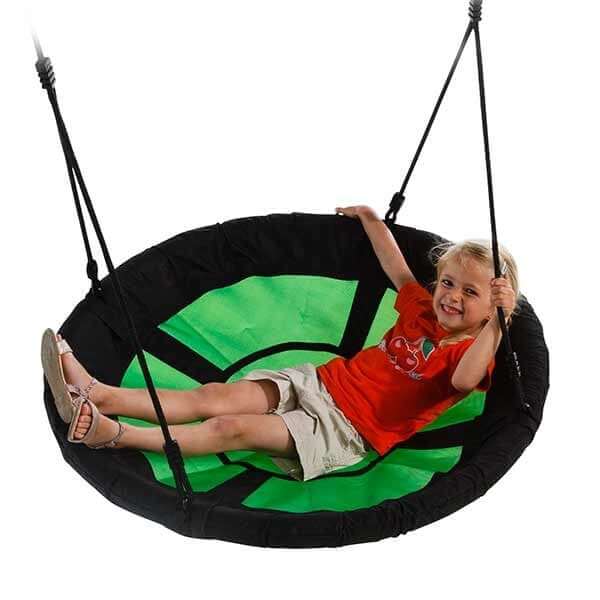
Swings are great for sensory input since they engage a multitude of senses. A kiddo can hop on a swing and get proprioceptive feedback, visual stimulus as the world moves around them, and get tactile input from the physical swing itself.
Since swings engage the mind and the body, they are great for calming, since they engage the entire vestibular system.
Not only that, but they are also a great way to break up the monotony of a school day. From sitting on the bus to sitting in a classroom, kids do a lot of sitting. Swing can encourage them to literally shake their sillies out in a healthy manner, increasing a rush of blood to the head. Getting a kiddo's heart rate up in a fun, safe, and therapeutic environment can help expel some of their pent-up energy from sitting all day. Getting rid of that energy can help them better focus and pay attention in class.
Swings are, in and of themselves, a really cool way of administering ninja therapy. Just climbing into and using a sitting in a swing (before you even move in it), encourages hand-eye coordination and physical activity. Moving back and forth in the swing encourages motor control, executive functioning, and task planning. Getting the swing to move can engage the individual's core muscles, improving their overall strength.
Things to keep in mind about therapy swings
Some kids have more unique needs than others. When choosing a swing, make sure that the fabric is soft and unobtrusive. When you're thinking about how the swing will mount, consider the motion. Is it linear, meaning it sways between front and back motion, or centripetal, meaning it goes in a circle? Individuals who have difficulty with motion sickness might be better served by a linear moving swing, rather than a centripetal one since there's less chance of them feeling motion sick from the movement.
Updated and reposted 4/2022 by Jessica Murray