 One of the most commonly asked question we receive is "How can I prevent my child with autism from getting out of their car safety seat, booster or seat belt?". Understandably, this is a serious concern, not for the safety of the child but for the driver, other passengers and other motorists as well. If you have read my other post Seat Belt Safety & Children with Autism, then you will know my family's personal experience with this very issue.
While many options exist in car seats and seat harnesses, the buckle guard is the simplest device on the market (and one of the least expensive ). The device works in most family vehicles, SUVs and minivans (except for the certain models of the Honda Odyssey "“ the seat belt is a wider shape that is too large for the buckle guard).
Field test
We sent out the Seat Belt Buckle Guard to fifteen families with children of various ages along the autism spectrum to see how they do against it.
Most of the kids played with it for 10 minutes trying to release it. There was also a wide range of reactions from the users from anger to dumbfounded to bottom lip quivers. I even tried it on my fifteen year old son to see how he would do. He tried it once to unbuckle, realized he couldn't and went back to listening to his iPod.
Two kids did manage to escape using creative approaches. One child decided it you can't release the buckle, then go and slide out from under the seat belt. Another child watched how mom released the buckle guard and then looked for something slim to stick between the grates. He used the center seat belt and pushed it in to release the button.
What is it?
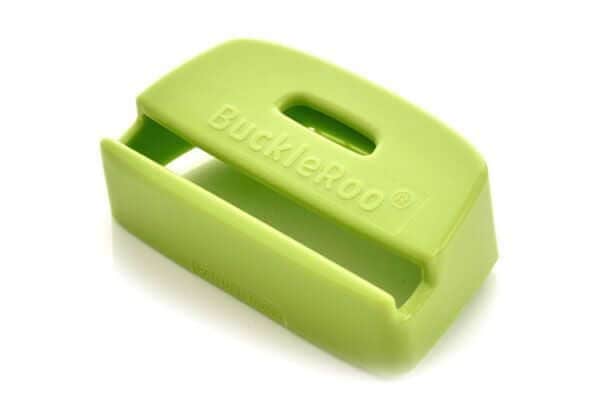
The Seat Belt Buckle Guard is a very simple device. Made of molded plastic, the rectangle has "bars" or slots on one side which prevent a child's finger from releasing the red button on the seat belt. The device does not actually interfere or change the connection of the seat belt.
How does it work?
 The buckle guard is designed to work with seat belts with an upright configuration and a red push-button release. The slotted cover fits over the button and belt receiver slot. The seat belt is inserted into the side slot of the Seat Belt Buckle Guard over the seat belt receptacle and locked in as it normally would be. That's it.
To unlock the seat belt, insert the end of another belt, a key, a nail file, or a similar item in the center slot and depress the red release button.
PROS:
- Inexpensive
- Simple to use
- Can be easily moved from one car to another
CONS:
- Child can slide out under the seat belt if they are really determined.
- Make sure there are no slim devices in the vehicle that can be used as a release device.
- Does not work on school buses or old vehicles without the re release button seat belt.
Conclusion:
Overall, the seat belt buckle guard performed well against some of the most determined Houdinis. It is an effective tool at an inexpensive price. If you are having problems with your child getting out of their car seat and they don't require any support or positioning needs offered in an adaptive car seat, Seat Belt Buckle Guard is ideal before graduating up to the vests of car seats.