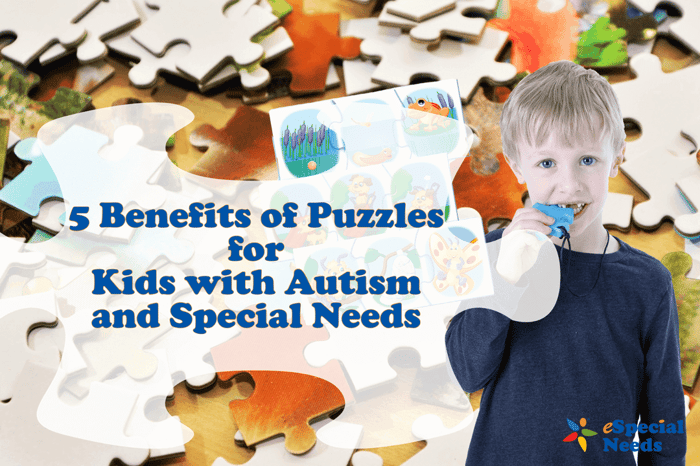
Often children with autism think in pictures rather than words, so puzzles offer them a creative outlet for grounding. In addition to being a generally enjoyable activity that you can do with your kids of all ages, puzzles also help develop the brain. The process of figuring out where each piece belongs encourages focus and creativity while also improving memory and critical thinking skills - making them terrific tools for learning!
Below are 5 benefits of puzzles for kids with autism and special needs:
1. Puzzles promote problem solving with confidence
Solving problems can be a fun, but challenging process. There is a clear problem based on the amount of clues and hints discovered in the process of solving the puzzle; similarly, there is only one solution as it has to do with rebuilding the puzzle correctly. Dealing with autism on a day-to-day basis may sometimes prove difficult because individuals have to deal with situations that are less structured or result in more than one possible outcome for their needs. Solving puzzles is not like working through complex day-to-day problems"”there are no solutions other than the one that is needed to solve the puzzle!
2. Puzzles help with building and developing attention spans
Developmentally appropriate puzzles help build the attention span of those with autism and other special needs. They do this by allowing the child to focus on colors, shapes and sizes all while seeing the results of their hard labor.
3. Puzzles help develop cognitive skills
Puzzles help children with reasoning skills. They encourage a child to see whole-part relationships. Depending on the subject matter they can teach a child about the alphabet, numbers, color recognition, shape recognition and categories like pets or transportation vehicles.
4. Puzzles are a fun way to develop and improve hand-eye coordination
As a child places each piece in the puzzle, they are manipulating it to see where it fits. As they move pieces around, they are improving their hand eye coordination. From non-connecting puzzles with knobs to jigsaw puzzles, there is a puzzle fit for every individual's age and ability.
5. Puzzles help improve social skills
Children who have special needs can benefit greatly from working together on developmentally appropriate puzzles. Group work helps children who are on the autism spectrum and with other conditions learn to listen and interact with others, reducing their sense of anxiety and helping them build their vocabulary. When they work in a team environment, they also become more confident in their own social abilities which further serves to improve social skills!